Dutch States Army (Maurician Drill)
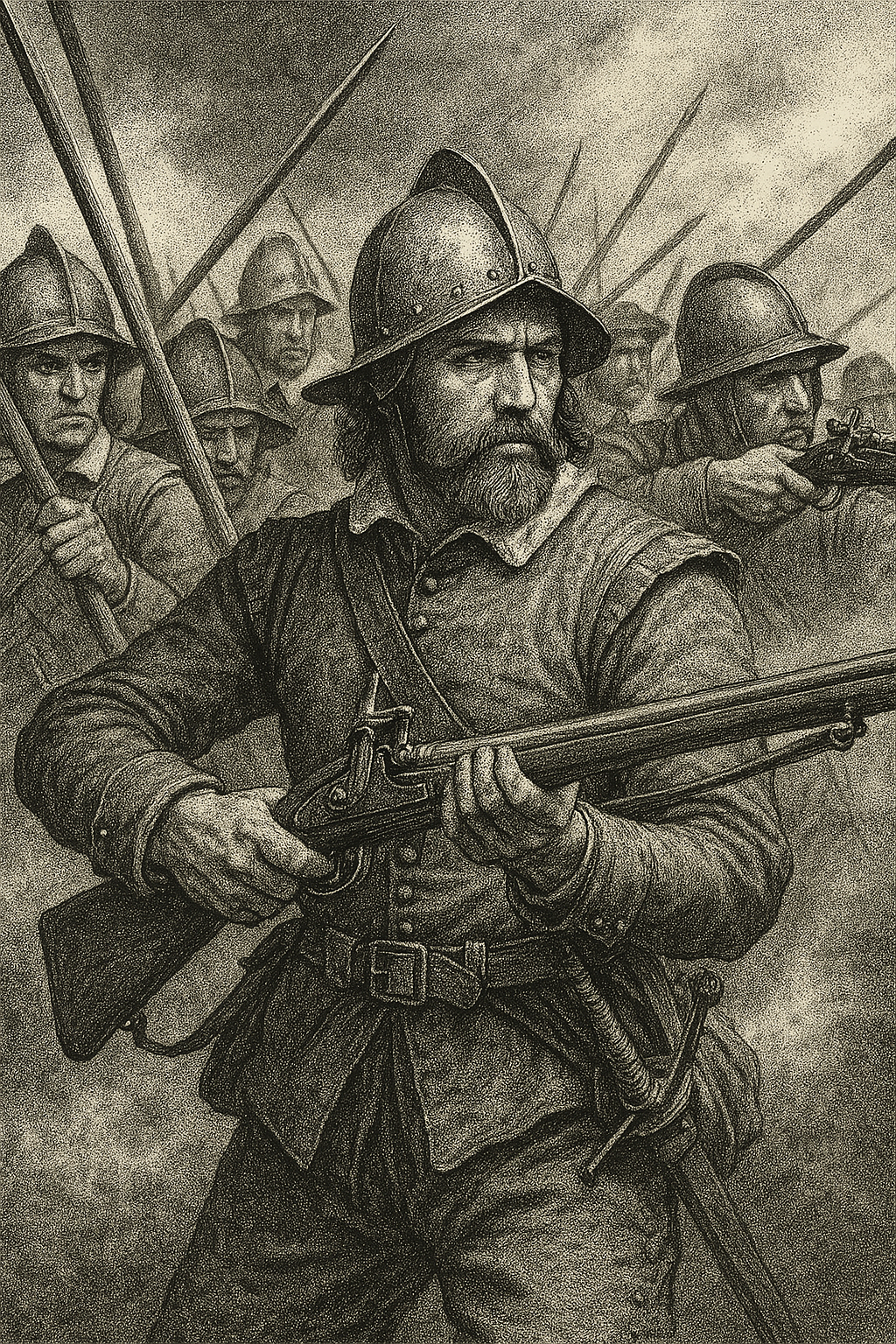
(1590-1672)
Low Countries, Europe
Brotherhood Rank #185
They came on like a hinge creaking open history’s next ugly door, the Dutch ranks moving with a stiffness that felt less like obedience and more like a pact made under duress. Powder smoke already swarm-thick, wind pulling it sideways off the Maas, the lines shifting in those clipped, unnatural increments that made veteran Spaniards mutter prayers under their breath. It wasn’t grace. It wasn’t fury. It was geometry learning how to kill. One rank knelt, another stepped through, muzzles leveled in a horizontal stormfront of match-lit anger, and then the volley cracked across the field with the precision of a hammer falling on a courtroom desk. No roar. No barbarous momentum. Just the cold punctuation of a people who had decided they were done being ruled and would now conduct their revolution as a sequence of timed explosions.
The ground trembled with the measured recoil of men drilled until the body forgot that it once possessed doubts. They had shed the medieval crowd-brawl in favor of something leaner, meaner, and stripped of personality. Honor had no seat in it. Artistry had no chamber. What marched in those years under Maurice of Nassau was an organism with nerves taut and responses engineered, a new creature forged under the long shadow of revolt. The Dutch States Army didn’t chase glory; they manufactured outcomes. To fight them was to step into an abacus that tallied death in strict intervals.
By mid-afternoon the fog of gunpowder slithered low and gray, clinging to boots, staining beards, blinding gods. The Dutch lines advanced again, silent except for the clink of ramrods and the curt commands rasped through clenched teeth. Across the broken field, Spanish tercios that once looked immortal felt their old rhythm buckle under the weight of fire that didn’t stop to breathe. They were watching the world discarding them in real time. And the Dutch? They did not cheer, did not howl, did not lift their eyes from the sights of their reformed muskets. They behaved like men who knew that rebellion wasn’t a firestorm but a schedule.
No hero stood at the center of this movement. The brotherhood itself was the myth. The drill was the theology. And the battlefield—flat, wet, bitter—was where they carved their testament into the bones of an empire that had once believed in permanence.
Origins and the Quiet Birth of Fury
Nothing about the Low Countries should have produced a new architecture of war. A swampy patchwork of provinces strangled by foreign taxation, devoured by religious fracture, and bled by the Habsburg habit of treating rebellion with iron. But desperation does what genius often cannot: it forces clarity. The Dutch States Army rose out of the Dutch Revolt not as a conventional army, but as a survival machine built by a people who refused to vanish.
Maurice of Nassau, cool-tempered and mathematically inclined, stripped war to numbers. He read ancient texts, tore apart structures, rebuilt them with a carpenter’s ruthlessness. The Dutch troops under him became less feudal inheritance, more civic weapon. Pay was regular. Logistics were sane. Units were designed as interchangeable parts in a murderous contraption.
They were not fighting to expand. They were fighting to exist.
The Psychology of the Brotherhoood
Their minds were tuned to repetition. Not blind obedience, but something far stranger: civic militarism. The Dutch soldier was a citizen with a rifle, a taxpayer whose drillbook became scripture. They believed in their cause because their lives sat directly on the line—not in some dynastic ledger, but in the mud beneath their feet. They didn’t worship Maurice; they worshiped order. That order replaced doubt with muscle-memory.
Fear was acknowledged but compartmentalized. In Dutch ranks, terror had no oxygen: every motion was timed, every volley layered, every rotation rehearsed until individuality became a rumor.
Their humor—gallows black—hinged on the notion that Spain, with all its gold, couldn’t buy a system like theirs. “The Empire needs saints,” one soldier wrote in a contemporary letter, “but we only need straight lines.”
Initiation, Punishment, and the Cold Edge of Discipline
The Maurician drill was not optional. A man who missed steps risked being literally shoved back into alignment by the sergeant behind him. Fines, confinement, and stockade time kept discipline tight. Mutiny was rare, not because these men lacked anger, but because the reforms removed the usual fuel: hunger, unpaid wages, purposeless marches.
Superstition survived in small pockets—lucky cartridges, saint medals hidden under wool—but the real amulet was competence. They trusted procedures over miracles.
Punishment for cowardice was brutal when it surfaced: public humiliation, expulsion, and in extreme cases execution by firing squad, an irony not lost on them. To die by the very machine you betrayed was the final lesson in Dutch military philosophy.
Tactics: The Art of the Volley and the Death of the Tercio
The Maurician system dismantled old warfare with arithmetic. Gunpowder no longer barked in irregular storms; it flowed in measured rainfall. Linear formations allowed more guns to fire simultaneously, while shallow ranks allowed faster rotation. The tercio—Spain’s proud, bulky combat block—found itself chopped apart by angles it was never built to see.
The Dutch fought like a door slamming repeatedly into an intruder’s ribs. They were patient. They favored attrition by precision, a slow grind of volleys that didn’t break formation to exploit openings. They left that to cavalry reserves engineered for timing, not swagger.
Their lethality came from predictability used as a weapon. Enemies knew what was coming. They just couldn’t stop it.
Defensive Temperament
Dutch soldiers learned to fight behind earthworks, canals, and fortifications designed by engineers who treated geography as an accomplice. The bastions at Ostend became a meat-grinder where the Spanish spent bodies like water. The Dutch held because their defenses were not heroic—they were mathematical. Angles, fields of fire, overlapping arcs: a geometry teacher’s nightmare turned into an army’s salvation.
They understood the value of refusing battle as keenly as waging it. Retreat was not shame but rearrangement.
Offensive Habits
When they chose to advance, they did so like a glacial fracture: inevitable, cold, unstoppable. Their offensives lacked romantic flair. They were machinery rolling forward, muskets loaded in sequence, pikes bristling in disciplined hedges. Sieges became their preferred language. They spoke it fluently.
The Dutch did not shred cities for pleasure. But neither did they shrink from brutality when war’s logic demanded it. Executions of collaborators, forced expulsions, and the calculated starvation of enemy-held towns appear in the record—harsh acts committed not for spectacle but as instruments of survival.
Leaders Without Overshadowing
Maurice shaped the drill, but the army’s identity survived him. Frederick Henry sharpened the machine further, adding mobility and engineering finesse. What mattered was continuity: the brotherhood outlived its architects, feeding on reforms, devouring old habits.
The officers were expected to know mathematics, fortification theory, gunnery. They didn’t ride at the front waving banners—they walked the lines correcting spacing with a surveyor’s obsession.
Their Respect and Their Rivals
Europe watched. Some with envy, some with alarm.
The Spanish tercios learned bitter humility. English officers walked Dutch fields like students visiting a laboratory. Swedish commanders absorbed the method and exported a more aggressive variant under Gustavus Adolphus.
The Dutch States Army reshaped Europe without declaring it. Their innovation arrived not as revolution but as inevitability.
Downfall, Metamorphosis, and Absorption
No army remains pure. By the late 17th century, the Dutch system that once toppled titans became conventional wisdom, its novelty diluted by imitation. The army struggled against France’s rising power, bled out in long coalition wars, and watched the brilliance of the Maurician drill fade into the background noise of “how professional armies now function.”
What began as a rebellion-forged experiment ended as a template absorbed by rivals. Their legacy was not heroic ruin, but widespread theft.
Cultural Afterlife
Today their story survives in diagrams, not ballads. In textbooks, not taverns. The Dutch States Army left no legendary last stand, no death-charge poem. Their immortality lives in every parade-ground command barked by modern militaries, every synchronized volley, every drillbook that demands a soldier’s body become a metronome.
Their myth is procedural. Their ghost is structural. Their legacy fires every time a synchronized line of rifles snaps into one communal heartbeat.
They left behind no anthem, only a blueprint for killing with cleaner lines.
Notable Members
Maurice of Nassau (1567–1625)
A commander whose pulse seemed to tick in measurements rather than emotions, Maurice shaped the army not by charisma but by calculation. He didn’t roar orders; he diagrammed them into men until they could march through storms with the calm of men counting steps. His victories were not born from battlefield epiphanies but from practice so punishing it burned chaos out of the ranks. Contemporaries admired him with a kind of wary respect, the way one admires a surgeon who can amputate without blinking. His legacy is etched into every drill sergeant’s bark to this day.
Frederick Henry, Prince of Orange (1584–1647)
He took Maurice’s machine and oiled it, tuned it, drove it harder. Frederick Henry blended engineering with audacity, cracking fortresses like eggshells by turning siegecraft into industrial routine. He lacked his half-brother’s cold mathematical aura, but not his discipline; under him the army gained mobility, cunning, and the confidence to treat European warfare as a solvable problem. His soldiers fought as if they were extensions of his patient mind, grinding cities into surrender with the inevitability of weather.
Sir Francis Vere (c. 1560–1609)
The Englishman embedded in Dutch ranks like a flint shard, Vere was the foreign officer who understood the rhythm of the States Army well enough to amplify it. Hard-drinking, iron-willed, and allergic to melodrama, he carved out authority through competence and a knack for rallying men in the instant when formations teetered. His accounts of combat carry that weary sharpness known only to officers who have outlived better soldiers. Vere helped translate Dutch precision into an Anglo military vocabulary that would linger for centuries.
RESOURCES
Parker, Geoffrey. The Military Revolution: Military Innovation and the Rise of the West, 1500–1800. Cambridge: Cambridge University Press, 1996.
Trim, David J. B. Fighting the King’s Wars: The Operational Art of the Dutch States Army, 1588–1688. Leiden: Brill, 2010.
Nolan, Cathal J. The Allure of Battle: A History of How Wars Have Been Won and Lost. Oxford: Oxford University Press, 2017.
Maurice of Nassau. Militaire Instructie van 1595. The Hague: Staatsdrukkerij, 1595.
Grotius, Hugo. Annales et Historiae de Rebus Belgicis. Paris: Morel, 1627.
van der Klapstoel, Hendrik. Teaching Precision to Peasants: A Practical Guide to Making Soldiers March on Purpose, 4th ed. Delft: Completely Imaginary Press, 1643. (Features an appendix on maintaining discipline in armies comprised largely of damp men.)