Spanish Guerrilleros
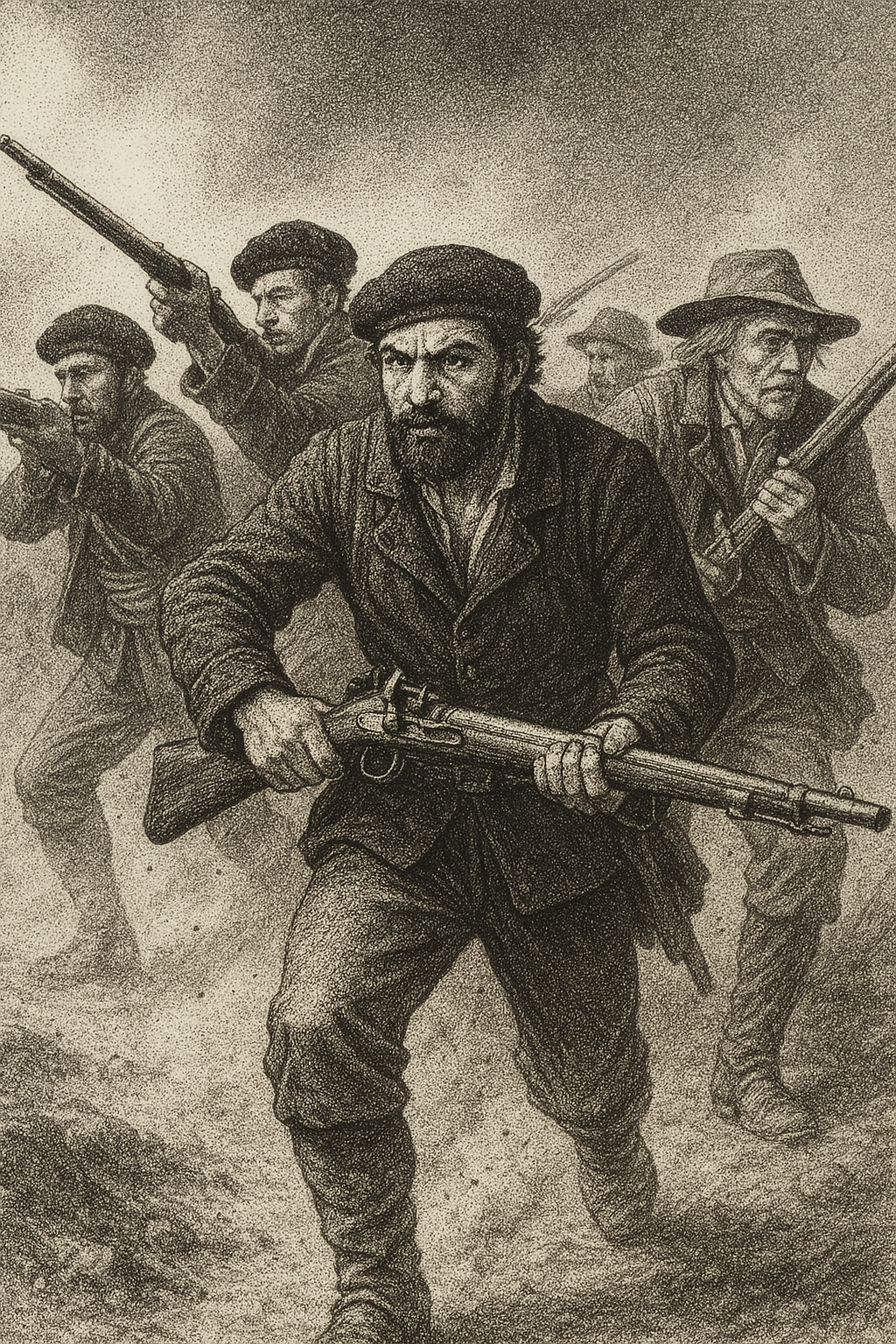
(1808-1814)
Iberian Peninsula
Brotherhood Rank #186
The mule tracks were already whispering their rumor of dead men when the column wound into the gorge. No drums, no heralds, only the somber machinery of Napoleon’s war trudging forward: boots, bayonets, knapsacks full of letters that would never be delivered. The road kinked like a broken rib. The cliffs leaned in as if listening. And then the silence changed temperature. The French didn’t know it yet, but the Guerrilleros had already arrived in the way storms do: first as pressure, then as inevitability.
A musket crack turned the air brittle. A second shot opened it wider. Then the gorge erupted — not with formations, not with an army, but with something more unnerving: dispersed shadows that fired, vanished, reappeared, and moved with the irregular heartbeat of a country that had decided to become an enemy. Horses screamed. A sergeant slumped. Somewhere above, a man in homespun cloth reloaded behind a ledge and muttered a prayer that belonged to no regiment. The French tried to dress lines, but the lines dissolved as fast as they formed. Discipline is a virtue only when someone is willing to stand and be seen.
The Guerrilleros weren’t seen unless they wanted to be. They were smoke given aim, geography given teeth. Each group fought like the land itself was an accomplice: cork-oak thickets, jagged passes, stone villages that folded shut around them like a fist. The French called them bandits, assassins, hyenas. The locals called them neighbors, cousins, parish boys, shepherds who had traded crooks for carbines. A village might host a christening in the morning and an ambush that afternoon. A schoolteacher might recite Virgil one day and slit a courier’s throat the next. War had stripped their lives of every treaty except vengeance.
The worst part for Napoleon’s men wasn’t the dying. Soldiers understand dying. What broke them was the sense that they were being hunted not by troops but by a collective, simmering will — a nation with a thousand eyes and a thousand hiding places. Some swore they saw the same man in three valleys at once. Others claimed the Guerrilleros walked through stone. In truth it was simpler, and more terrifying: the brotherhood wasn’t a fixed body at all. It was Spain herself, weaponized and furious.
By the time the French realized the road was already lost, the shadows had slipped back into thorn and smoke, carrying their dead and their stories with them. The gorge kept the bodies of the fallen, but the echoes belonged to the Guerrilleros.
Origins in Ruin
They didn’t begin as an army. They began as a rupture. Napoleon’s invasion in 1808 detonated a society already fraying at the seams. Royal authority collapsed. Juntas sprouted like weeds. Peasants watched French columns requisition grain and livestock and answered the way the poor traditionally answer empire: they took up whatever weapons they could lift and struck at the arteries.
The word “guerrilla” — little war — already existed in Spanish, but it was the Peninsular War that transformed it into a doctrine. Not because theorists sketched it out, but because survival demanded it. No single man founded the movement; it grew from countless local cells: partidas led by priests, smugglers, veterans of the disbanded Spanish army, aristocrats whose estates had burned, and shepherds who knew every fold of the terrain. What held them together wasn’t hierarchy. It was refusal.
A Psychology Forged in Occupation
The Guerrilleros operated with a collective temperament best described as relentless spite sharpened into strategy. They were fueled by humiliation — the indignity of foreign boots on local soil — but their cohesiveness sprang from shared risk. If one man struck a French patrol, the entire village might pay. This fused communities into something harder and crueler than patriotism. Cowardice became treason; cooperation became damnation. Their oaths were often unwritten: nobody needed parchment to know that betrayal meant a shallow grave behind an olive grove.
Many historians describe them as “bands” or “cells,” but a more accurate image is a swarm. Individuals came and went; membership blurred between farmer and fighter. Their culture celebrated audacity, but it also demanded secrecy. Bragging could get families killed. Discipline wasn’t drilled into them; it was lived into them through reprisals, retaliations, and the knowledge that hesitation meant extinction.
Initiation and Punishment
Formal initiation rarely existed. A new recruit joined by showing up with a musket and a willingness to act. But the real trial came later: surviving the first ambush, marching with no rations except stolen ones, or participating in the brutal accounting that followed a French reprisal.
Punishment for treachery was swift. A suspected informer might vanish overnight. A thief caught stealing from the group could lose a hand. Priests involved with Guerrillero units sometimes conducted blessings before raids, but even faith bent before necessity. God forgave; the brotherhood did not.
Tactics: The Anatomy of a Thousand Cuts
What made the Guerrilleros terrifying wasn’t firepower; it was selectivity. They cut French logistics with surgical cruelty. Couriers, supply wagons, isolated detachments — all bled out in ditches and ravines. A column might march for weeks without receiving mail. Ammunition trains disappeared. Foraging parties returned as rumors. Napoleon’s marshals commanded some of the best troops in Europe, but even they couldn’t fight phantoms.
The Guerrilleros avoided pitched battles; they attacked edges. Their raids favored dusk, fog, narrow passes, market-day crowds, and river crossings. They moved lightly: many carried only a musket, a knife, a pouch of powder, and the kind of hunger that collapses moral arguments.
Their kill-patterns followed terrain logic. In Galicia, they fought from dense forests and stone hamlets. In Aragon, they used ravines and dry riverbeds. In La Mancha, they operated from blackthorn thickets and village courtyards that doubled as killing floors. They knew which bridges could bear a cannon and which could not. The French often did not.
The Leaders Who Refused to Become Generals
The brotherhood produced men who could have commanded armies but chose to command chaos instead. Juan Martín Díez, “El Empecinado,” fought with a stubborn ferocity that the French both cursed and respected. Francisco Espoz y Mina built a proto-intelligence network that rivaled any regular army’s reconnaissance. Cura Merino, the priest-turned-raider, blurred the line between holy vocation and tactical cruelty.
But these figures never overshadowed the whole. Their fame was functional: inspiration, not centralization. The Guerrilleros remained a dispersed organism, not a hierarchy. Attempts to formalize them often failed. Their power depended on autonomy and the geography that nurtured it.
Atrocities, Reprisals, and the Moral Spiral
Guerrilla war corrodes all virtues. The Guerrilleros and French both participated in cycles of brutality. French troops burned villages suspected of aiding partisan bands; Guerrilleros executed collaborators, sometimes publicly, sometimes in the shadows. Throats were cut, eyes gouged, corpses mutilated as messages. Some groups tortured captured dragoons for information; others simply shot them.
This wasn’t heroic wilderness justice; it was a war of annihilation conducted one ridge and one orchard at a time. Civilians bore the worst of it. Many Guerrillero attacks were indistinguishable from banditry. Some bands drifted into outright criminality. Others enforced strict codes to avoid that slide. Spain’s landscape filled with graves belonging to both patriots and opportunists.
Their Impact: The Bleeding of an Empire
Historians still debate the exact effect of the guerrilla war, but its strategic weight is undeniable. French armies spent enormous manpower garrisoning towns, escorting convoys, and reacting to threats that refused to stand still. Napoleon himself called Spain his “ulcer.” While he maneuvered against Austria and Russia, his marshals were forced to play exterminator against an enemy that multiplied with every atrocity.
The Guerrilleros didn’t win the Peninsular War. But they made French victory impossible. They stretched the conflict until British regulars under Wellington could exploit the fractures. They contaminated morale. They sabotaged the illusion of French inevitability. And they left Europe with a new vocabulary of resistance.
Metamorphosis and Afterlife
After the war, many units dissolved back into the soil they’d defended. Some became soldiers in Spain’s restored army. Others became bandits — unsurprising, given the habits violence had carved into them. The legend of the Guerrillero grew far larger than any man: freedom fighters to romantics, terrorists to their enemies, prototypes for every insurgent movement that followed.
The word they gave the world, “guerrilla,” escaped its cradle and wandered across centuries: used by Maoists, anti-colonialists, nationalists, warlords, and anyone who preferred the ambush to the charge. Their descendants are ideological rather than literal — but the template is unmistakable.
The French left Spain eventually. The Guerrilleros never did.
And the land still remembers how to bite.
Notable Members
Juan Martín Díez “El Empecinado” (1775–1825)
A farmer’s son who became a nightmare stitched into French dispatches, Díez fought with the cold resilience of a man who had nothing left to surrender and no interest in learning how. His partidas moved like migrating storms, appearing across Castile with unnerving timing and uncanny local support. He understood terrain the way a surgeon understands joints: where to press, where to tear. The French sent cavalry after him so often it became a tragic comedy of hoofprints and corpses. After the war, monarchy politics swallowed him whole — he was executed by the system he had fought to restore, a bitter testament to how nations use and discard their sharpest tools.
Francisco Espoz y Mina (1781–1836)
Mina turned Navarre into a labyrinth the French never solved. His talent wasn’t brute violence but intelligence work: networks of informants, coded routes, couriers who seemed to walk through walls. He built a guerrilla machine with the discipline of a regular army and the vindictiveness of a wounded province. French columns chasing him often found only empty barns, vanished footprints, and occasional booby traps that spoke fluent profanity. After the war, he served Spain as a soldier and liberal agitator, forever balancing the instincts of a partisan with the obligations of a politician.
Julián Sánchez “El Charro” (1771–1832)
A cavalryman turned raider, Sánchez led a mounted force so dangerously nimble that French officers wrote his name with the tone normally reserved for plagues. His riders slashed through convoys, burned depots, and evaporated before infantry could load muskets. He fought with a showman’s bravado and a butcher’s efficiency, the kind of combination war rewards and peace mistrusts. His reputation among Spanish peasants hovered somewhere between protection and legend.
Cura Merino (1769–1817)
Father Jerónimo Merino was a priest until the French torched his world, at which point he traded sacraments for sabotage. As a Guerrillero leader, he blended piety with ferocity in a way that unsettled both congregations and occupiers. He blessed men before ambushes, then joined the musket fire with disconcerting enthusiasm. To the French, he became a symbol of Spain’s ungovernable rage; to locals, he was proof that the divine occasionally enjoys a gunfight.
References
Arteche, José Gómez. Guerra de la Independencia: Documentos Históricos. Madrid, 1863–1903.
Suchet, Louis-Gabriel. Mémoires du Maréchal Suchet. Paris, 1829.
Esdaile, Charles. The Peninsular War: A New History. Penguin Books, 2003.
Fraser, Ronald. Napoleon’s Cursed War: Popular Resistance in the Peninsular War. Verso, 2008.
Tone, John Lawrence. The Fatal Knot: The Guerrilla War in Navarre and the Defeat of Napoleon in Spain. University of North Carolina Press, 1994.
Ruiz del Viento, Alfonso. A Manual for Ambushing French Marshals with Only a Goat, a Cloak, and Poor Intentions. Cadiz: Imaginary Press, 1815. A practical guide for the creatively vengeful.