Russian Grenadiers
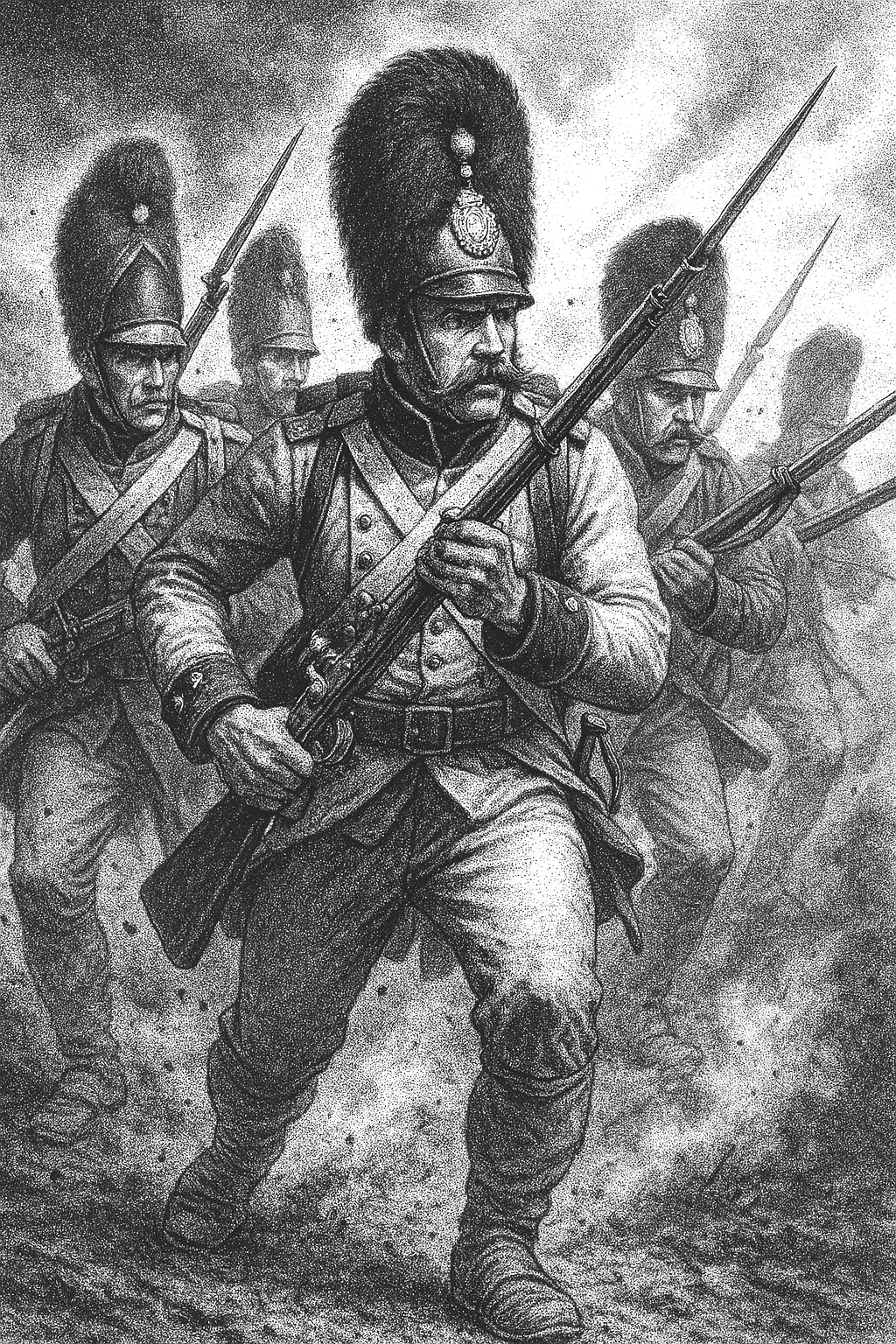
(1680-1917)
Russian Empire, Eastern Europe, Caucasus, Manchuria
Brotherhood Rank #187
Smoke hangs low in the morning freeze, the kind that cuts the throat and makes rifles misfire, and the grenadiers are already moving—heavy boots, breath like steam from draft horses, the thump of cartridge boxes slapping against wool. There’s no chant. No roar. Just that strangely calm murmur that comes from men who have broken enough enemies to know shouting is wasted oxygen. They advance with the unhurried certainty of a regiment that has seen winter outlive empires.
The column bends around the ridge, white coats ragged with soot and mud, grenades tucked in bandoliers like oversized eggs of iron, each one a promise to rearrange the landscape. A Prussian observer once wrote that Russian grenadiers “move as though the earth will split before them rather than impede them”—and on mornings like this, you can almost believe it. Even the wind slows down to watch.
An officer tries to quicken the pace; he gets ignored. The front ranks know the rhythm; they set it. They’ve been doing this since the days when grenades weren’t ceremonial baubles but smoking iron kettles with the fuse already burning in a man’s fist. The grenadier was the one who stepped forward when others stepped back, who hurled fire into wooden palisades, who cracked the locked jaws of fortress gates. There were times when their eyebrows never grew back from the heat.
Now, in this scene—pick your century, it barely matters—they’ve become something else: an institution of muscle memory, a collective temperament forged from too many wars against too many enemies. Ottomans on the Danube, Swedes on the ice, Frenchmen in the snow, Highlanders in Polish fields, mountain fighters in the Caucasus. A century of bayonet lines; another of rifle volleys; another of marching until the world goes blue around the edges. They accumulate grudges like campaign medals.
The drums start, not to inspire but to count distance. The grenadiers let the sound settle into their joints. Their faces look carved rather than grown: cheekbones wind-cut, brows lowered to conserve warmth, moustaches stiff with frost. They breathe through their noses like they’re trying not to inhale the stench of the day’s work before it’s finished.
Somewhere ahead is an enemy battery, half-hidden behind a hedge of broken wagons. The grenadiers don’t discuss it. They don’t speculate. They simply close ranks, bring the muskets level, and continue forward with the grim resolve of men who understand the only way out is through—and who secretly prefer it that way.
The first volley hits their line like a slap of iron hail. The Russian grenadiers keep walking.
And that is where their story always seems to begin: under fire, unblinking, advancing into a problem most sane armies would reconsider.
THE THICK OF THEM — ORIGINS, CULTURE, AND THE MAKING OF A WAR MACHINE
The Russian grenadier tradition arrived in the late 17th century, an import from Western Europe during the militarized re-engineering frenzy of Peter the Great. Grenades in Russia had existed before, but the concept of elite shock troops—men chosen for strength, height, and the temperament to lob explosives at close range—fit Peter’s ambitions. He wanted soldiers who could storm fortresses, bully trenches, and break lines by sheer physical presence.
Early grenadiers weren’t subtle. They trained by throwing stones, kettlebells, anything with weight. Their grenades were unreliable enough that every throw contained the possibility of self-revision. But this danger shaped their psychology: a grenadier was a man who accepted that the enemy wasn’t the only thing that could kill him. Risk became familiar. Violence became a craft.
By the 18th century, Russian grenadiers evolved into battalions and then entire divisions. The grenades themselves diminished in battlefield utility as firearms improved, but the prestige remained. The title “grenadier” became shorthand for the Empire’s most imposing infantry. Even after the grenade went ceremonial, the role stayed assault-oriented. They were the Empire’s hammer, and whenever Russia pointed them at something, it usually broke.
Their internal culture simmered with contradictions:
Stoic fatalism mixed with explosive bravado.
Strict drill paired with bouts of vodka-fueled camaraderie.
A near-religious respect for the bayonet, “the Russian bullet’s cousin,” as one officer joked, though no one laughed.
Discipline was harsh, sometimes grotesque. Flogging, stocks, forced marches. But grenadiers absorbed it with the same endurance they brought to battle. The state needed them terrifying; the punishment system obliged.
TACTICS, FORMATIONS, AND THE PERSONALITY OF THE FIGHT
Grenadiers were built for shock. Russian doctrine loved the bayonet charge, and grenadiers executed it with unnerving patience. They closed distance under fire, ranks tightening as casualties punched holes in the line. When the order came—“Na shtyk!”—the formation broke into a forward tilt, a human avalanche gaining momentum.
They weren’t the fastest troops in Europe; they were the most inevitable.
Against Swedes at Poltava, they dug in, soaked casualties, and waited for the moment to counterattack. Against Ottomans, they stormed fieldworks like they were clearing brush. In the Napoleonic Wars, grenadier regiments became the anchor of entire corps—units that simply refused to retreat without explicit orders, and even then obeyed reluctantly.
Their lethality varied by era. In the age of muskets, they excelled in close combat and siege assaults. In the rifle era, they became steady line infantry with elite conditioning. By the Russo-Turkish War of 1877–78, they were the Empire’s professional veterans, storming Plevna’s redoubts through meat-grinder trenches and machine-gun corridors.
An Austrian observer, watching grenadiers advance through a hail of Ottoman fire, wrote that “they resembled a wall that had decided to walk.”
Their ruthlessness was not decorative. Prisoners taken after bitter fighting—especially on the Caucasus front—sometimes suffered reprisals. Russian grenadier regiments were not known for gentleness, especially when facing irregular fighters who gave no quarter.
INITIATION, LOYALTY, AND THEIR PARTICULAR BRAND OF MADNESS
Despite the fearsome reputation, grenadiers weren’t mythical giants. Many were farmers, craftsmen, factory workers. But the selection criteria favored height and intimidation. A grenadier company entering a village looked like the god of war had sent his bouncers.
Their loyalty ran to the Tsar, the regiment, and the man to their left. Not in that order. Grenadiers were cynics about politics but fanatics about cohesion. A battalion that had fought together through more than one campaign developed a collective personality—hard, slow to warm, and contemptuous of softer units. If another regiment routed, grenadiers muttered about it for years.
Superstitions threaded through their barracks life. Some swore by lucky charms, others by icons polished smooth by generations of fingerprints. Before major battles, grenadiers knelt for blessings, rising with a composure that suggested the prayer was less for protection and more for permission.
DEFINING CAMPAIGNS AND THE LONG NIGHT OF THE EMPIRE
Great Northern War (1700–1721).
Grenadiers earned their first legendary scars. Storming Swedish positions at Noteburg, Narva, and Poltava, they learned the value of stubbornness when skill faltered.
Napoleonic Wars.
Russian grenadiers stood at Borodino like rooted stones. They countercharged French Guard units, marched into a burning Moscow, and chased Napoleon’s retreating army through fields littered with frost-gnarled corpses.
Caucasus Wars (1817–1864).
Here the grenadiers fought mountain warriors who understood ambush, guerrilla endurance, and vengeance. The brutality escalated on both sides. Grenadiers stormed auls, seized fortifications, and endured terrain that murdered horses and froze lungs.
Crimean War (1853–1856).
Outgunned but indestructible, grenadiers defended Sevastopol’s bastions until the trenches resembled geological layers of the dead.
Russo-Turkish War (1877–1878).
Plevna nearly broke them. Nearly. Their assaults—bloody, repeated, catastrophic—became the kind of national myth that mixes heroism with futility. Even Ottoman defenders wrote grudging praise for grenadiers who climbed corpses like ladders.
Russo-Japanese War (1904–1905).
A darker chapter. Grenadiers fought well but died in droves at Liaoyang, Shaho, Mukden. Machine guns shredded the old doctrine of slow advance and bayonet climax. The world had changed. The grenadiers had not.
World War I (1914–1917).
Still elite, still disciplined, but trapped in a collapsing empire. At Lake Naroch and Przasnysz, they fought with traditional stamina. But starvation, munitions shortages, and political rot hollowed them. By 1917, many grenadier units disintegrated into the revolutionary storm.
Their downfall wasn’t a battle. It was the empire dissolving under their boots.
THE CULTURAL AFTERLIFE
After 1917, the grenadier identity dissolved. The Red Army rejected Tsarist elitism. Grenadier battalions were renamed, reorganized, or wiped out in purges of tradition.
Yet the ghost lingers: statues, paintings, reenactment societies, and the unreachable stoicism Russians admire in their military past. Even modern VDV and Spetsnaz units claim—quietly—the grenadier lineage: the shock instinct, the unbroken advance, the idea that discipline outlives weapons.
The grenadiers are gone. The posture remains.
Notable Members
Prince Bagration (1765–1812) — Associated Commander
A Georgian aristocrat who fought like a man trying to outrun prophecy, Bagration led grenadier formations in the Napoleonic Wars with a mixture of calm brilliance and suicidal courage. At Borodino, he held the left flank with grenadiers who would’ve followed him into a volcano if asked politely. He moved through gunfire with the aloof grace of someone shopping for peaches. His wounding in the “Bagration fleches” broke the grenadiers’ morale more than any French volley. He died days later, refusing opium, determined to feel every inch of the end.
Count Suvorov (1729–1800) — Patron-General of Grenadier Doctrine
Suvorov wasn’t a grenadier, but grenadiers worshipped him like a war-soaked patron saint. He trained them to move fast, strike hard, and ignore pain like it owed them money. His manual—Science of Victory—turned shock tactics into a religion. At Izmail, grenadiers under his command stormed walls so tall you could get a nosebleed looking at them. Suvorov once said, “Bullet’s a fool; bayonet’s a fine lad”—and the grenadiers lived every syllable of that insanity.
Alexei Yermolov (1777–1861) — Grenadier Commander and Caucasus Scourge
Yermolov led grenadier units with the weary expression of a man who’s seen empires rot from the inside. In the Caucasus, he used grenadiers as the iron edge of Russia’s expansion, storming auls and carving roads through rebel territory with gunpowder and stubbornness. His brutality was notorious; even his allies whispered that he enjoyed fear too much. But grenadiers respected him because he didn’t order what he wouldn’t do himself. His legacy is equal parts strategy, cruelty, and granite-hard resolve.
References
Suvorov, Alexander. The Science of Victory. 1795.
Denikin, Anton. Essays on the Russian Troubles. Moscow, 1921.
Duffy, Christopher. Russia’s Military Way to the West: Origins and Nature of Russian Military Power 1700–1800. Routledge, 1981.
Stone, David. A Military History of Russia: From Ivan the Terrible to the War in Chechnya. Praeger, 2006.
Lieven, Dominic. Russia Against Napoleon: The True Story of the Campaigns of War and Peace. Viking, 2009.
Sokolov, Pytor. Why My Eyebrows Never Grew Back: Memoirs of a Grenadier Demolition Instructor. St. Petersburg, 1814 — includes a deeply questionable recipe for “victory vodka.”