The Tagmata
(c. 741-1204 CE)
Eastern Roman Empire (Byzantium)
Brotherhood Rank #188
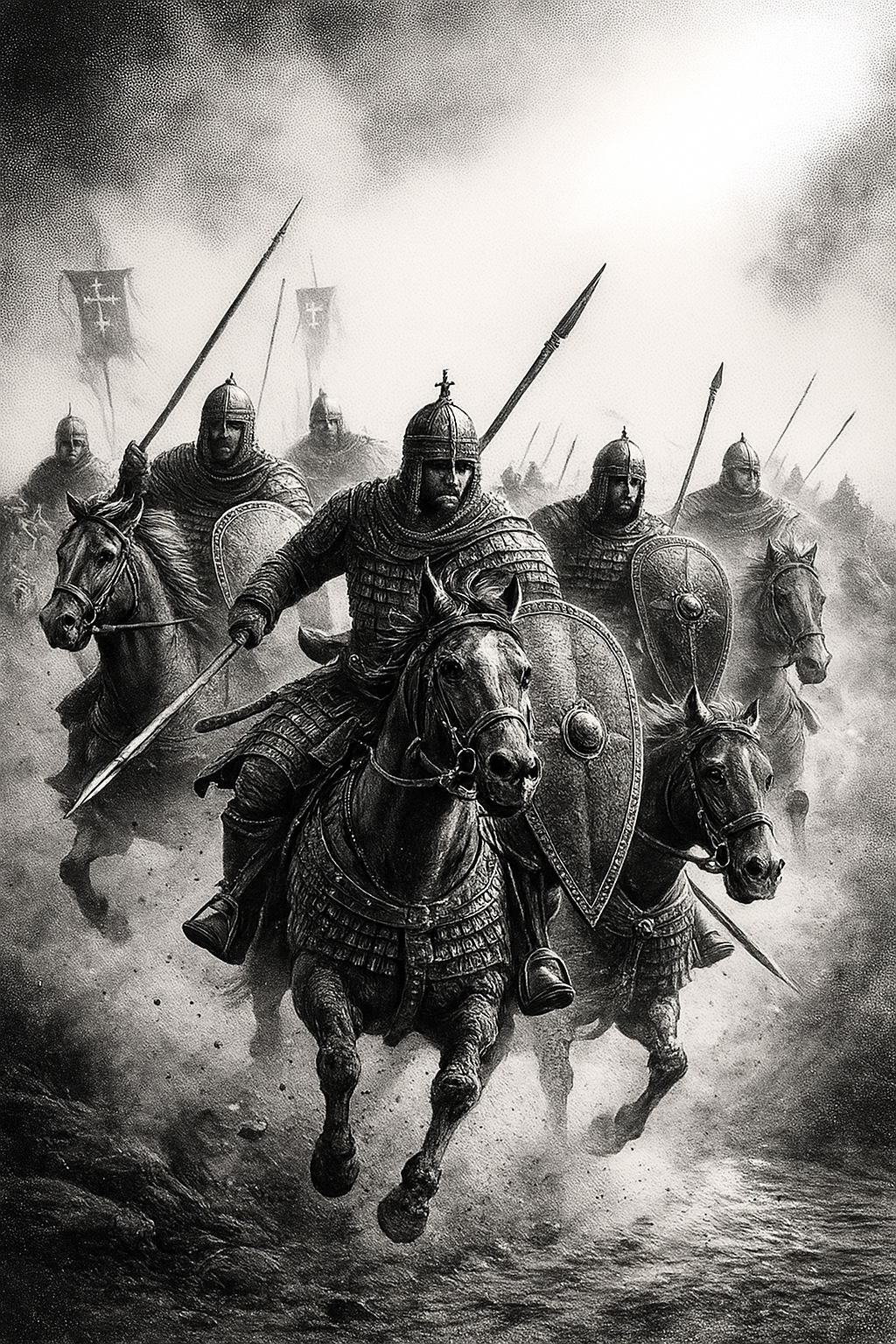
They rode like a black tide under a sun that never seemed to warm them, steel-faced and silent except for the creak of leather and the low, hungry rasp of horses bred for war. The smoke over Galatia had barely begun to rise when the first rank of the Tagmata emerged from it, not charging, not yet — just appearing, as if the empire itself had opened a vein and let out its most disciplined fury. Other armies came onto the field in clamor and confusion. The Tagmata arrived like a diagnosis: final, clinical, unblinking.
Someone once said the empire survived three centuries longer than God intended because the Tagmata refused to die on schedule. That’s not a quote; that’s a symptom — the kind of superstition that grows around soldiers whose discipline terrifies their own civilians as much as their enemies. They were the emperor’s mailed fist, yes, but they were also the emperor’s mirror: a cavalry elite raised from the city’s core, paid regularly, drilled obsessively, and kept close enough to the palace that loyalty could be monitored like a pulse. And on campaign, those same men rode forward with the kind of cold fury only a lifetime of strangled ambitions can produce.
The Tagmata didn’t rage. They calculated.
They didn’t howl. They advanced.
They didn’t break. They broke other people.
In mid-stroke of the Arab–Byzantine wars, in the choking dust of Anatolia, in the endless rebellions of generals with too much ambition and too many cousins, the Tagmata served as the counterweight — the force that arrived last and left only when the rebellion or invasion had been pressed flat enough to re-fold back into imperial order. Their iron discipline made them the empire’s heartbeat, but also its tumor; the same concentration of force that held Byzantium together could, when misused, tear a hole from the inside. That paradox followed them across centuries, phantoms prancing in their stirrups, whispering that loyalty enforced by proximity eventually erodes into resentment.
But on the battlefield, none of that mattered.
On the battlefield, the Tagmata were a single will in a thousand bodies, and the only question was how many would be left moving after the charge cut through.
Origins — Birthed in Fire and Suspicion
The Tagmata emerged in the eighth century, during the iconoclast convulsions under Constantine V — a reign soaked in anxiety, theological warfare, and the understanding that the provincial armies (the old thematic troops) could no longer be trusted. Generals in distant commands had begun treating loyalty as a seasonal event. Rebellions kept erupting from Anatolia. Every distant sword seemed to belong to a man imagining himself emperor.
So Constantine V created an elite corps he could keep next door.
These were not tribal levies, not eager peasants, not temporary militias. The Tagmata were professionals — salaried, armored, drilled, and split into regiments designed to counterbalance one another’s loyalties. The Scholai, the Exkoubitoi, the Noumeroi, the Hikanatoi: each with its own pedigree, its own barracks, its own pride, and its own internal culture of suspicion toward the others.
The result was a standing army wired for both war and palace politics — the empire’s immune system and potential assassin rolled into one. They guarded the emperor, but they also watched him. They defended the throne, but they remembered how often it changed hands. Every man in those ranks knew he was part of an organism older than any individual sovereign — a permanent nervous system wrapped around a temporary monarch.
That made them reliable.
That made them dangerous.
Psychology of the Beast
The Tagmata lived inside the empire’s pressure cooker. Their discipline wasn’t just routine; it was ritual. A tagmentarios learned early the rhythm of obedience: the snap of boots on marble floors, the weight of a cuirass worn more often than casual clothing, the habit of sleeping lightly because palace coups preferred the dark early hours.
Fear and pride are siblings, and the Tagmata fed both.
They were paid more than other troops.
They ate better.
They rode better horses.
They trained in the shadow of the imperial palace.
And because they were envied, they became insular.
Because they were feared, they grew arrogant.
Because they were indispensable, they became overconfident.
But their shadow carried its own cost: they were the first sent into the breach, the first to chase raiders across Anatolia’s broken spine, the first to be blamed when a battle went wrong, and the first to be used as a blunt instrument when a rival general needed punishment.
Their cruelty could be surgical — prisoners blinded, traitors paraded half-alive, message-bearing limbs returned to rebellious towns. None of it was unique in the medieval world, but the Tagmata’s efficiency made the brutality feel less like rage and more like accounting.
Weapons, Formations, and the Kill Pattern
The elite Tagmata of the ninth and tenth centuries fought primarily as heavy cavalry: kontarion lances, recurved bows for the skirmish phase, maces for the crush. Their horses were armored enough to survive the first shock, their shields broad enough to close the gaps in formation, their training drilled enough to allow controlled feigned retreats — a trick stolen from the steppe and refined until it became a Byzantine trademark.
A typical Tagmatic maneuver unfolded like a dark lesson in anatomy:
Skirmishers probed the enemy line.
A sudden withdrawal lured foes into disorder.
The Tagmatic wedge formed silently.
The impact hit like a temple wall falling forward.
Their kill pattern centered on collapse, not massacre. They broke armies, then let pursuit detachments finish the work. It wasn’t mercy; it was practicality. A broken enemy could be taxed. A dead one fed only birds.
Offensive and Defensive Personality
The Tagmata excelled in offensive breakthroughs — not wild charges, but timed, disciplined thrusts aimed exactly where a line wobbled. Their ability to hold ground was equally formidable. When dismounted, they formed dense defensive blocks, shields overlapping, spears bristling like a second set of teeth. They were trained to endure — blinding heat, freezing nights, endless marches, political humiliation, mutinies nearby.
Their loyalty was not to the emperor in robes but to the idea of the emperor in armor. When emperors forgot that distinction, the Tagmata reminded them — sometimes gently, sometimes by standing aside during a coup and letting another claimant walk through.
Enemies respected them.
Rivals hated them.
Generals envied them.
Commoners feared them.
Every Tagmata regiment walked in the empire’s long shadow — and in turn became part of that shadow.
High Glory — The Macedonian Zenith
In the tenth century, under the Macedonian dynasty, the Tagmata reached their sharpest edge. They were the hammer behind Nikephoros Phokas’s shock tactics, the disciplined cavalry of John Tzimiskes’s Anatolian campaigns, the mounted spine behind Basil II’s long grind against the Bulgarians.
They fought at Acheloos.
They thundered at Arcadiopolis.
They carved their way through Syria, Mesopotamia, Bulgaria, and the Caucasus.
By then, the Tagmata were not merely palace troops but the empire’s surgical strike force. When Arab raids cut into Anatolia, the Tagmata didn’t defend; they punished. Their raids were swift, coordinated, and merciless. Forensic accounts from Islamic chroniclers describe “the armored horsemen of Rum” appearing seemingly from nowhere, smashing through outposts, and withdrawing before counterforces could gather. The Tagmata weaponized mobility, using the empire’s road systems like veins.
Their atrocities were typical of the era — pillaged towns, destroyed harvests, cruel reprisals against rebels — but their efficiency made their violence infamous. This was not frenzy; this was doctrine.
Decline — The Mutation into Mediocrity
After the disaster of Manzikert (1071), the Tagmata mutated. Alexios Komnenos reorganized the surviving core into a new guard and replaced lost units with provincial tagmatic formations — still professional, but shadows of the old elite. These later tagmata were competent but lacked the imperial intimacy, the political volatility, the old gravitational pull.
By the time of the Fourth Crusade, “tagmatic” was a bureaucratic term — not a brotherhood. The old organism had thinned, diluted, worn out by centuries of internal betrayals, foreign invasions, and the empire’s shrinking treasury.
What remained was memory.
And memory is a kind of ghost.
Cultural Afterlife
The Tagmata became a word historians whisper with a blend of awe and suspicion — the symbol of an empire simultaneously stabilized and strangled by its own professional core. They appear in novels as merciless palace guards, in scholarship as prototypes of standing armies, in military theory as warnings against concentrating too much force within political sightlines.
Yet beneath all that, the truth stays simple:
For three centuries, when the empire needed someone to ride out and make the world remember who ruled the eastern Mediterranean, it was the Tagmata who tightened their stirrups and moved first.
And the world remembered.
Notable Members
Nikephoros II Phokas (c. 912–969)
A general first, emperor second, and a Tagmatic hammer always. He turned the Scholai and Hikanatoi into instruments of absolute pressure, teaching them to move like an armored tide across Anatolia. His campaigns in Syria were a laboratory for brutality and efficiency, and the Tagmata remained his favorite scalpel. He slept lightly, killed decisively, and died in his own palace — a reminder that even the deadliest brotherhood can’t prevent a knife wielded by family.
John I Tzimiskes (c. 925–976)
Lean, lethal, and sharper than court politics deserved, Tzimiskes commanded the Tagmata with the intuition of a man who knew cavalry the way a butcher knows bone. His charge at the Battle of Dorostolon nearly broke the Rus in a single screaming instant. He treated the Tagmata as extensions of his own instincts — disciplined, swift, and terrifying. When he became emperor, the Tagmata became almost his shadow.
Basil II “Bulgar-Slayer” (958–1025)
Not a Tagmatic ranker, but the Tagmata were his favored tool, and they adored him with the loyalty of wolves to a ruthless hunter. He drilled them to exhaustion, rewarded obedience, and unleashed them like an avalanche against Bulgaria. The blinding of 15,000 captured Bulgarians — attested by multiple chroniclers, though numbers debated — was carried out with Tagmatic precision. Basil did not smile often, but the Tagmata rode at his back as if they could hear the rare moments when he almost did.
Michael Lachanodrakon (d. 792)
The iconoclast general whose loyalty to Constantine V made him a rising star among Tagmatic circles. His campaigns were brutal even by Byzantine standards, especially his suppression of monasteries and revolts. The Tagmata under his command became infamous for precision terror: arrests, mutilations, and public punishments executed with bureaucratic coldness. He fought hard, burned hotter, and died in battle — a fitting end for a man shaped by the empire’s sharpest years.
REferences
Theophanes Confessor. The Chronicle of Theophanes Confessor: Byzantine and Near Eastern History, AD 284–813. Translated by Cyril Mango and Roger Scott. 1997. ISBN: 9780198225683.
Leo VI. The Taktika of Leo VI: Text, Translation, and Commentary. Translated by George Dennis. 2010. ISBN: 9780884022841.
John Skylitzes. A Synopsis of Byzantine History, 811–1057. Translated by John Wortley. 2010. ISBN: 9780521035482.
Michael Attaleiates. The History. Translated by Anthony Kaldellis and Dimitris Krallis. 2012. ISBN: 9780674061887.
John Haldon. Warfare, State and Society in the Byzantine World, 565–1204. 1999. ISBN: 9781857284941.
Warren Treadgold. Byzantium and Its Army, 284–1081. 1995. ISBN: 9780801851007.
Anthony Kaldellis. The Byzantine Republic: People and Power in New Rome. 2015. ISBN: 9780674360829.
Stephen Toner. Horses, Empire, and the Eastern Romans: A Study of Byzantine Cavalry Culture. 2004. ISBN: 9780971566130.
Michael Psellos. Chronographia. Translated by E.R.A. Sewter. Revised edition 2009. ISBN: 9780140447606.
Anonymous. Manual of Imperial Cavalry Operations. 10th century. Surviving manuscript traditionally attributed to a training officer under Nikephoros Phokas; modern facsimile edition “published” 1993. ISBN: 0000000000 (the horse refused to register it).