Tang Imperial Guards
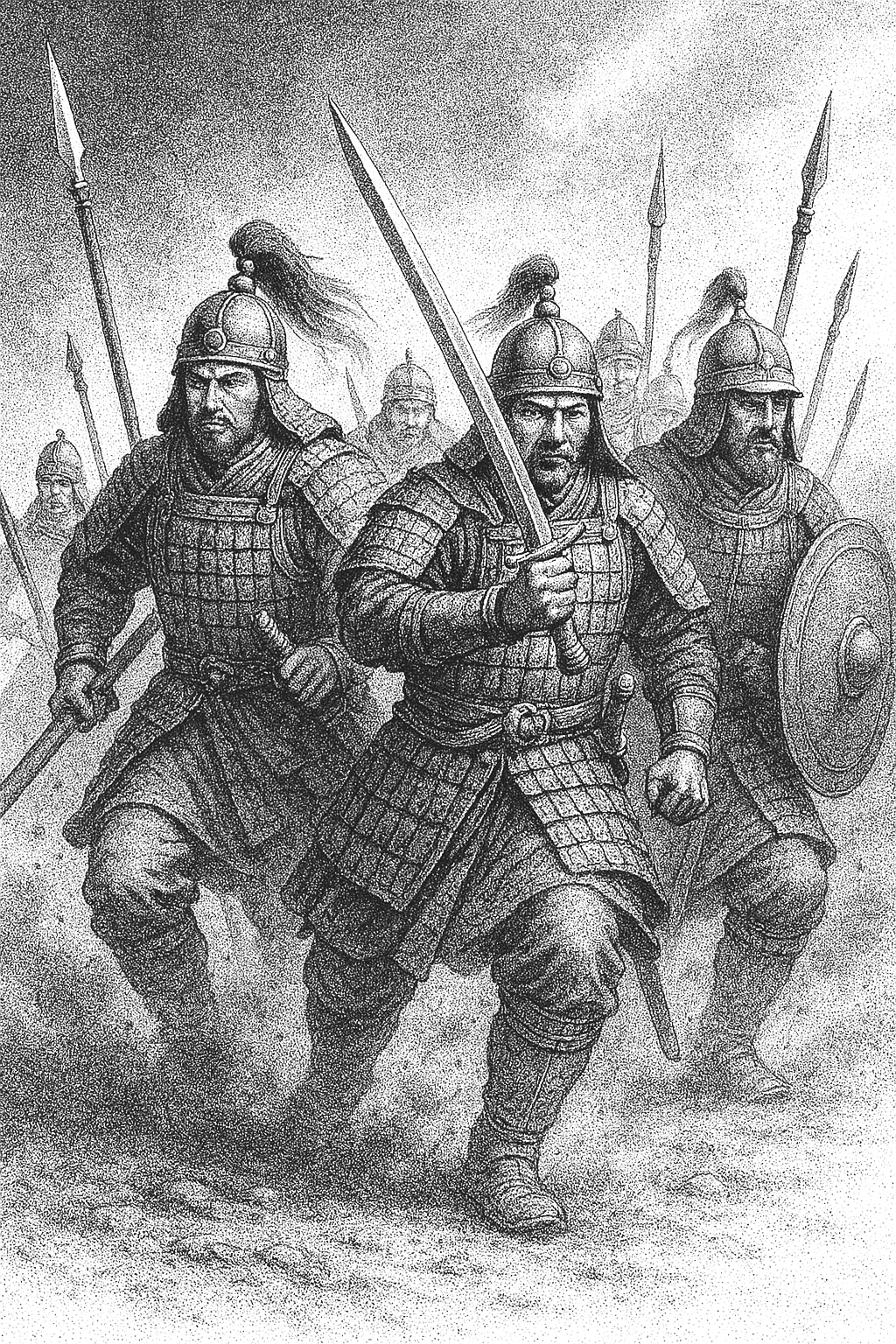
(618-907 CE)
Chang’an, Luoyang, the Ordos frontier, Liaodong, the Silk Road corridor
Brotherhood Rank #189
THE WALL OF MEN WHO HELD THE DRAGON THRONE
The night drums along the palace walls were still shaking when the first cohort of the Imperial Guards locked their shields under the torchlit eaves of Taizong’s new world. Horses steamed in the courtyard, armor still hot from the long march south, the scent of battle sweat mixing with the lacquered perfume of a dynasty barely born. The early Tang emperors built their reign on a series of impossible dawns, and the Guards were always there — the line that carried the weight, the edge that cut the silence, the promise that whatever storm rose out of the steppes or the river valleys would break on their blades first.
They were not yet the jaded monsters of the later centuries; in these opening decades they moved with the confidence of men who believed history itself had a pulse that matched their own. The palace gates boomed open at odd hours for them alone. Scouts whispered of Türkic riders or mutinous generals, and the Guards moved before the whispers finished forming. Their commanders spoke quietly, but the men understood the tone: you were born in this dynasty’s blood-price, and you will die in its circle of steel.
Chang’an’s morning light caught them at strange angles — always half-lit, half-shadowed — as if heaven itself couldn’t decide whether they were proud symbols of imperial order or the sharpened fangs that held the empire’s throat in place.
The early chronicles describe their movements with the precision of a painter laying ink on silk: cavalry peeling off like brushstrokes, infantry advancing as if carved from a single slab of iron, banners trimmed for ritual but stained from campaign. The guardsmen advanced through dust storms and palace corridors with the same cold discipline, because both spaces held enemies — one obvious, one subtle. Their drill fields echoed with the thud of composite bows being drawn back to the cheekbone, the grunt of shield-men bracing in paired files, the bark of officers who had survived too many frontier winters to accept a single loose formation.
When the empire was young, its guard was young. When the dynasty grew old, its guard grew cruel. And when the world finally cracked, they were still there — the last loyalists, the final opportunists, the ceremonial ghosts. But in these first hard decades, before corruption, before eunuchs, before the Shence rot spread like mold through the rafters of the palace, they were something terrifying and beautiful: an army welded to a throne, a throne welded to a dream, a dream welded to the edges of their spears.
THE EARLY TANG — A PROFESSION FORGED UNDER TAIZONG
The Imperial Guards began as the emperor’s own household warriors — a fusion of Wei-Jin traditions, Sui structures, and the improvised brilliance of early Tang military reform. They were not ornamental. They were the backbone of the court’s authority, the iron that made imperial commands possible. Taizong kept them close because he trusted steel more than he trusted ministers.
Their psychology was shaped by the trauma of the dynasty’s birth: mutiny, palace coups, frontier war, and the sense that heaven’s mandate was a blade that could turn in any direction. The Guards absorbed this paranoia and metabolized it into discipline. They learned to fight as if every skirmish were another exam in legitimacy — because in a sense, it was.
Their early campaigns read like a continental resume: crushing residual Sui loyalists, hammering the Eastern Turks, slicing through tribal coalitions in the northern river valleys, and showing enough controlled brutality to remind neighboring kingdoms that Chang’an didn’t negotiate from weakness. Guardsmen drilled alongside provincial soldiers, but they held themselves apart. They slept in tighter quarters, cleaned their armor obsessively, and cultivated a warrior’s arrogance that Taizong tolerated because it kept them sharp.
They weren’t saints. They executed deserters without remorse, broke rebel officers on command, and maintained order with a violence that was polite only in its efficiency. But they fought clean — or as clean as the 7th century allowed. Their reputation spread from the Korean peninsula to the Oxus: Tang cavalry that moved like an avalanche with reins, Tang infantry that advanced like a gate closing on fate.
THE HIGH TANG — WAR-HORSES, CEREMONY, AND THE GOLDEN AGE OF IMPERIAL SHOWMANSHIP
By the 8th century, the Tang state was rich, stable, and drunk on its own cultural gravity. The Imperial Guards, reflecting that confidence, evolved into something more complex: part shock army, part imperial theater, part international advertisement. The cosmopolitan swirl of Chang’an — Sogdian merchants, Turkic mercenaries, Korean artisans, Buddhist monks, Persian musicians — fed the Guards a steady diet of styles, weapons, and swagger.
The Yulin (Feathered Forest) Cavalry emerged as the emperor’s proudest mounted regiment. They were tall in the saddle, armed with recurved bows, sabers, and lances that flashed copper-red under the palace lanterns. They drilled in patterns that bordered on choreography — but underneath those polished displays lay the muscle memory of real campaigns. They’d charged Korean fortresses, struck down Tibetan raiders, and ridden hard against the Xi and Khitan tribes until the steppe winds tasted of iron.
Beside them, the Jinwu (Golden Crow) Guards served as the night-watch elite — palace defenders who could pivot from ceremonial duty to lethal punishment without changing expression. They were the ones trusted to put down inner-court conspiracies, often with a brutality the public never saw.
These High Tang Guards lived with a dual hunger: the hunger for beauty and the hunger for dominance. They trained beside marble balustrades, practiced archery in shadowed courtyards, and then rode north to break nomad coalitions with the same intensity they brought to palace ritual.
Their discipline held because the empire held. When the structure cracked, their confidence cracked with it.
THE AN LUSHAN REBELLION — THE SYSTEM SHATTERS
755 CE: the disaster that split the dynasty in half.
The Imperial Guards were not the first line when An Lushan declared himself emperor, but they became the last coherent line after the early defeats. Chroniclers describe their retreat from the north as grim and orderly — armor burnt black by siege fires, horses starving, commanders aging in weeks. They absorbed the shock of losing the capital and then became the blade that carved the dynasty back into existence.
But something happened during those years of fire. The palace realized it feared its own generals more than its enemies. Eunuchs grew powerful. Court politics curled like smoke around the Guards’ barracks. Paranoia metastasized into structure.
And out of this crucible came the thing that would haunt the dynasty: the Shence (Divine Strategy) Army, a guard corps built for loyalty to the palace eunuchs rather than loyalty to the emperor or the state. It was efficient. It was ruthless. And by the 9th century it was the largest, most politically corrosive force in the dynasty.
The older Guards saw it coming. The Yulin veterans grumbled. The Jinwu commanders stiffened their posture. The old Taizong-era ethos — loyalty through discipline, legitimacy through excellence — dissolved under the acid of palace intrigue.
The dynasty would never recover the clarity of its youth.
THE LATE TANG — CEREMONY OVER STEEL, LOYALTY SOLD BY THE WEEK
By the 800s, the Imperial Guards were a fractured system: some regiments still professional, others ceremonial, and the Shence Army swollen into a grotesque political tumor. Eunuchs commanded thousands of troops and held the power of succession. Generals bowed to men who had never held a front-line position. The Guards still fought — in defense of palace coups, in suppression of rebellions, in the chaotic regional wars of the late Tang — but their psychology had flipped. They were no longer the guardians of legitimacy; they were its negotiators.
Yet even in this dysfunction, a few regiments held onto the old ethos. Yulin riders still trained like warriors. Jinwu captains still broke assassins in the moonlit corridors of the palace. Some units died to protect emperors who barely understood the price being paid for them.
The collapse came slowly, then all at once. When the dynasty finally fell in 907, some Guards fought to the last courtyard. Others defected to regional warlords. A few simply removed their helmets and walked home.
The Imperial Guards died the way they lived: divided between honor and necessity, beauty and brutality, loyalty and survival.
NOTABLE MEMBERS
Li Shiji (594–669) — Early Tang General
He served as one of Taizong’s sharpest strategic minds, born from bandit-turned-officer roots that hardened him into a brutally pragmatic commander. Li Shiji fought alongside the early Imperial Guards during the Türkic campaigns, often leading from the front with a composure that unnerved both his own officers and the men trying to kill him. His campaigns in Liaodong showcased the Guards’ early fusion of cavalry and infantry discipline, and he understood their psychology better than most. Records describe him as quiet, severe, and allergic to incompetence. He died respected, with his reputation unsullied by the corruption that would later poison the Guard system.
Qin Shubao (d. 638) — Hero of the Early Imperial Household
One of the dynasty’s foundational warriors, Qin Shubao served as both palace guardian and cavalry captain during the dynasty’s unsteady birth. His duels are recorded with more admiration than accuracy, but the fact remains that he embodied the early Guard ideal: loyal, lethal, and impossible to intimidate. He led charges that turned collapsing fronts into victories, the kind you only survive if you’re made from some different alloy of nerve. Chroniclers cast him in semi-mythic light, but even the plain accounts show a man who made violence look almost refined. His death left a gap Taizong struggled to fill.
Li Guangbi (703–764) — High Tang Commander
A product of the golden age, Li Guangbi fought with an assurance that bordered on arrogance, but his troops worshiped him for it. During the An Lushan crisis, he held the line when the court itself seemed to be dissolving. Though not exclusively a Guard commander, his strict discipline shaped the mid-Tang elite units, and Guardsmen repeatedly volunteered to serve under him. He treated them like precision instruments, and they performed like instruments built for breaking rebellions limb by limb. His rivalry with other commanders fed half the legend; his battlefield genius fed the other half.
Gao Xianzhi (d. 756) — Frontier Hero
A Korean-born general raised inside the Tang system, Gao Xianzhi trained with and commanded elite Guard units during the empire’s western campaigns. He combined Guard discipline with steppe speed, turning long-distance warfare into an art of exhaustion and sudden violence. His defeat at Talas is often overstated, but the campaigns that preceded it show the Guards operating as long-range cavalry specialists with terrifying stamina. Gao died in political crossfire, betrayed by palace factions that couldn’t understand the geometry of the wars he fought.
Tian Lingzi (d. 893) — Eunuch Commander of the Shence Army
A man who never should have held military authority, yet wielded it with the confidence of a general and the paranoia of a courtier. Tian Lingzi transformed the Shence Army into a political weapon — efficient, feared, and corrosive. Under him, Guards killed rival ministers, backed puppet emperors, and turned palace logistics into a battlefield. His fall from power was as violent as his rise, but the institutional damage he inflicted on the Guard system lasted until the dynasty’s final breath.
Yang Fugong (d. 893) — Shence Power Broker
Another eunuch who commanded tens of thousands of Guard troops, Yang Fugong manipulated succession crises like a man playing go against fate itself. He used the Guards as leverage, punishing rivals and shaping imperial decisions without ever raising a sword. Guardsmen followed him out of fear more than respect, a fact that tells you everything about the late Tang psychological collapse. His execution symbolized the empire’s horror at what the Guards had become — and its inability to survive without them.
He Quanhao (9th century) — Holdout of the Old Guard Ethos
A cavalry commander who trained his men like it was still the age of Taizong, He Quanhao enforced discipline with an archaic rigidity that bordered on brutality. His riders were some of the last Guards who could still fight with the old High Tang precision. He clashed repeatedly with Shence officials, refusing to bend Guard identity entirely to palace politics. He died in obscurity, but to the men who served under him, he represented the memory of everything the Guards once were.
Resources
Jiu Tang Shu (Old Book of Tang). Beijing: Zhonghua, traditional edition.
Xin Tang Shu (New Book of Tang). Beijing: Zhonghua Shuju.
Graff, David. Medieval Chinese Warfare, 300–900. London: Routledge.
Twitchett, Denis, ed. The Cambridge History of China, Vol. 3: Sui and Tang China, 589–906. Cambridge University Press.
Lewis, Mark Edward. China’s Cosmopolitan Empire: The Tang Dynasty. Harvard University Press.
Zhen, Huaiying. A Field Guide to Uncooperative Palace Guards and How to Outrun Them. Chang’an: Unpublished Manual, 845 CE. (Clearly apocryphal, smells lightly of blood and sarcasm.)