Public Flogging
counting the lash
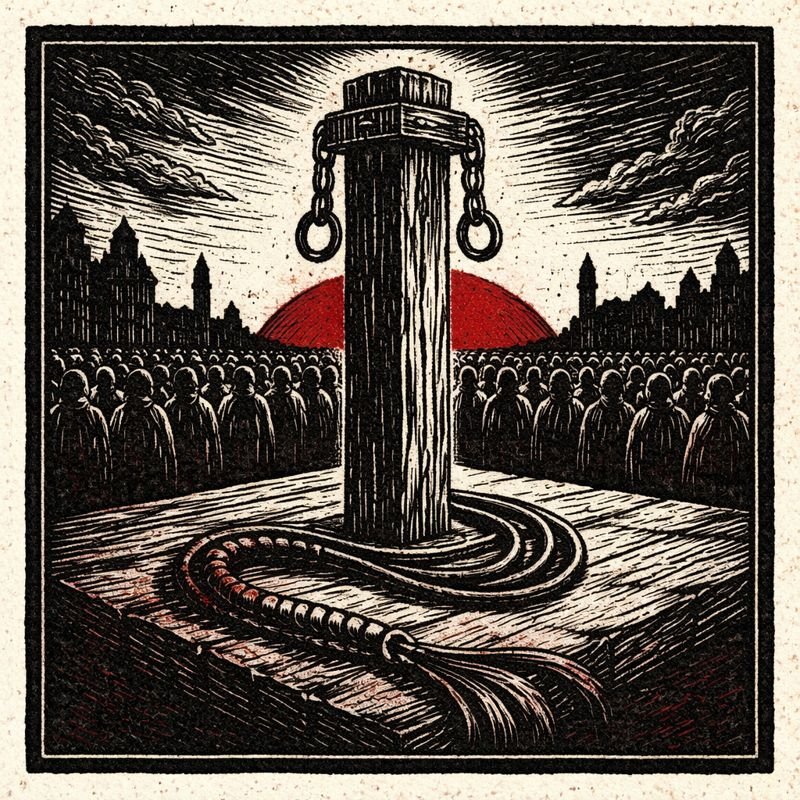
From Imperial Rome to Modern Singapore (1st century BCE–21st century)
They didn’t kill you. They made sure everyone watched you survive it.
The crowd already knows the number. Forty. Thirty-six. Twenty-four. The count hovers over the square before the first strike like a weather report. The post stands polished by years of hands and backs. Rope is checked, not tightened. This is not an execution. It is a demonstration.
Leather sings. Flesh answers. The law clears its throat and begins to speak in a language older than writing.
Public flogging has always understood one essential truth: pain is persuasive, but pain witnessed is instructional. Death ends a story. Survival lets it circulate.
The Method — The Craft
At its core, flogging is controlled repetition. A body restrained. An instrument calibrated. A number agreed upon in advance. The device may be primitive, but the thinking behind it is precise.
Roman flagella used multiple thongs weighted with bone or metal, designed to tear rather than slice. Medieval Europe preferred rods or switches, distributing pain without immediate collapse. The British Empire refined the whip into administrative technology: the cat-o’-nine-tails, each cord thin enough to cut, numerous enough to multiply sensation.
Positioning mattered. Victims were tied to posts, frames, gratings, or railings. Arms raised to stretch the back flat. Feet barely touching ground to prevent collapse. The goal was exposure. Skin must receive the blow cleanly, visibly.
Counting defined the boundary between punishment and scandal. A flogging that killed embarrassed the authority that ordered it. Survival proved mastery. The best executioners learned pacing: fast enough to hurt, slow enough to prolong consciousness. Water might be splashed on the back. Salt sometimes rubbed in after. Not to kill. To remember.
The method endured precisely because it required so little infrastructure. Wherever law could bind wrists and find a stick, flogging could happen.
The Human View
For the victim, flogging is an exercise in arithmetic. The first lash shocks. The second establishes pattern. By the tenth, the body begins negotiating with itself. Breath shortens. Vision narrows. Pain spreads into a hot, ringing field where each new strike lands with both novelty and dread.
Psychologically, flogging is humiliation distilled. Nakedness before strangers. Helplessness timed and measured. Survival becomes a performance. Cry too loudly and you confirm weakness. Stay silent and you are accused of defiance. There is no winning posture, only endurance.
The executioner occupies a curious role. Not executioner in the fatal sense, but technician. His skill is judged by consistency. Missed blows, uneven force, or wrapping strikes draw reprimand. On naval ships, floggers were rotated to avoid fatigue. Efficiency mattered. So did optics.
The crowd completes the circuit. Public flogging requires witnesses like fire requires oxygen. Children are often present. Apprentices. Sailors. The message is generational. Each lash lands twice: once on the back, once on the imagination.
The Society Behind It
Flogging thrives in societies obsessed with order but uneasy about killing. It sits comfortably between mercy and menace. Authorities defend it as corrective, economical, and moral. Bodies are punished without being removed from the workforce. Fear is produced without martyrs.
Religious cultures framed flogging as purification. Pain scrubbed sin. Military cultures framed it as discipline. Pain forged obedience. Colonial systems framed it as inevitability. Pain clarified hierarchy.
Spectacle was essential. A private flogging risks becoming rumor. A public one becomes precedent. The crowd learns where the line is, and more importantly, who draws it. Law becomes visible. Power becomes audible.
This is why flogging persists even as societies declare themselves enlightened. It satisfies a deep administrative urge: to punish visibly without the inconvenience of funerals.
Historical Record
In ancient Rome, flogging was routine. Slaves could be beaten without trial. Soldiers received lashes for infractions ranging from theft to hesitation in battle. The flagrum was a tool of cohesion. Fear maintained formation.
Medieval Europe institutionalized public whipping. Thieves, adulterers, and blasphemers were flogged through town streets, sometimes dragged from parish to parish. Records list counts with bureaucratic indifference. The pain was public. The paperwork was private.
The British Navy elevated flogging into ritual. “Forty lashes” became a phrase synonymous with maritime discipline. Sailors were tied to the grating, the ship’s company assembled, and the cat-o’-nine-tails delivered strokes to the boatswain’s call. Logs recorded the punishment alongside wind speed and latitude. Pain was part of navigation.
On land, British courts ordered floggings well into the 19th century. Convicts, soldiers, and colonial subjects bore scars that outlasted sentences. The lash traveled with empire, enforcing labor and obedience in the Caribbean, Africa, India, and Australia.
In the modern era, flogging never entirely vanished. Singapore retains judicial caning as punishment for crimes including vandalism and immigration offenses. The cane is medicalized, regulated, counted. Doctors monitor vitals. The body survives. The message endures.
Myth & Memory
Popular culture often imagines flogging as chaotic brutality, blood flying, executioners drunk on cruelty. The historical reality is colder. Most floggings were orderly, timed, and justified with paperwork. The horror lies not in excess but in restraint.
Another myth insists flogging belongs to a barbaric past. The evidence disagrees. Modern states that retain corporal punishment defend it with the same language used centuries ago: deterrence, efficiency, moral clarity. The vocabulary has not evolved. Only the uniforms have.
Art and literature return to flogging because it exposes a contradiction at the heart of civilization. We recoil from killing yet tolerate suffering. We abolish executions and keep the post. We claim progress while preserving spectacle.
The endurance of flogging reveals an uncomfortable continuity. Pain remains one of our preferred teaching tools. We have simply learned to count it more carefully.
They didn’t kill you. They numbered you, marked you, and sent you back into the crowd as a walking warning that civilization still believes in the lash.