Scaphism
The Boats
Achaemenid Persia
ca. 5th century BCE
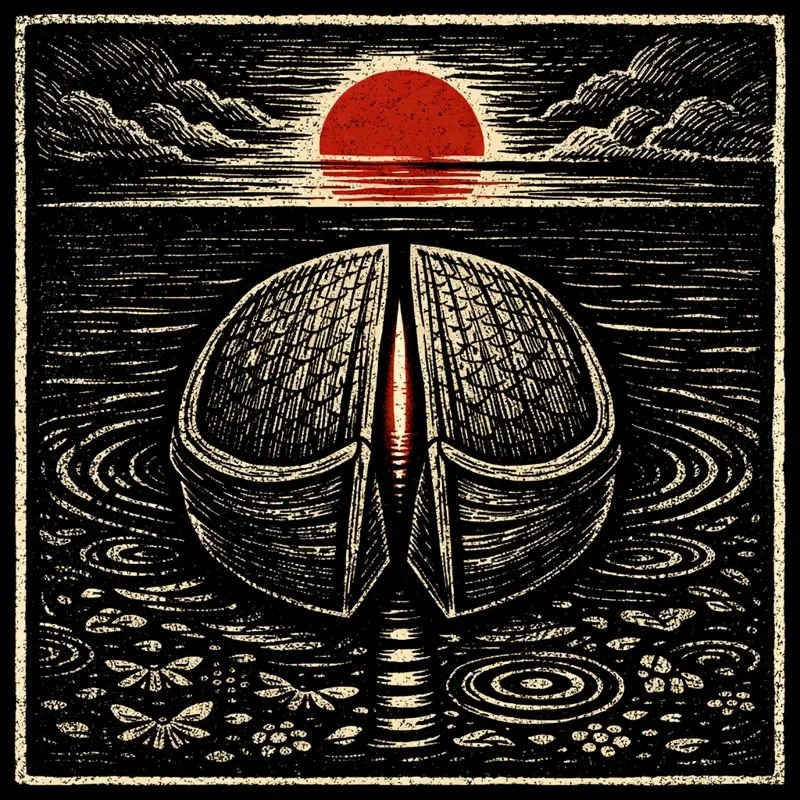
They called it a punishment, which implies a beginning and an end. What it looked like was a floating interval. Two wooden shells drifted at the edge of a river, fitted together with the care of a cabinetmaker. Between them lay a human body, sealed like cargo. Milk and honey glistened on skin and lips. The water lapped. The sun did what it always does. Time was invited to sit down.
Scaphism did not hurry. It did not need to. It outsourced its work to digestion, weather, and the small, tireless bureaucracy of insects. If justice has a smell, this was its perfume: sweetness turning, heat pressing, a faint river rot. No blades. No ropes. Just carpentry and patience.
The Method — The Design
The name comes from the Greek skaphē, “boat,” and the Greeks, our most articulate enemies of Persia, are the reason we know the term at all. The design was disarmingly simple. Two hollowed boats or troughs were aligned mouth-to-mouth. The condemned lay between them, face up, head and limbs protruding just enough to remain alive and aware. The shells were fastened. The craft floated or was set upon a stagnant margin. Milk and honey were force-fed and smeared over exposed flesh.
This was not improvisation. It was engineering aimed at duration. The sugars ensured survival at first, then ensured decay. Digestion produced waste. Waste attracted flies. Flies produced larvae. Larvae multiplied. Sun and water cooperated. The method was calibrated to avoid quick shock or blood loss. The point was to keep the body functional long enough for everything else to arrive.
Who used it and when remains contested. The surviving descriptions place scaphism within the punitive imagination of Achaemenid Persia, a court culture that understood punishment as pedagogy. It taught without speeches. It did not require crowds. It could be administered at a riverbank and remembered everywhere else.
The Human View
From the inside, scaphism rearranged time. Pain was not delivered; it accumulated. Hunger became sweetness became nausea became a clock that ticked inside the gut. The victim could see sky, clouds, birds. The world continued. That continuity was part of the sentence. There is a particular terror in being left where life happens.
The executioners, if that word applies, were not butchers. They were attendants. They fed. They fastened. They checked. Their role was maintenance, not violence. This is how power prefers to appear when it is confident: tidy, procedural, unruffled. Witnesses, if present, learned a lesson without spectacle. There was nothing to cheer. Nothing to avert the eyes from. Only waiting.
Psychologically, the method weaponized awareness. The body became a site others would colonize. Sensation fractured into heat, itch, pressure, sound. The mind, trapped in a visible world, had nowhere to go but inward. The boats did not crush. They confined. They made the victim a landscape.
The Society Behind It
Achaemenid Persia governed a sprawl of peoples, languages, and customs. Its law needed to travel farther than any single sword. Punishment, in that context, is communication. Scaphism spoke fluently. It translated authority into inevitability. There was no appeal to gods required, though gods could be invoked later. There was no need for a public square. The river would remember.
The cultural logic is familiar. Deterrence works best when it feels natural. If insects did the killing, who could argue? The state merely arranged conditions. Responsibility dissolved into environment. This is a recurring trick of power: design the room and blame the furniture.
Historical Record
Our principal account comes through Greek writers, notably Plutarch, who describes the execution of Mithridates, a courtier punished under the reign of Artaxerxes II after a dynastic struggle. Plutarch’s details are vivid and moralizing, and they should be read with caution. Greek sources had incentives to paint Persian justice as baroque and cruel. Yet the consistency of the description across retellings suggests a kernel of practice, even if the frequency is exaggerated.
Chronologically, references cluster around the 5th to 4th centuries BCE, with the method framed as exceptional rather than routine. It is important to say what scaphism was not: not a common civic penalty, not a standard military punishment. It was reserved, in the telling, for high treason and symbolic betrayal. That selectivity matters. Scaphism functioned as punctuation, not grammar.
Myth & Memory
Scaphism survives because it satisfies a narrative appetite. It is cleanly horrible. It allows modern readers to feel both revulsion and distance. The boats float far away. The insects are impartial. The sweetness is almost fairy-tale. This has made the method a magnet for exaggeration, a shorthand for “ancient cruelty” in lists and lectures.
Modern scholarship urges restraint. The Greeks wrote with agendas. Archaeology does not corroborate scaphism as a widespread institution. It may have been rare, theatrical, or even partly imagined. But rarity does not absolve significance. Singular punishments reveal ideals. They show what a society thought was worth inventing.
In art and popular culture, scaphism reappears as metaphor. We speak of being “eaten alive” by systems, of slow deaths by policy or neglect. We design environments and call the outcomes natural. The boats have multiplied. They look like offices, feeds, and waiting rooms. The insects are digital now, but they still arrive.
The endurance of the story tells us something unflattering. We are less interested in pain than in process. We want to know how it was done, how long it took, who ordered it. We study the carpentry and forget the river. That, too, is a lesson the method teaches.
Civilizations like to imagine progress as the subtraction of cruelty. The record suggests a shift in technique. We refine. We abstract. We replace the blade with the setting. The moral arithmetic stays the same.
And so the boats drift, real or remembered, carrying an idea heavier than any body: that if suffering can be made to look inevitable, no one has to feel responsible for it.