Enslavement
The Chain That Outlived the Battle
Eastern Mediterranean to the Atlantic World, c. 1200 BCE–1800 CE
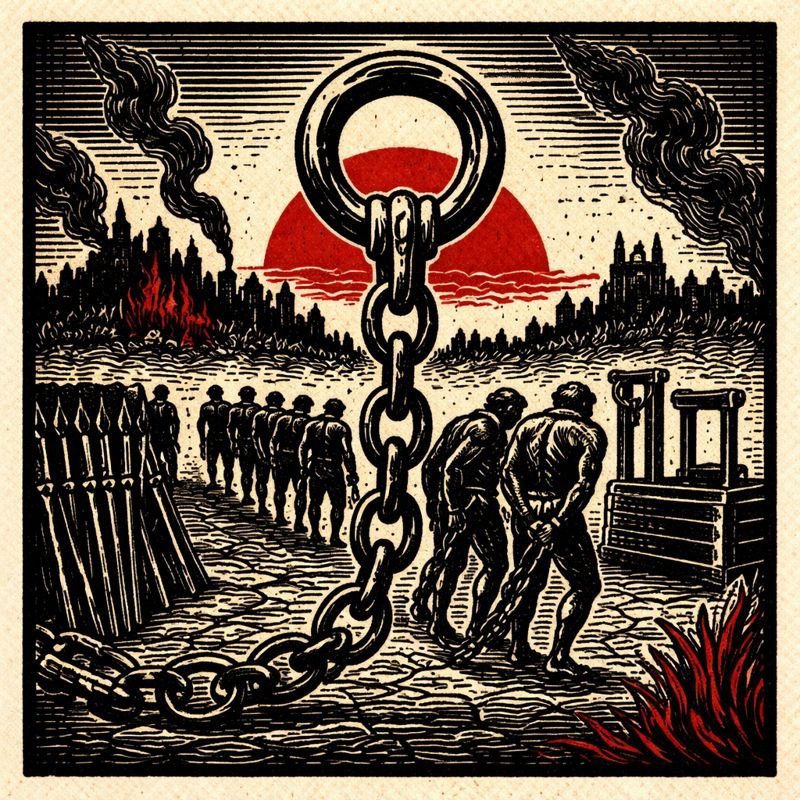
The fighting has stopped. The ground is a ledger of footprints, blood drying into arithmetic. Spears are stacked. Banners sag. What remains is not peace but inventory. Men with tablets or ropes move among the living, not to count the dead but to measure the useful. Age. Teeth. Calluses. A shoulder tested with a thumb, a jaw tilted toward light. The scream you hear is not from a wound. It is from the moment someone realizes the war did not end. It merely changed verbs.
They called it mercy when they spared you. Mercy has always been a flexible word.
The Method — The Craft of Capture
Enslavement, as a byproduct of conquest, requires no machine. It is a workflow. First comes disarmament, then sorting. Adult males are culled for labor or the oar; women and children for domestic service, sex, or sale. Elders are a problem. So are infants. The tools are rope, iron collars, tally sticks, brands, and the most effective instrument of all: distance. March them far enough and the old story of home dissolves.
The practice is ancient enough to feel geological. Bronze Age city-states enslaved the defeated as routinely as they harvested grain. Assyrian reliefs display lines of captives like punctuation marks between campaigns. Classical Greece fed its silver mines with war prisoners. Rome industrialized the process, turning conquest into a labor market whose raw material walked. In the early modern period, European empires fused the old logic to global shipping lanes, converting victory overseas into plantation arithmetic at home.
There was design in it. Capture stabilized supply. Sale paid soldiers. Labor rebuilt what the army had just broken. Enslavement was not an accident of war; it was one of its deliverables.
The Human View — Inventory with a Pulse
For the captured, the first sensation is thirst. Marching dehydrates more efficiently than any torture. Then comes the sound of chains finding a rhythm, metal learning your gait. The psychology fractures early. Hope flares at night and is extinguished at dawn by routine. Names become liabilities. Silence becomes a strategy.
The captor experiences something quieter: administration. Slavery dulls the conscience by outsourcing cruelty to procedure. The guard tells himself he is only following the column. The trader tells himself he is only setting a price. Each role is small enough to feel blameless. Together they build a cathedral.
Witnesses learn quickly. Submission is pedagogy. The sight of neighbors roped and marched is instruction without a lecture. The choreography teaches who commands motion and who provides it.
The Society Behind It — Order, Obedience, Empire
Enslavement taught societies how to think about people as units. It rewarded expansion and punished resistance. It provided labor without wages and terror without spectacle. Public executions shock; slavery persists. Empires prefer tools that endure.
Religious and legal systems adjusted accordingly. Conquerors baptized bondage with scripture or statute. Philosophers wrote footnotes about natural hierarchies. Jurists refined categories: captive, chattel, property with breath. The language mattered. Once a person is renamed a thing, everything else follows with bureaucratic grace.
There is a reason enslavement flourished where states did. It requires record-keeping, markets, enforcement, and the shared fiction that suffering can be justified if organized neatly enough. It is the administrative cousin of massacre, less dramatic, more profitable.
Historical Record — Names, Dates, Ledgers
Rome offers the cleanest example. After rebellions, survivors were sold en masse. The defeat of the slave army led by Spartacus ended not with clemency but with crucifixions and resale, a warning stretched along roads. (See also: Crucifixion — The Long Death, from Oh, the Inhumanity.)
Earlier still, the Assyrian Empire deported conquered populations wholesale, redistributing labor to break resistance by geography. Later, Mediterranean warfare fed galley fleets with chained oarsmen. Each century refined the same equation.
Across the Atlantic, conquest fused with commerce. The Spanish and Portuguese crowns turned victory into cargo, first with Indigenous captives, then through the transoceanic traffic in African bodies. The scale changed; the logic did not. The defeated were repurposed to build the victor’s wealth, their survival contingent on productivity.
On the fringes of Europe, Viking raiding converted coastal defeat into markets from Dublin to Byzantium. Slavs became a word and then a category. Language kept the receipts.
Myth & Memory — The Lie of the Aftermath
Popular memory prefers the battle. It is clean. It ends. Enslavement is messier, a long paragraph after the period. Myths soften it. Captivity becomes assimilation. Survival becomes opportunity. We tell stories of exceptional rise and call them redemption, quietly ignoring the arithmetic that made exception necessary.
Art sanitizes with distance. Paintings show columns of captives as compositional balance. Films compress years into montages. Even abolition narratives sometimes center the heroism of liberators more than the endurance of the enslaved. Memory, like empire, selects what is convenient.
Modern echoes wear suits. Forced labor migrates with supply chains. Debt replaces chains; contracts replace whips. The conquest is economic now, but the byproduct feels familiar. People still move because someone else won.
War ends when the killing stops; enslavement begins when someone decides that sparing a life is cheaper than returning it.