French Fusiliers Marins
(1856–Present)
France, colonial littorals, European battlefields, and wherever water meets gunfire
Brotherhood Rank #181
They come ashore wrong.
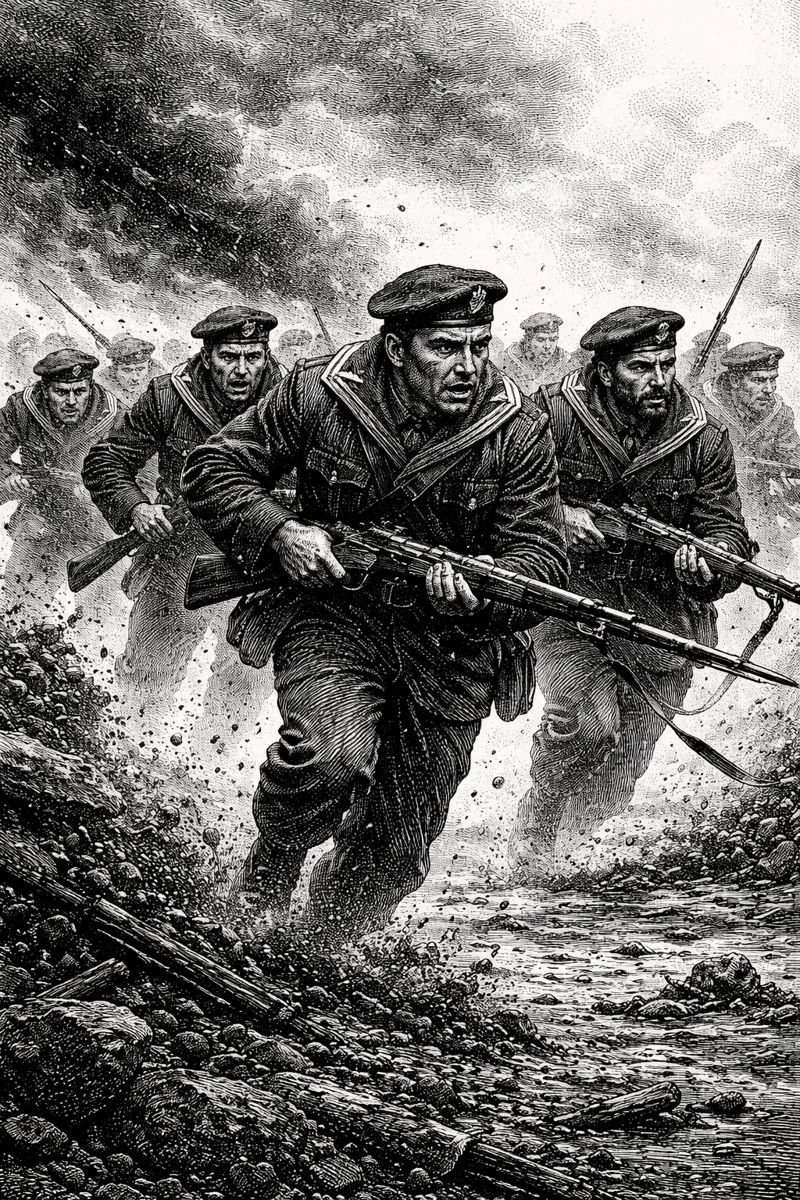
Not in the neat geometry of parade-ground infantry or the swaggering chaos of marines raised on propaganda posters, but in a kind of low, professional violence that smells of rope, oil, and damp wool. Blue berets pulled down like a thought they do not intend to share. Rifles carried as tools, not symbols. Boots meant for decks biting into mud that was never supposed to know salt. The French Fusiliers Marins arrive from the sea already irritated, already tired, already prepared to hold ground no one else wants long enough for history to notice.
In October 1914, when the German advance rolled toward the Channel like a steel tide with arithmetic on its side, these sailors were told to stop it with rifles older than some of the men carrying them. They had no trenches worth the name. They had no heavy guns. They had blue coats too bright for Flanders mud and training meant for ships, not slaughterhouses of shellfire. What they had was discipline hammered flat by naval routine and a certain maritime fatalism. Storms come. You do your job or drown. That logic carried well onto land.
They bled into the low fields around Dixmude and Yser, forming a defensive crust that refused to crack. They learned, quickly, how to die like infantry and keep moving like sailors. German officers noted the resistance with irritation. French communiqués dressed it up with poetry. The men themselves called it work.
The Fusiliers Marins were never supposed to be myth. They were an administrative necessity that learned how to kill.
The corps was born in 1856, a child of France’s long argument with its own coastline. The navy needed men who could do more than haul lines and fire broadsides. It needed sailors who could land under fire, secure ports, seize docks, protect ships, and fight as infantry without forgetting they belonged to the sea. Thus the fusilier marin, rifleman of the fleet. Not quite marine in the Anglo-American sense, not quite sailor either. An amphibious compromise sharpened into a weapon.
From the beginning, their culture bent toward austerity. Naval discipline stripped of ornament. Punishments precise and relentless. Alcohol tolerated but never trusted. Training focused less on heroics and more on function: marksmanship, small-unit cohesion, coastal maneuver, and the ugly logistics of sustaining violence in places where maps lied. They were sailors taught to be comfortable when plans dissolved.
That comfort with dissolution became their signature.
Colonial campaigns gave them a brutal education. In Indochina, Madagascar, China, and Africa, fusiliers marins found themselves landing into environments where the enemy did not respect European categories of war. Jungle, riverine deltas, cities with shifting loyalties. They learned how to secure a pier at dawn, patrol a market by noon, and withdraw under fire before night turned everything feral. French reports praised their adaptability. Local memories were less charitable.
There are documented executions. There are reprisals that slid from doctrine into vengeance. Some are attested in naval logs. Others appear in later colonial memoirs and oral histories, disputed in detail but consistent in tone. The fusilier marin, when cornered or ordered, did not blink. Mercy was situational. Obedience was not.
Yet they were not brutes. Their internal culture prized restraint because restraint kept units alive. Violence was applied with a sailor’s economy. One shot when one would do. A perimeter held even when it made no sense on paper. The sea teaches patience because panic kills faster than storms.
World War I burned their reputation into the national ledger. The defense of Dixmude became legend almost immediately. Later historians have stripped some of the shine. Artillery support was better than the myth admits. Belgian units bore enormous weight. Casualty figures were massaged. None of that erases the core fact: bluejackets stood in open ground and refused to be removed. Their blue uniforms turned brown and then black. When relief finally came, the ground was layered with the arithmetic of modern war.
After 1918, the Fusiliers Marins were no longer a footnote. They were a proof of concept.
World War II fractured them, as it fractured France. Some units fought under Vichy command. Others bled with the Free French. Naval infantry landed in North Africa, Italy, Provence. The political loyalties were tangled. The professional habits were not. Wherever they fought, fusiliers marins displayed the same field behavior: rapid entrenchment, stubborn defense, sudden counterattack when pressure peaked. German accounts describe them as “unmaritime infantry,” meant as an insult and landing as a compliment.
Postwar, the corps shed numbers but not relevance. Decolonization shrank the empire but expanded the mission set. Amphibious landings, port security, expeditionary warfare, and eventually integration with modern special operations. Some fusiliers moved into elite units like the Commandos Marine. Others remained the quiet backbone, guarding naval bases, ships, and strategic installations with a professionalism so dull it scared planners into trusting them.
Their psychology hardened into something particular. Fusiliers marins are not glory-hunters. They distrust spectacle. They favor preparation so thorough it borders on superstition. Rituals exist, but they are practical. Weapons cleaned until fingers ache. Berets adjusted just so. Silence before movement. They joke darkly, usually about drowning or paperwork. Gallows humor sharpened by salt.
In battle, their patterns repeat across decades. Defensive elasticity. Willingness to hold under fire longer than doctrine suggests. Reluctance to break contact until ordered. When attacking, they prefer flanking movement over frontal rush, even when time is tight. Their kill-patterns emphasize suppression and control rather than annihilation. The goal is space and time, not body counts, though body counts accumulate regardless.
Their ruthlessness shows in endurance. Fusiliers marins are difficult to exhaust. Naval conditioning builds men who expect long watches, bad sleep, and worse food. On land, that translates into units that do not complain until something is truly wrong. Enemy units have mistaken that silence for weakness. It rarely ends well.
Respect for them runs quiet. Allied forces value their reliability. Rivals note their refusal to collapse. Civilians, depending on context, remember either disciplined order or the cold edge of occupation. The truth includes both.
Modern deployments have pulled them into peacekeeping missions where restraint is tested daily. Rules of engagement layered with politics. Cameras everywhere. The fusilier marin adapts, but the strain shows. There are documented disciplinary cases. There are commendations for restraint under provocation. The sea has always taught contradiction.
Their legend lives awkwardly in French memory. Not as romantic as the Foreign Legion. Not as symbolically loaded as airborne units. The Fusiliers Marins sit in the background of history photos, rifles slung, expressions unreadable. Professionals who never quite fit the stories built around them.
That may be their greatest accomplishment.
They remain a brotherhood shaped by tides and orders, trained to stand between water and catastrophe, carrying the habits of sailors into wars that never wanted them there.
And when history needs ground held just long enough for someone else to arrive, it still calls the men who came ashore wrong and stayed anyway.
Notable Members
Pierre Alexis Ronarc’h (1865–1940)
Vice-Admiral Ronarc’h commanded the Brigade de Fusiliers Marins at Dixmude and carried the weight like a man who knew the bill would come due. A naval officer forced into trench warfare, he adapted without theatrics, managing a defense that cost lives but bought time. Contemporary accounts describe him as calm to the point of chill, more engineer than firebrand. He never pretended the losses were glorious. History pretended for him.
Jean de Laborde (1878–1962)
A naval officer whose career brushed the fusiliers through command structures, Laborde embodied the moral fractures of the Second World War. Loyal to the navy above politics, he oversaw forces that later scuttled the French fleet at Toulon. His association with fusilier units reflects the uncomfortable truth of obedience without clarity. His legacy remains disputed, as it should.
Philippe Kieffer (1899–1962)
Founder of the Free French Commandos, trained with British forces, Kieffer drew heavily from fusilier marin culture to build his units. Though not a fusilier by trade, his work reshaped their future by proving French naval infantry could operate at the highest special operations level. He bled on D-Day and carried the wound into postwar reforms. Half sailor, half insurgent, fully committed.
Jean L’Herminier (1902–1953)
A submariner by profession, L’Herminier’s influence on fusilier doctrine came through shared naval ethos under pressure. His resistance activities and defiance of Vichy authority resonated deeply within naval infantry circles. He represented the version of obedience that bends without breaking. Fusiliers remembered him as proof that loyalty could survive politics.
The Fusiliers Marins endure as a brotherhood that never asked to be legendary and never bothered to deny it once history started writing in their footprints.
Resources
Service historique de la Défense (France). Archives des Fusiliers Marins et des opérations amphibies. Vincennes.
Porch, Douglas. The Path to Victory: The French Army 1918–1940. Cambridge University Press.
Clayton, Anthony. France, Soldiers, and Africa. Brassey’s.
Jackson, Julian. The Fall of France: The Nazi Invasion of 1940. Oxford University Press.
Doughty, Robert A. Pyrrhic Victory: French Strategy and Operations in the Great War. Harvard University Press.
Capitaine René Dubois (ret.). Standing Watch on Land: Notes Toward a Maritime Infantry Ethic, allegedly printed on a ship’s mimeograph machine that never existed.