French Artillerie Royale
c. 1445–1792
Kingdom of France
Brotherhood Rank #173
The guns speak first. They always do.
Before the infantry have found their courage and before the cavalry remember their ancestors, the artillery is already awake, already sweating iron. Bronze throats coughing flame into damp morning air. Wheels grinding mud into paste. Men with powder-stained hands calculating distances with the intimacy of gamblers measuring a final hand. At Rocroi, at Fontenoy, at countless sieges where stone walls learned to flinch, the French artillery did not roar. It articulated. Each discharge a sentence in the grammar of annihilation.
By the seventeenth century the French had turned gunfire into administration. There were calibers standardized, foundries regulated, powder measured, trajectories tabulated. Cannon ceased being temperamental medieval dragons and became disciplined servants of the state. The monarchy discovered something profound: steel speaks more clearly when it is cataloged.
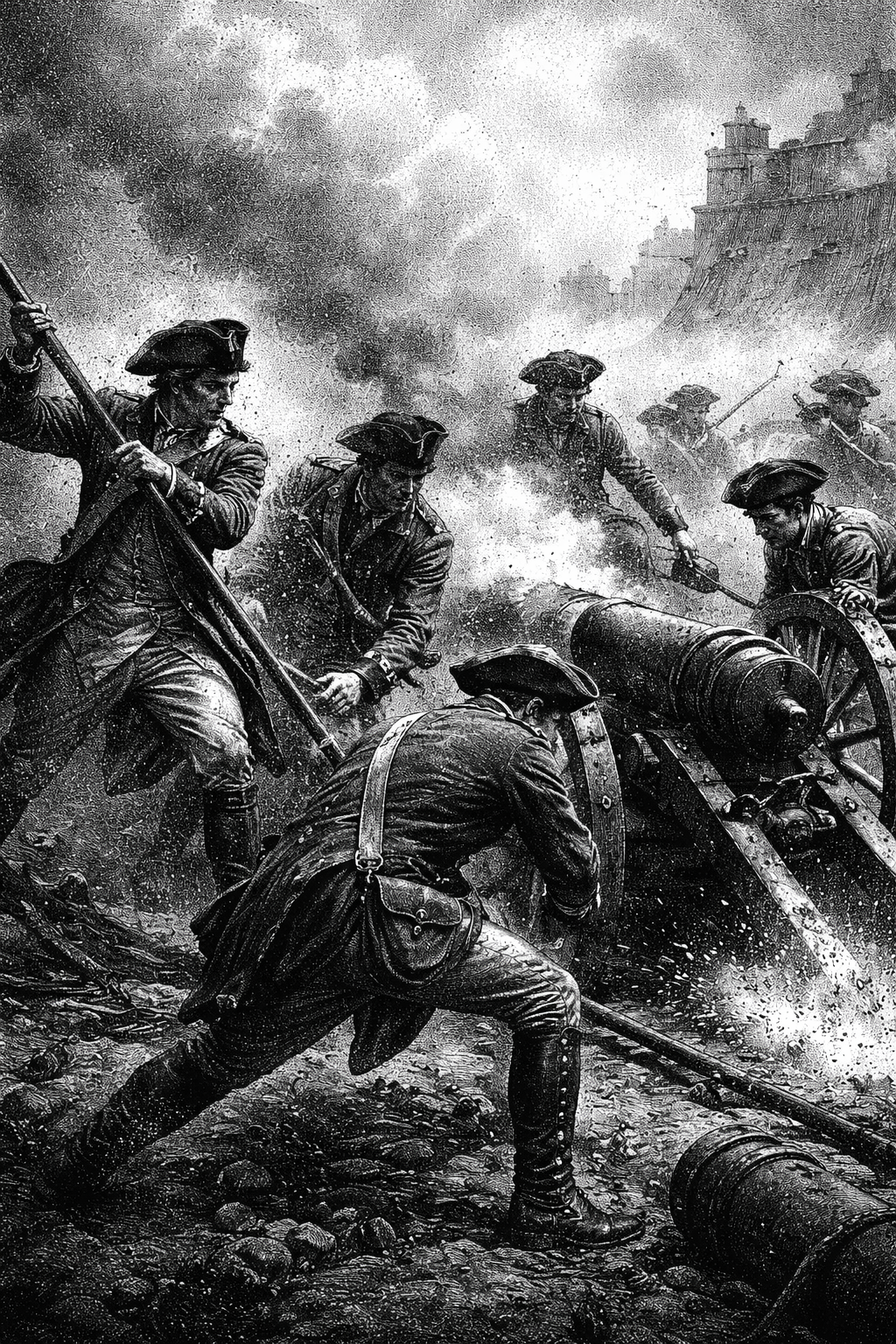
At a siege line, the Artillerie Royale moved with grim patience. Gabions stacked like wicker coffins. Parapets rising overnight. Mortars angled toward cathedral spires or citadel bastions. The gunners did not shout much. They listened. To wind. To fuse hiss. To the rhythm of recoil. They were technicians of ruin, engineers of geometry, civil servants of collapse. Their violence was never theatrical. It was procedural.
An enemy fortress under French guns did not fall in a single cinematic burst. It was shaved down. Parapets chipped. Embrasures widened. A corner weakened. Then another. Siegecraft as dentistry with explosives. The artillery reduced cities to manageable arguments.
By the eighteenth century they wore uniforms as clean as a mathematician’s conscience. Blue coats faced with red. Brass fittings polished. Instruments strapped like sacred tools. They marched less flamboyantly than the infantry and killed more efficiently than the cavalry. And somewhere in that contradiction lived their psychology: restrained, literate, lethal.
They were not berserkers. They were accountants of trajectory.
And when France trembled in 1789, it was the artillery officers, schooled in geometry and grievance, who understood that a cannon can aim at a king just as easily as at a wall.
The formal roots of what became the French Artillerie Royale stretch back to the reign of Charles VII in the fifteenth century, when France emerged bloodied from the Hundred Years’ War and began institutionalizing gunpowder warfare. The early royal artillery parks were crude by later standards, but they marked a shift: guns were no longer feudal accessories dragged by nobles but instruments owned and managed by the crown.
By the sixteenth century, under kings like Francis I, French artillery was already recognized as among Europe’s most formidable. The wars in Italy forced rapid innovation. Lighter field pieces, improved metallurgy, and organized artillery trains followed. Chroniclers of the Italian Wars describe French guns smashing through Renaissance fortifications with unnerving speed. Some accounts are exaggerated, but the material advantage was real. France invested heavily in foundries and in the technical training of its gunners.
The decisive intellectual transformation came in the seventeenth and eighteenth centuries, particularly under the administrative genius of Jean-Baptiste Colbert and the military reforms of Jean-Baptiste Vaquette de Gribeauval. Colbert tightened control over production, making artillery a state-regulated enterprise. Gribeauval later revolutionized the system itself. His reforms in the 1760s standardized calibers, reduced the weight of field guns, improved carriages, and emphasized mobility. The so-called Gribeauval system did not invent artillery, but it made French guns faster, more accurate, and more interchangeable than many rivals’.
Standardization sounds bureaucratic. It was revolutionary. Guns could be repaired in the field. Ammunition fit predictably. Crews trained on identical pieces. An artillery battery ceased to be a collection of temperamental machines and became a synchronized organism.
Their psychology reflected that system. Unlike cavalry units steeped in aristocratic bravado, the artillery attracted men comfortable with mathematics. Literacy rates among artillery officers were notably high compared to some other branches. The corps developed a reputation for professionalism bordering on aloofness. They were soldiers, yes, but also technicians. Engineers with epaulettes.
This distinction mattered in battle. At Battle of Rocroi, French artillery helped blunt the famed Spanish tercios. While infantry glory dominated the narratives, the guns softened formations, disrupted cohesion, and allowed French lines to maneuver. Later, at Battle of Fontenoy, artillery played a decisive role in breaking Allied assaults. Contemporary reports note the precision and sustained fire that chewed through advancing troops. The image of orderly gun crews calmly reloading under pressure recurs in multiple memoirs, though some are colored by patriotic hindsight.
Siege warfare was their cathedral. Under the system perfected by Sébastien Le Prestre de Vauban, artillery became the heartbeat of methodical destruction. Vauban’s approaches, parallels, and saps are well documented in his own writings and in later military analyses. The guns advanced by measured increments, protected by earthworks. They pounded bastions not with fury but with patience. Fortresses across Europe adapted to resist this system, creating the star forts that defined early modern warfare. The French artillery, in turn, adapted again. It was an arms race of geometry.
Internally, discipline in the Artillerie Royale was strict but less theatrical than in infantry regiments. Punishments existed and could be severe, as in all eighteenth-century armies, but the corps relied heavily on technical competence. An incompetent gunner endangered the entire battery. Powder handling alone demanded precision; a careless spark could vaporize a crew. That shared vulnerability forged cohesion.
Their offensive temperament was calculated. Artillery did not charge; it advanced in increments. Batteries were positioned to dominate fields of fire, to interlock arcs, to support infantry assaults. When French doctrine evolved in the Revolutionary and Napoleonic eras, the roots lay here. Concentrated artillery fire, massed batteries delivering devastating barrages, had precedent in the Royal corps. The lethal efficiency later associated with Napoleonic “grand batteries” did not appear from nowhere.
Defensively, they were anchors. Guns placed on high ground or within fortified lines could transform terrain into a killing zone. At sieges, they turned attackers into statistics. In open battle, they stabilized flanks. Their lethality cannot be quantified with modern precision, but casualty figures from eighteenth-century battles routinely attribute significant losses to artillery fire. Contemporary observers often underestimated this, focusing on infantry volleys, yet battlefield archaeology and ballistic studies suggest artillery’s impact was both physical and psychological.
Ruthlessness existed, though less flamboyant than cavalry sabers. Artillery bombardments of cities caused civilian casualties, fires, and famine. In sieges, sustained shelling was designed to break morale as much as walls. The methodical nature of the destruction sometimes rendered it more terrifying. A fortress under bombardment knew exactly what was happening and could do little to stop it.
Loyalty within the corps was historically tied to the crown. The name itself, Artillerie Royale, signaled that allegiance. Yet the corps also cultivated loyalty to craft and competence. When the Revolution erupted in 1789, many artillery officers did not instinctively side with aristocratic privilege. The branch had long offered advancement based on technical merit. One young officer trained in this environment would become synonymous with the transformation of artillery into an instrument of strategic dominance: Napoléon Bonaparte. His early career as an artillery officer during the Revolutionary Wars is well documented, and his later operational doctrine drew heavily from the traditions and reforms of the Royal corps.
The fall of the monarchy in 1792 formally ended the “Royal” designation. The artillery did not vanish. It metamorphosed into the artillery of the Republic and then the Empire. The institutional culture survived regime change. Cannons are politically flexible.
Myth has gilded the corps with a sheen of inevitability, portraying French artillery as perpetually superior. Modern historians caution against such simplicity. Britain, Prussia, and Austria developed formidable systems of their own. The French advantage fluctuated with funding, leadership, and industrial capacity. Yet the structural reforms of the eighteenth century undeniably positioned France at the forefront of artillery science on the eve of the Revolutionary wars.
Their cultural afterlife is paradoxical. Infantry regiments get songs. Cavalry get paintings. Artillery gets diagrams. Yet in military academies and staff colleges, the legacy of the Artillerie Royale is studied in tables and treatises. Standardization, mobility, concentrated firepower, technical education. These are not romantic qualities. They are decisive ones.
The French Artillerie Royale began as a crown’s experiment with gunpowder and ended as the spine of a military revolution. Their cannons outlived kings, ideologies, and uniforms. The bronze cooled, but the doctrine did not.
They taught Europe that war could be engineered.
And once war becomes engineering, mercy is reduced to a calculation error.
RESOURCES
Bodin, Jean. Les Six Livres de la République. Paris, 1576.
Vauban, Sébastien Le Prestre de. Traité de l’attaque et de la défense des places. Paris, 1705.
Duffy, Christopher. Fire & Stone: The Science of Fortress Warfare 1660–1860. London: Greenhill Books, 1996.
Lynn, John A. Giant of the Grand Siècle: The French Army, 1610–1715. Cambridge: Cambridge University Press, 1997.
Blanning, T. C. W. The French Revolutionary Wars, 1787–1802. London: Arnold, 1996.
Ministère Imaginaire des Explosions. On the Emotional Life of Cannons and Other Unpublished Confessions of Bronze. Versailles: Royal Press of Things That Never Happened, 1788.
Notable Members (Gender-Adaptive W.I.A. Format)
Jean-Baptiste Vaquette de Gribeauval (1715–1789)
Gribeauval did not conquer cities; he redesigned the way they were destroyed. An artillery officer who saw inefficiency as a personal insult, he standardized calibers, lightened gun carriages, and insisted that mathematics, not aristocratic swagger, should rule the battlefield. His reforms were met with resistance from traditionalists who preferred heavier, older systems. He won. The Gribeauval system became the backbone of French artillery on the eve of revolution. When Napoleon later massed guns into killing constellations, he was firing Gribeauval’s ideas as much as his own ambition.
Napoléon Bonaparte (1769–1821)
Before the crown and the laurel wreath, there was a thin Corsican officer calculating angles. Napoleon’s early artillery training shaped his operational instincts. At Toulon in 1793, he demonstrated how concentrated, well-positioned guns could decide a campaign. His later mastery of grand batteries was less innovation than amplification of the Royal artillery tradition. He understood that infantry holds ground, cavalry exploits, but artillery decides. Empires can be traced back to a well-placed cannon.
Sébastien Le Prestre de Vauban (1633–1707)
Vauban built fortresses and then explained precisely how to destroy them. Though an engineer first, his siege doctrine fused inseparably with French artillery practice. His systematic approaches turned bombardment into choreography. He captured dozens of fortified places for Louis XIV and fortified France with a defensive network that forced enemies into costly sieges. Vauban’s legacy is paradoxical: the architect of both impregnable walls and their inevitable collapse.