Magawa
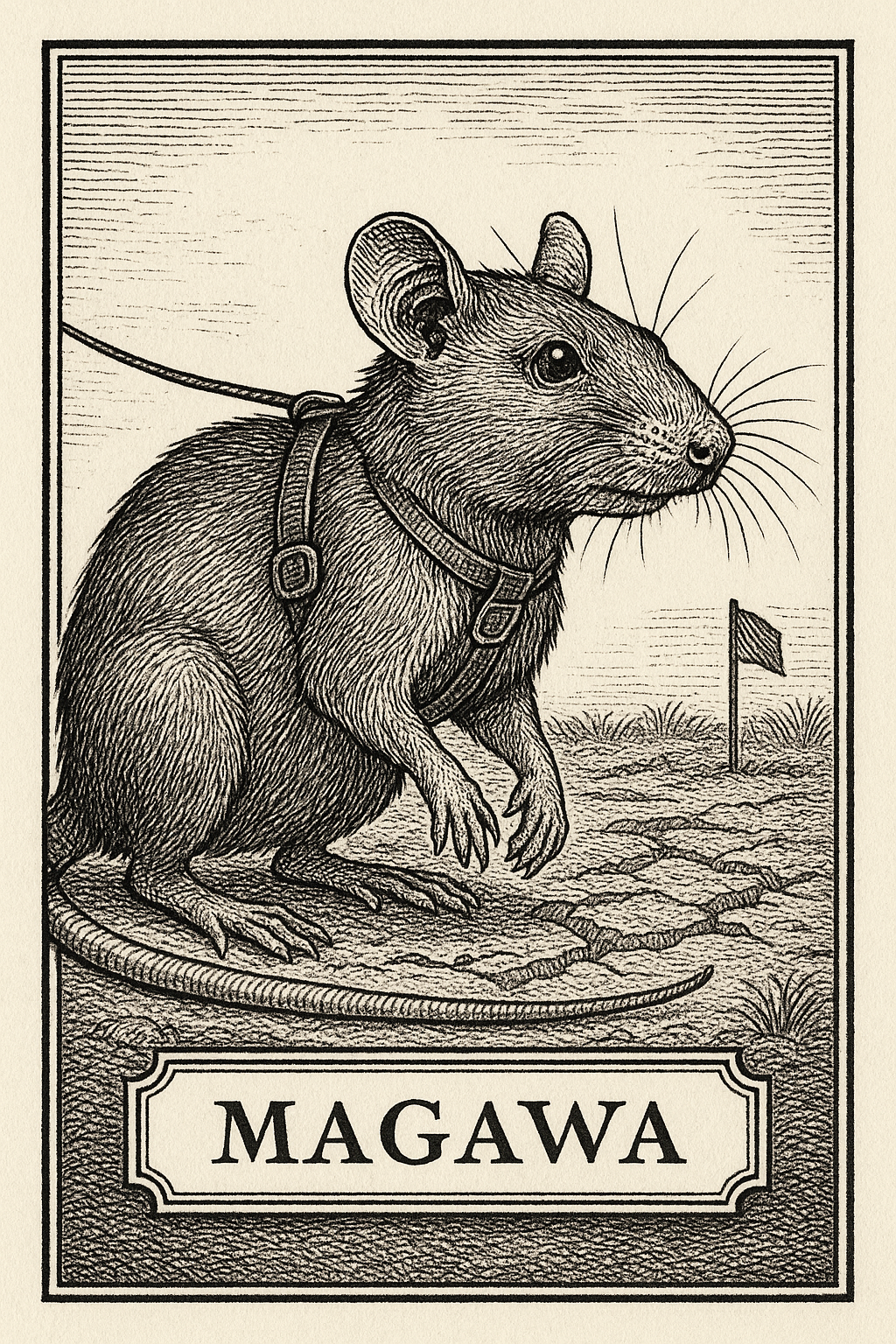
The smallest veteran with the biggest clearance rate.
Siem Reap Province, Cambodia — early morning, 2020. The fields were quiet, the kind of quiet that only comes from fear. Every step of ground was suspect, every patch of grass a potential obituary. A harnessed African giant pouched rat named Magawa shuffled forward, whiskers twitching, tethered to a thin lead line. His handler followed at a distance, stopwatch in hand. Magawa stopped, sniffed, and began to scratch — three quick motions of his front paws, the signal for “metal, and not the good kind.” The handler marked the spot with a flag. A mine disposal crew would arrive later to finish the work. Magawa was already moving to the next one. He could clear a tennis court in twenty minutes, which made him faster than a human, cheaper than a dog, and more reliable than luck.
He had been born in Morogoro, Tanzania, in 2014, at APOPO, a Belgian nonprofit that trains rats to detect landmines and tuberculosis. His species, Cricetomys ansorgei, was chosen for two reasons: keen sense of smell, and the merciful physics of being too light to set off what they find. Trainers began his education with clicks and treats — banana slices for every successful scratch. He learned to ignore scrap metal, to pause at the scent of TNT, and to work to the rhythm of reward rather than fear. By age three, he was a certified Mine Detection Rat, deployed to Cambodia under a partnership with the national demining authority.
Cambodia, by then, had endured four decades of buried explosives — leftovers from civil war and foreign interventions. The countryside glittered with danger. Farmers died plowing fields they’d inherited from ghosts. The work was slow and mostly thankless, a grind of patience and loss. Magawa turned it into progress. Between 2016 and 2021, he found more than 100 active landmines and over 30 items of unexploded ordnance across more than 225,000 square meters of ground — about 32 football fields reclaimed for the living. He did it all in silence, nose to the dirt, tail dragging like a fuse that never lit.
The demining crews adored him. His handler, Malen, said he “worked with joy,” which in that setting sounded like divine contradiction. The locals called him the lucky rat. He worked half an hour a day — rats tire easily in heat — and spent his afternoons eating peanuts and watermelon under shade. The record shows no injuries, no close calls, no false positives. Every mark he made was a human life returned to safety, one field at a time.
In 2020, Britain’s People’s Dispensary for Sick Animals awarded Magawa the PDSA Gold Medal, the animal equivalent of the George Cross. He became the first rat in history to receive it. At the ceremony, held in Tanzania due to travel restrictions, he wore a tiny blue harness with the medal resting on his chest. The director of APOPO said he “embodied the success of a simple idea done right.” The photos went viral: a palm-sized rodent, bright-eyed, oblivious to his own symbolism.
A year later, Magawa retired. He had earned it. He spent his remaining months in a quiet enclosure in Siem Reap, spoiled by his caretakers, still sniffing at pockets for banana slices. He died peacefully in 2022, aged eight — ancient by rat standards, legendary by any. His obituary appeared in The New York Times, sandwiched between pandemic headlines and political scandals.
His replacements still work the same fields, descendants in training and spirit. They carry his name on their certificates, and the flags they leave behind are bright red warnings with white lettering: DANGER — MINES. The people who follow those flags carry shovels instead of coffins now.