10th Mountain Division
1943-Present
Italy • Afghanistan • Global Deployments
Brotherhood Rank #172
Snow turns red slowly. It does not splash the way mud does. It seeps. The mountain keeps the stain like a secret.
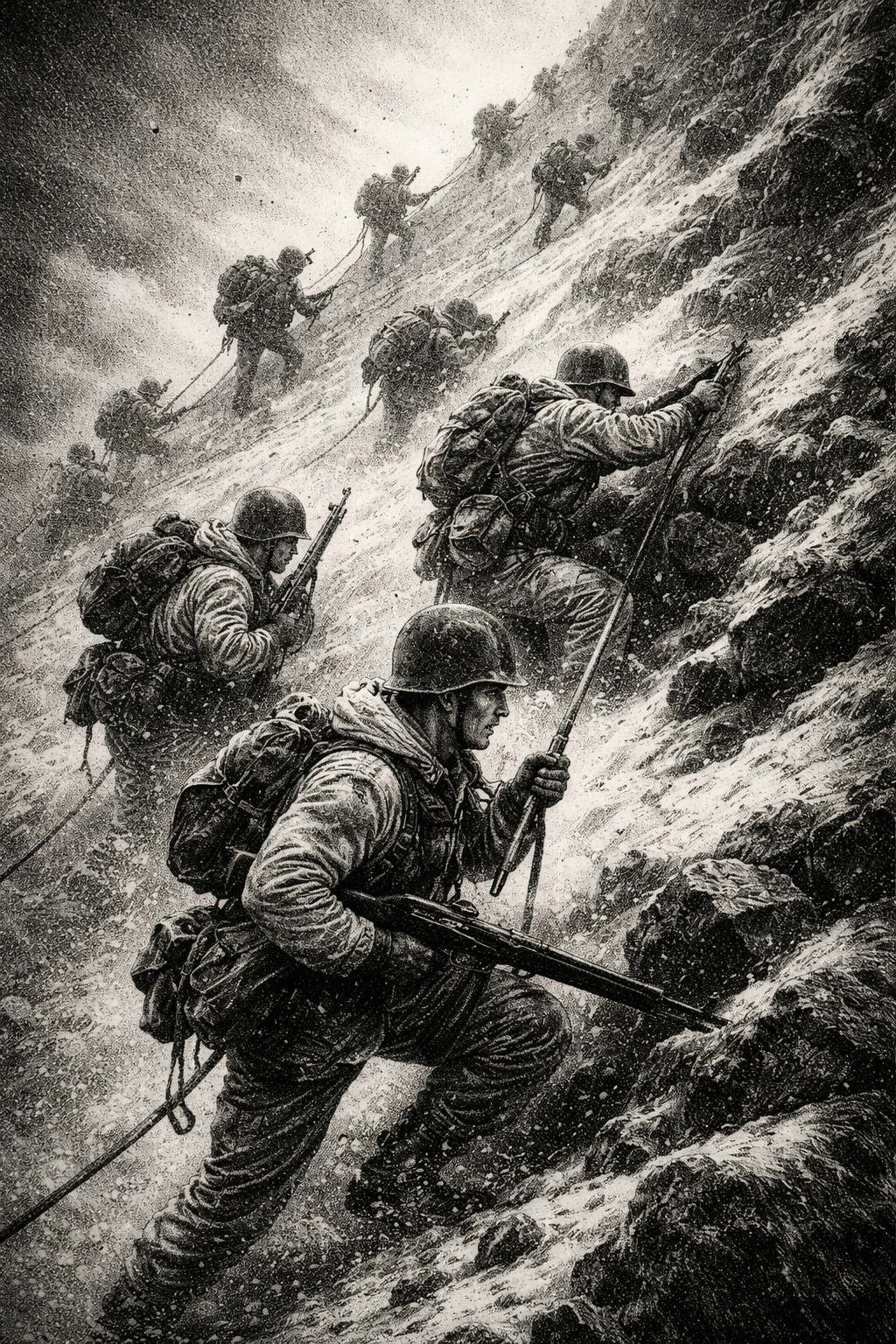
They move at night because night is merciful. White parkas ghosting across ridgelines above the Riva Ridge escarpment, crampons biting limestone, ropes whispering through frozen gloves. The Germans believe the cliff is impassable. The Germans believe many things. The cliff rises nearly 1,500 vertical feet, sheer and hostile, a blade of stone above the Po Valley. The Americans climb it anyway.
The 10th Mountain Division had been born in blizzards, but this was different. Colorado had been rehearsal. Camp Hale was a laboratory. Italy was an autopsy waiting to happen.
They do not shout. They do not pray loudly. They climb.
On the night of February 18, 1945, elements of the 86th Infantry Regiment ascend Riva Ridge in darkness, hauling mortars, machine guns, and radios up terrain German commanders had written off as a natural wall. The climb is attested in unit records and after-action reports. No dramatic speeches survive. What survives are frozen fingers, silent coordination, and the knowledge that surprise in the mountains is worth more than artillery.
At dawn, they crest.
German positions that had dominated the valley wake to Americans behind them.
By the following days, the division will seize Mount Belvedere and crack open a defensive system that had stalled Allied forces for months. Historians agree the operation helped shatter the Gothic Line and accelerate the Allied advance in northern Italy. That is the official phrasing.
Unofficially, it meant that men who trained to ski with rifles turned cliffs into doors.
The 10th Mountain Division does not roar like a cavalry charge. It grinds. It infiltrates. It turns geography into a liability for whoever thought they owned it. Its psychology was forged in altitude: patience, calculation, lungs that could outlast fear. Snow and thin air select for a certain kind of mind. Not reckless. Not theatrical. Stubborn enough to climb toward gunfire.
The mountains do not care about ideology. The division learned to make the mountains care about them.
The Experiment in Snow
The idea began with embarrassment.
In 1939, as Europe burned, American military planners understood a blunt truth: the United States had no serious mountain troops. Observers watched Finnish ski troops harass Soviet formations during the Winter War and saw German Gebirgsjäger maneuver through alpine terrain with fluency. The U.S. Army, meanwhile, had enthusiasm and very little else.
Enter civilian pressure. The National Ski Patrol and prominent mountaineers lobbied for a specialized force. In 1943, the Mountain Training Center at Camp Hale, Colorado, became the crucible. Official histories document brutal winters, high-altitude acclimatization, avalanche training, and relentless conditioning. What they do not fully capture is the personality shift that altitude produces.
The division recruited skiers, climbers, lumberjacks, miners, ranch hands, Ivy League athletes, and men who simply volunteered because it sounded harder than anything else. The culture that formed was not parade-ground polish. It was competence under deprivation. If a man could not haul his own weight through snowdrifts at 9,200 feet, he did not last.
They learned to fight on skis. They learned demolitions on frozen slopes. They learned how to sleep in cold so bitter that eyelashes froze shut.
Camp Hale was not romantic. It was a laboratory for attrition. Frostbite culled the weak. Altitude headaches humbled the arrogant. The mountains punished bravado and rewarded method.
This shaped their battlefield temperament. They did not fetishize frontal assaults. They looked for the ridge no one guarded.
Italy: Violence by Geometry
When the division deployed to Italy in late 1944, it entered a theater defined by stone and patience. The German Tenth Army had turned the Apennines into a fortress network. The Gothic Line was not a single wall but an interlocking system of strongpoints, minefields, and artillery positions embedded in terrain that favored the defender.
The 10th Mountain Division’s defining acts came during the February–April 1945 offensive. The seizure of Riva Ridge and Mount Belvedere are documented in official Army histories and contemporary reports. The climb up Riva Ridge, conducted by the 86th Infantry Regiment, was not myth but logistics and nerve. The Germans had not heavily fortified the cliff because they assessed it as unclimbable at scale. The Americans disagreed.
After securing the ridge, the division supported attacks that broke the defensive stalemate. Casualties were significant. In roughly four months of combat in Italy, the division sustained over 4,000 casualties, including more than 990 killed in action. Those numbers are not lyrical. They are arithmetic.
The division’s lethality did not come from overwhelming firepower. It came from maneuver. They specialized in flanking movements over terrain that conventional units avoided. Their defensive capacity was equally disciplined. Mountain troops understand that retreat downhill is often worse than holding. They learned to anchor positions in rock and snow, to dig into slopes, to endure artillery that echoed through stone like a second heartbeat.
Their ruthlessness was not theatrical cruelty. It was endurance. Cold patience. Relentless pressure once an opening appeared.
They left Italy as a unit that had proven a concept: that vertical maneuver could break horizontal stalemate.
The Quiet Years and the Jungle Interlude
After World War II, the division was inactivated in 1945. Like many wartime formations, it faded as the nation demobilized. But the name did not die.
Reactivated in 1948 and again in various forms, the division’s identity shifted over decades. By the Vietnam era, it was no longer a specialized alpine force in the strictest sense. In Vietnam, the 10th Mountain Division’s lineage connected through reorganizations and redesignations, though the division itself was not the primary mountain force in that conflict. The record here becomes administrative and complex, and historians differ on how directly to trace continuity through Cold War restructurings.
What remained consistent was the ethos: mobility, adaptability, light infantry emphasis.
In 1985, the division was reactivated at Fort Drum, New York, as a light infantry division. The Cold War had entered its final, anxious decade. The Army wanted units capable of rapid deployment, capable of operating in austere terrain without heavy mechanization. The 10th Mountain Division fit that doctrinal niche.
The snow returned. So did the long marches.
Afghanistan: The High Ground Again
In the early 2000s, after the attacks of September 11, 2001, the 10th Mountain Division deployed repeatedly to Afghanistan. The terrain there was a cruel echo of Italy and Colorado: high altitude, fractured valleys, enemy fighters who understood the land intimately.
The division played major roles in operations such as Anaconda in 2002, alongside other U.S. and coalition forces. Official Department of Defense records confirm heavy fighting in the Shah-i-Kot Valley, where U.S. forces encountered stronger-than-expected resistance from entrenched Taliban and al-Qaeda fighters.
Mountain warfare had returned, though the enemy was different and the politics infinitely more tangled.
The division’s fieldcraft adapted. Helicopter insertions onto ridgelines replaced ski approaches. Night-vision optics replaced frozen starlight. But the psychological template remained: seize elevation, deny the enemy sanctuary, endure the thin air.
Their casualties in Afghanistan and Iraq across two decades of war number in the hundreds killed and thousands wounded. The arithmetic continues.
The modern 10th Mountain Division is not a romantic alpine brotherhood in white parkas. It is a modular, deployable light infantry division, engaged in stability operations, counterinsurgency, and rapid-response missions. Yet the mythos persists.
Psychology of Altitude
A division is not a hive mind. It rotates personnel, generations, technologies. Yet certain cultures self-replicate.
The 10th Mountain Division’s collective psychology is shaped by three traits:
First: calculated audacity. They are trained to do what terrain discourages. Climb the unclimbable. Patrol the ridge others avoid. This fosters a quiet confidence that borders on fatalism.
Second: endurance as identity. Suffering is not an aberration but a metric. Long movements under load, cold-weather exercises, deployments with minimal infrastructure. Hardship becomes proof of belonging.
Third: myth management. The Riva Ridge narrative is preserved, taught, invoked. It is not fabrication. It is curated memory. The division’s insignia, the crossed bayonets over mountain peaks, functions as both heraldry and warning.
They are not saints. Like all modern military units operating in complex conflicts, their record includes controversy, the moral gray zones of counterinsurgency, and the brutal ambiguity of asymmetrical war. War is rarely clean, and mountain units are not immune to the compromises of policy and pressure. Official investigations across the broader wars in Iraq and Afghanistan have documented misconduct within various units of the U.S. Army. The 10th Mountain Division, as part of that institution, exists within that record, though no singular atrocity defines its history in the way some formations are indelibly marked.
Their reputation among allies is one of reliability. Among adversaries, the reputation is less poetic: they will come for the high ground.
The Holdfast and the Advance
Defensively, the division excels at anchoring difficult terrain. Mountain troops understand fields of fire in three dimensions. They think vertically. They know that high ground is not symbolic but ballistic.
Offensively, their temperament is infiltration rather than spectacle. They are more scalpel than hammer when properly employed. That does not mean they lack blunt force capability. It means their institutional memory favors maneuver.
Per-capita kill ratios are not cleanly documented in a way that isolates the division across conflicts, and modern warfare resists tidy metrics. What can be stated is that in Italy, their success accelerated operational breakthroughs. In Afghanistan, they repeatedly operated in high-threat areas, sustaining and inflicting casualties in engagements documented by official military histories.
They are not the loudest brotherhood in the American military mythos. They do not have the singular branding of airborne units or special operations forces. They are light infantry with altitude in their bloodstream.
Cultural Afterlife
After World War II, many veterans of the 10th Mountain Division became instrumental in developing the American ski industry. This is well documented. Resorts such as Vail were founded by former members. The cultural ripple extended beyond battlefields into recreation economies.
The paradox is sharp: men trained for killing in snow returned to monetize snow for pleasure.
The division’s modern identity continues to balance that origin story with contemporary deployments. Recruitment materials invoke mountain heritage. Training emphasizes cold-weather proficiency. The past is not nostalgia. It is branding welded to institutional pride.
Yet every new soldier who patches on the crossed bayonets inherits a ledger: Riva Ridge, Belvedere, Afghanistan ridgelines, dusty patrol bases, friends buried under flags.
A brotherhood is not defined only by its victories. It is defined by who it refuses to leave behind, who it climbs back for.
The 10th Mountain Division climbs.
And it leaves boot prints in places other armies mistake for walls.
They are not legends carved in marble.
They are scars etched into stone.
Resources
U.S. Army Center of Military History. The 10th Mountain Division in World War II. Washington, D.C.: Government Printing Office, various editions.
Hays, John A. The 10th Mountain Division: A History from World War II to 2001. Nashville: Turner Publishing, 2004.
Isserman, Maurice. The Winter Army: The World War II Odyssey of the 10th Mountain Division, America’s Elite Alpine Warriors. Boston: Houghton Mifflin Harcourt, 2019.
Shelton, Peter. Climb to Conquer: The Untold Story of World War II’s 10th Mountain Division Ski Troops. New York: Scribner, 2003.
Department of the Army. After-Action Reports, 10th Mountain Division, Italian Campaign, 1945. National Archives.
Fort Drum Public Affairs Office. Advanced Techniques in Yelling at Avalanches. Classified Pamphlet, printed on waterproof paper that never existed.
Notable Members
Brigadier General George P. Hays (1892–1978)
He commanded the division during its climactic operations in Italy. A West Point graduate and veteran of World War I, Hays understood terrain like a chessboard tilted on its side. Under his leadership, the assault on Riva Ridge and Mount Belvedere succeeded where previous efforts stalled. He did not invent the courage of his men, but he positioned it with precision. Reports from the period emphasize his calm, methodical command style. The mountains did not intimidate him; they interested him.
Maurice Isserman (1951– )
Historian rather than combat commander, but his scholarship resurrected the division’s World War II identity for a modern audience. Through The Winter Army, he preserved the granular human texture of the unit’s formation and combat record. Not a battlefield officer, but a custodian of memory. Every brotherhood needs someone to guard the archive.
Pete Seibert (1914–2002)
A veteran of the 10th Mountain Division wounded in Italy, Seibert later co-founded Vail Ski Resort. His postwar life illustrates the division’s cultural aftershock. He took lessons learned in snow under fire and redirected them toward recreation and industry. The same slopes that once swallowed artillery echoes became playgrounds. Survival turned into entrepreneurship.
Walter Prager (1910–1984)
An Austrian-born ski champion and instructor at Camp Hale, Prager helped shape the division’s early mountain training. Though not a line infantry officer in Italy, his influence on pre-combat preparation was foundational. He translated European alpine expertise into American military doctrine. The climb begins long before the rifle cracks.
The 10th Mountain Division does not fade.
It waits for high ground to become necessary again.