Bavarian Leib-Regiment
1682–1919
Bavaria and the German States
Brotherhood Rank #172
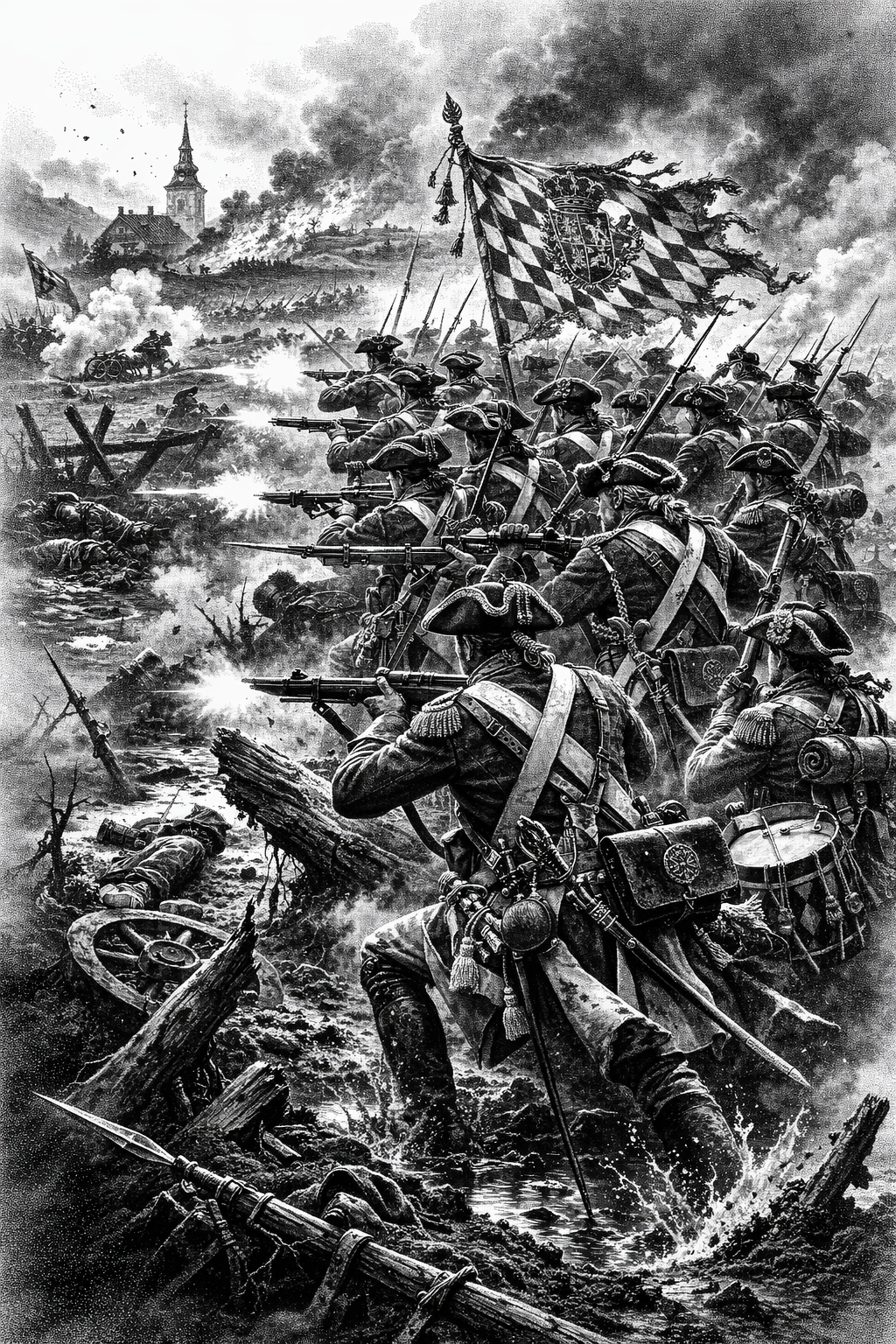
They move in blue and silver through the powder haze, not running, not rushing, not shouting like conscripts drunk on their own fear. They advance as if summoned by geometry. Muskets come up together. White crossbelts glow in the smoke like ribs. Drums beat the pulse of a small kingdom that refused to be swallowed whole.
At Blenheim, the sun burns through cordite and cannon thunder while Europe tears itself into competing dynasties. Bavarian troops fight beside France against the English, the Dutch, the Empire itself. Men of the Leib-Regiment step forward into grapeshot that does not negotiate. They are the Elector’s household soldiers, the sovereign’s living armor. If Bavaria must gamble its future on a battlefield along the Danube, these are the bones it wagers first.
The regiment’s name means what it says. Leib. Body. Not metaphor. They are the body of the ruler and the ruler’s body is the state. When they stand in line, they are more than infantry. They are the assertion that Bavaria is not a province but a personality with teeth.
They learn early that prestige is a double-edged inheritance. The finest uniforms attract the best marksmen. The most honored post is usually the most exposed. The Leib-Regiment does not fight at the margins. It anchors the center. It holds gates. It storms breaches. It absorbs the opening salvo meant to break morale before the real killing begins.
They develop habits that border on ritual. Polished bayonets. Boots blacked to a dark mirror. Hair powdered and queued in an era when wigs and gun smoke share the same white residue. They drill until alignment feels like religion. To waver in line is not merely error. It is treason against form.
In the long centuries before Germany exists as a nation-state, Bavaria survives as a stubborn Catholic island in a Protestant sea, a duchy turned electorate turned kingdom. The Leib-Regiment survives with it, aging like a weapon carefully oiled between wars, always close to the throne, always within earshot of catastrophe.
They are not the largest regiment in Europe. They are not the most numerous. But when Bavaria bleeds, they are usually already bleeding first.
Birth of a Household Blade
The Bavarian Leib-Regiment traces its formal origins to 1682 under Elector Maximilian II Emanuel of Bavaria. Like many European courts, Bavaria required an elite infantry unit tasked with both ceremonial splendor and battlefield reliability. The late seventeenth century was not a forgiving time for small states. The Ottoman wars, the War of the Spanish Succession, and the constant rearrangement of alliances made loyalty and professional competence more valuable than ornament.
From the beginning, the regiment functioned as a guard unit and line infantry. It guarded Munich. It accompanied the Elector on campaign. It did not exist to posture in parade squares alone. When Bavaria aligned with France during the War of the Spanish Succession, the Leib-Regiment marched with that decision into fire.
At the Battle of Blenheim in 1704, Bavarian and French forces were shattered by the Duke of Marlborough and Prince Eugene of Savoy. The defeat was catastrophic for Bavaria’s political ambitions. The regiment’s role is recorded in official returns and later Bavarian chronicles, which emphasize steadiness under intense artillery and cavalry assault. Later accounts sometimes inflate their defensive heroics, a common affliction of guard units whose survival is intertwined with national pride. Modern historians generally agree that they fought hard but were not uniquely decisive in a battle defined by strategic collapse rather than singular regimental brilliance.
Still, they did not dissolve. That matters. Many regiments vanish in rout. Household troops, when properly forged, have institutional memory thicker than blood.
Drill as Theology
The eighteenth century belongs to drill. Prussia turns it into an obsession. Austria refines it. Bavaria, smaller and less wealthy, borrows ruthlessly. The Leib-Regiment absorbs this culture of mechanical precision. Line infantry tactics demand cohesion under appalling stress. Three ranks deep. Present. Fire. Reload. Advance.
Discipline in such units is neither gentle nor philosophical. Flogging is documented across European armies of the period, Bavaria included. Punishments for desertion are severe. Guard units are expected to set an example. The Leib-Regiment develops a reputation for exacting internal standards. Surviving regulations show attention to uniformity, posture, and battlefield conduct.
Their psychology evolves accordingly. They are taught that to break formation is worse than to die. The line is life. When volley fire rips men out of the front rank, the rear rank steps forward into the gap. The regiment becomes less a collection of individuals and more a conveyor belt of obedience.
They are Catholic in a deeply confessional era. Chaplains accompany campaigns. Faith and loyalty intertwine. Bavaria’s identity as a Catholic stronghold in the Holy Roman Empire reinforces the regiment’s sense of guarding not only a prince but a confession.
Napoleon’s Forge
By the early nineteenth century, Europe convulses again. Bavaria sides with Napoleon. The Elector becomes King Maximilian I Joseph in 1806 as part of the Confederation of the Rhine. The Leib-Regiment marches beneath tricolor shadows.
The Napoleonic Wars are less forgiving than the linear set pieces of the previous century. Columns replace rigid lines in many engagements. Mobility increases. Casualty rates climb. The Bavarian Army fights in campaigns across Central Europe and into Russia. Bavarian losses in the 1812 invasion of Russia are catastrophic. Contemporary returns show entire units reduced to skeletal remnants after the retreat from Moscow.
The Leib-Regiment endures this furnace. Surviving documents confirm its participation in major coalition campaigns. Its casualties are significant, though precise regimental breakdowns vary by source. What is clear is that Bavaria pays dearly for its alliance.
When Bavaria switches sides in 1813, aligning with the Sixth Coalition against Napoleon, the regiment follows the political pivot. Guard units do not debate foreign policy. They enact it. Loyalty is to the sovereign, not to abstract ideology.
This flexibility, often framed as pragmatism, also reflects the survival instinct of small states. The regiment internalizes this: steadfast on the field, adaptable in allegiance.
Between Empire and Identity
The nineteenth century remakes Germany. Prussia rises. Austria declines. Bavaria resists absorption but cannot avoid unification. After the Franco-Prussian War of 1870–71, the German Empire is proclaimed in Versailles. Bavaria retains certain military privileges within the imperial structure. Its army remains distinct in administration, though integrated into the broader German war machine.
The Leib-Regiment becomes part of this imperial mosaic. It retains Bavarian identity. Blue uniforms, regional pride, and royal patronage continue. But the battlefield logic shifts again. Industrialization introduces rifled artillery, breech-loading rifles, machine guns. The age of pageantry shrinks.
Guard units across Europe wrestle with relevance. Are they ceremonial relics or modern shock troops? The Bavarian Leib-Regiment attempts to be both. Training manuals from the late nineteenth century show adaptation to new tactics: dispersed formations, skirmishing, entrenchment. The parade ground polish remains, but the ground itself is about to become a trench.
The Great War
In 1914, the regiment marches not as the bodyguard of a minor kingdom but as a component of the German Empire’s vast army. Bavaria still maintains a degree of autonomy, and Bavarian units, including former guard formations, enter the war with strong regional identity.
Records indicate that Bavarian infantry regiments serve on both Western and Eastern Fronts. The old Leib-Regiment designation evolves within the reorganized structure of the Imperial German Army, and like many traditional units, it is absorbed into modern regimental numbering systems. Precise lineage tracing becomes complex due to reorganizations, but Bavarian guard heritage persists in regimental traditions.
On the Western Front, guard units are frequently committed to critical sectors. Ypres. Verdun. The Somme. Trench warfare flattens distinctions. Prestige does not stop shell fragments. The machine gun is indifferent to lineage.
Yet the psychology remains. Bavarian troops are often described in contemporary accounts as disciplined and resilient. Allied intelligence reports occasionally note strong cohesion in southern German formations. Such observations, while filtered through wartime bias, align with the long cultivation of regimental identity.
Casualties are enormous. Guard units do not escape industrial slaughter. If anything, they are often fed into offensives intended to break stalemate. The Leib-Regiment’s descendants fight in assaults that gain meters at the cost of companies.
By 1918, exhaustion defines the army. Revolution breaks out in Germany. The Bavarian monarchy collapses. King Ludwig III flees. The body no longer has a sovereign to protect.
Collapse and Afterlife
In 1919, the old Bavarian Army dissolves into the Reichswehr. The Leib-Regiment, as a distinct royal household formation, effectively ceases to exist. Its officers and men disperse into a reduced postwar force or into civilian life.
There is no grand last stand. No ceremonial disbandment in flames. Just paperwork and a new political reality.
Its legend survives in regimental histories written in the interwar period. These volumes emphasize loyalty, steadiness, sacrifice. They rarely dwell on the political compromises of Bavaria’s shifting alliances. Like most military memoir traditions, they polish.
Modern historians treat such narratives carefully. The regiment was elite within its context. It was not superhuman. It fought competently across multiple centuries. It absorbed the ambitions and miscalculations of its rulers. It represented the continuity of Bavarian statehood in an era when small polities were routinely swallowed.
Its atrocities, where applicable, are not uniquely documented beyond the broader conduct of eighteenth- and nineteenth-century European warfare. Bavarian forces, like others of their time, participated in sieges, reprisals, and campaigns that inflicted suffering on civilian populations. Guard status did not exempt them from the brutality normal to early modern and industrial war.
What endures most clearly is culture. A culture of proximity to power. A culture of drill as doctrine. A culture that taught men to see themselves as living ramparts.
The Bavarian Leib-Regiment did not conquer Europe. It did not found an empire. It did something smaller and, in its way, more relentless. For over two centuries, it stood between a throne and the chaos that kept trying to erase it.
It died not in battle but in the quiet administrative extinction that follows when kings become memories and uniforms become museum fabric.
The line finally broke because there was no body left to guard.
Resources
Befreiungskriege und Napoleonische Zeit. Bayerisches Hauptstaatsarchiv, Kriegsarchiv, Munich.
Bavarian Army Regulations (selected eighteenth- and nineteenth-century editions). Munich State Archives.
Clark, Christopher. Iron Kingdom: The Rise and Downfall of Prussia, 1600–1947. Harvard University Press, 2006.
Showalter, Dennis E. The Wars of German Unification. Bloomsbury Academic, 2004.
Wilson, Peter H. Heart of Europe: A History of the Holy Roman Empire. Harvard University Press, 2016.
von Schnitzel, Otto. How to Polish a Bayonet for Three Hundred Years Without Losing Your Kingdom. Munich: Phantom Press, 1911.
Notable Members
Maximilian II Emanuel (1662–1726)
Elector of Bavaria, 1679–1726.
He built the stage the regiment marched across. Ambitious, flamboyant, and allergic to small destinies, he tied Bavaria’s fortunes to France and rode the gamble into the furnace of Blenheim. The Leib-Regiment existed as an extension of his political will. When his alliances collapsed, the regiment absorbed the consequences in blood and exile. He is less remembered for tactical brilliance than for audacity, and audacity requires someone to stand in front of the cannon.
Maximilian I Joseph (1756–1825)
King of Bavaria, reigned 1806–1825.
Elevated from elector to king under Napoleon’s rearrangement of Europe, he presided over the transformation of Bavaria into a modern kingdom. His troops, including the Leib-Regiment, marched deep into the Napoleonic wars and survived the pivot away from France. He governed with caution where his predecessor had lunged. The regiment under his reign learned the art of survival through allegiance shifts. He left them a crown to guard rather than a dream to chase.
Ludwig III (1845–1921)
King of Bavaria, reigned 1913–1918.
He inherited a throne already half-submerged in imperial politics. During the First World War, Bavarian units fought under the broader German command structure. When revolution tore through Germany in 1918, he fled. The Leib-Regiment’s long vocation ended not with a heroic charge but with abdication papers. His reign closed the book the regiment had been written in for over two centuries.
Their sovereigns changed. Their uniforms evolved. Their enemies rotated. But for generations, when Bavaria looked for a physical expression of its will, it found it in a line of blue coats standing very still under fire.