Burgundian Ordonnance Companies
(1470-1500 CE)
Burgundy, Low Countries, Northeastern France, the Rhine Frontiers
Brotherhood Rank #191
They came into focus the way a battlefield resolves through smoke — figures made of armor, flags, and intent — long before anyone could decide whether they were the future of warfare or the final tantrum of a dying feudal world. Iron creaked, horses snorted, and gun crews murmured their half-religious oaths around the bronze throats of the great bombards. In the half-light before contact, the Ordonnance Companies looked less like an army than a machine built out of pride. A machine that did not yet understand it had been born on the edge of extinction.
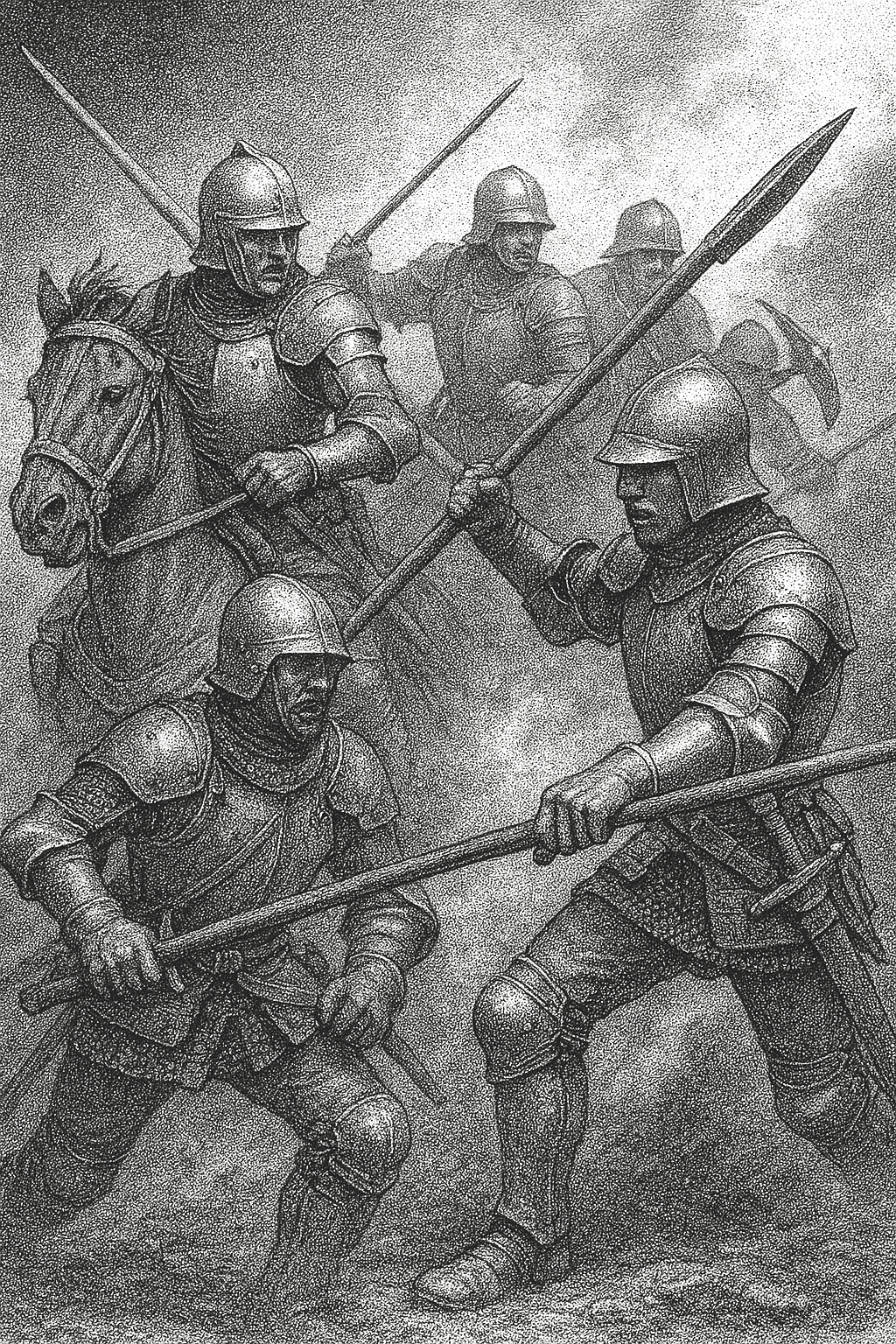
The cavalry sat heavy in the saddle: gendarmes with plate polished to a blinding, almost indecent shine, as if vanity alone might stop a Swiss pike. Their lances — thirteen feet of tapered doctrine — swayed with the promise of a first strike meant to erase whatever stood in front of them. Behind them waited the mounted archers, lighter, hungry, and far more cynical, whispering gutter jokes about who would die first if the infantry failed to hold. The infantry themselves clumped together in the half-ordered blocks Charles the Bold insisted would remake Europe: pikemen drilled to the inch, halberdiers cross-bred with butchers, handgunners squinting through powder-fog dreams of thunderous salvation. Between them rattled artillery teams, sweating under shirts filled with the fear of premature detonation.
On campaign, this organism behaved like a single creature with armor for skin and ambition for bone. And at moments — rare, sharp, surgical — it even worked: a living demonstration of Charles’s vision of a permanent army, drilled like a monastic order, equipped like a king’s ransom. When the drums hit their cadence, when the flags snapped overhead, when the cavalry leaned forward and the gunners lifted their slow matches together, the Ordonnance Companies looked invincible.
But that illusion never survived long. Beneath the armor, they were human: too proud, too methodical, too convinced the world would wait for them while they dressed the line. The Swiss had no patience for such aesthetics. The French even less. And somewhere in the fog at the edge of every Burgundian battle, the future was already sharpening a pike.
The origins of this thing — this proto-modern army — lie in Charles the Bold’s personal mania for order. His father had ruled through intrigue and charm. Charles preferred geometry. He wanted squares of infantry moving like chess pieces, cavalry charges timed to seconds, artillery that sang in perfect unison. The Burgundian state was rich enough, for a moment, to indulge him: Flemish revenues, Low Countries textile wealth, and a treasury that could pay men year-round. Thus the Ordonnance system was born — not as an evolution of feudal levies, but as a declaration of war on chaos itself.
The Companies were divided into standardized units: cavalry companies with tightly defined roles, infantry bands with regular pay, and the artillery train, whose bronze monsters were cast in the ducal foundries like relics of a new cult. Their captains were appointed by the duke and expected to instill a monastic obedience. In theory. In practice, many were swaggering nobles who treated their companies like personal theaters, competing in brutality, discipline, and display.
Psychologically, the brotherhood had two faces. On parade, they were the polished knights of a meticulously painted Burgundian miniature. On campaign, they devolved into something rougher: a fraternity of shared hunger and cold steel, held together by the duke’s will and the knowledge that defection to the French or Swiss would mean a shorter life and a ruder death. Their discipline was real, but brittle. Their confidence was immense, but hollow. And their loyalty — that famous Burgundian loyalty — was less about love and more about gravity. Charles pulled them by force of ego alone.
Their initiation wasn’t mystical. It was worse. It was administrative. You received your contract, your pay, your place in the formation, your expectations of conduct, your punishments for disobedience. It was the bureaucratic birth of the European standing army, and it terrified men who still believed war should feel like freedom. For the infantry, failure to hold the pike line meant execution. For the cavalry, breaking formation meant disgrace more lethal than death. For the gunners, mishandling powder meant the kind of explosion that left pieces of men clinging to cannon wheels like grisly ornaments.
Their weaponry defined them. The cavalry rode with lances, maces, and swords designed for blunt, bone-collapsing work. The infantry wielded eighteen-foot pikes, glaives, and halberds whose axe-heads split skulls like rotting gourds. The handgunners, still half-incompetent as a battlefield class, prayed their serpentine locks wouldn’t misfire. The artillery — the real jewel — hurled iron balls that tore lines of infantry open like wet cloth. This was the company’s offensive personality: slow, methodical, crushing, beautiful in the way glaciers are beautiful while swallowing villages.
Defensively, they were less divine. Burgundian squares could hold if the terrain favored them and their discipline held. But when struck by the Swiss — whose pikes were faster, whose morale was simpler, whose hunger burned hotter — the Ordonnance lines buckled. At Grandson, the Burgundians never had a chance to show their drill; they panicked before the Swiss ever truly closed. At Morat, their defensive preparations dissolved under a storm of alpine fury. And at Nancy, their final hour, they died in snowdrifts while the future marched over their corpses.
Through all this, their ruthlessness was genuine. Captured rebels were tortured with inventive precision: ears and noses taken as warnings, hands removed for insolence, slow strangulation by garrote for treason. The Companies were Charles’s mailed fist, and he was not gentle with subjects or enemies. Their reputation for brutality was not propaganda — it was administrative policy.
Yet the brotherhood had flashes of brilliance. Their artillery train was among the finest in Europe. Their cavalry charges, when executed in full weight, were devastating. Their uniforms, banners, and pageantry inspired awe and terror in equal measure. They represented the last, grand attempt to build a centralized Burgundian state capable of standing toe-to-toe with France and the Swiss Confederation. And for a few years, they succeeded.
Then Charles died face-down in a winter ditch, half-eaten by wolves, his armor a ruin. With him died the cohesion of the Ordonnance Companies. Mary of Burgundy inherited the shattered remnants. Maximilian of Habsburg reorganized them, contracted them, reabsorbed them, but the brotherhood that had ridden under the black-red-gold banners was already a ghost.
From 1477 onward, the Companies staggered through Europe like a wounded giant. Some captains defected to French service. Others sold themselves piecemeal to Habsburg battlefields. The artillery train was split, shipped, and rebuilt. Infantry units fused with German mercenaries. Cavalry units were renamed, repurposed, or quietly dissolved. The Companies lived on in fragments — in manuals, in drill routines, in the bones of future standing armies — but the brotherhood itself was dead long before 1500.
The legend that survived was not one of glory, but of ambition: the dream of a ruler who believed he could out-drill history. Their legacy is carved into every European army that came after — the idea that discipline, permanence, and logistics could replace feudal whim. But their ghost lingers most strongly in the Low Countries, in the tales of men who marched in geometric perfection straight into the jaws of a world that had already moved on.
The Burgundian Ordonnance Companies did not fade.
They shattered — loudly, gorgeously, fatally — and left their fragments inside the machine of modern war.
Notable Members
Charles the Bold (1433–1477)
More force of nature than duke, Charles forged the Ordonnance Companies out of gold, gunpowder, and stubbornness. He demanded a standing army decades before Europe was ready for one and drove his men into a rhythm of drill that bordered on madness. His charisma was gravitational: men followed him not because they loved him, but because resisting him felt impossible. He rode in the front rank during charges, daring fate to tell him no. Fate eventually obliged, leaving him dead in the snow at Nancy — and with him, the heart of his army.
Antoine de Bourgogne, the Bastard of Burgundy (1421–1504)
Half-brother to a line of dukes and twice as dangerous as any legitimate relative, Antoine fought as one of the Ordonnance cavalry’s most relentless captains. He had the soldier’s gift of reading terrain like scripture, turning ambushes into opportunities and retreats into counterblows. When Charles fell, Antoine became one of the last true Burgundians still breathing. He slid uneasily into Habsburg service, carrying the ghost of the Companies with him like an unlaid curse.
Philippe de Crèvecœur d'Esquerdes (c. 1418–1494)
A hardened commander who understood the limitations of Burgundian pride better than the duke who employed him. He served Charles faithfully until the walls began to crack, then crossed into French allegiance with the weary pragmatism of a man who had seen too many doomed formations. His memory sits uncomfortably in Burgundian histories — half-traitor, half-prophet — but no one denied his steel.
If you want a shorter version for web display, a pull-quote selection, SEO metadata, or an illustration prompt for the Companies, just say the word.
Bibliography
Chronicles of Philippe de Commynes. Paris: 16th c. editions.
Molinet, Jean. Chroniques. Valenciennes, late 15th c.
Vaughan, Richard. Charles the Bold: The Last Valois Duke of Burgundy. Boydell Press, 2002.
de Sousa, P. The Burgundian Wars. Osprey Publishing, 2010.
Contamine, Philippe. War in the Middle Ages. Blackwell, 1984.
Van der Gracht, Hendrik. A Practical Guide to Maintaining Your Personal Artillery Train, 1493 (apocryphal; likely written by a drunken blacksmith with a grudge against horses).