The Byzantine Cataphractoi
(c. 600–1204 CE)
Eastern Roman Empire, Balkans, Anatolia, Levant, Caucasus
Brotherhood Rank #184
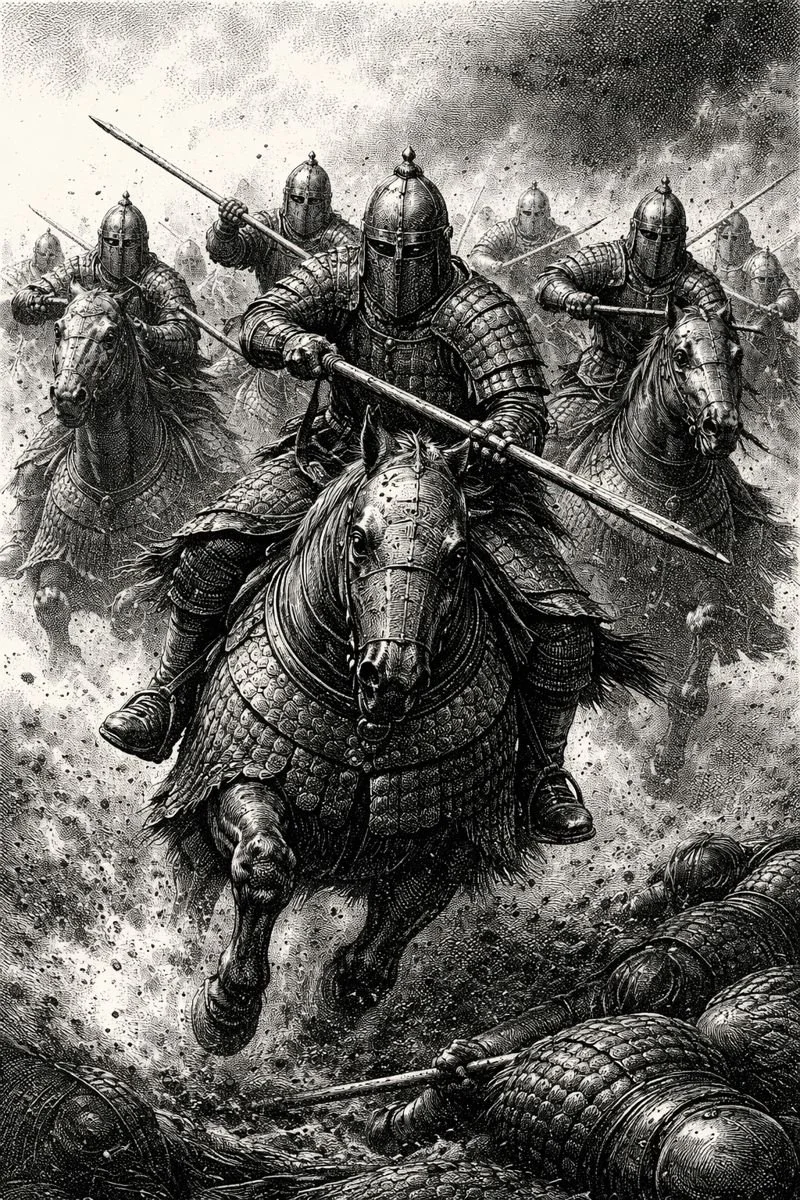
They did not arrive quickly. That was the first mistake enemies made when watching the horizon. Dust rose in layers, not clouds. Hooves struck the earth with a measured patience that felt wrong on a battlefield. Sunlight hit metal and did not scatter; it settled. The line advanced like a door being pushed shut on the world. Man and horse were sheathed together, ribs and muscle hidden under lamellar scales, faces reduced to slits and breathing holes. No war cries. No banners whipping themselves into frenzy. Just weight, direction, inevitability.
The Cataphractoi came forward as if the outcome had already been signed and sealed somewhere else. Their pace suggested confidence bordering on boredom, the posture of men who had rehearsed this ending since youth. Horses sweated inside armor built for them, nostrils flaring, eyes visible through iron cages. Lances angled down, not yet couched, a forest waiting for the wind. Somewhere behind them moved lighter cavalry, archers, skirmishers. Somewhere farther back, infantry closed ranks. But the Cataphractoi were the sentence. Everything else was grammar.
When contact finally happened, it was not the explosive chaos sung about in epics. It was compression. Shield rims cracked ribs. Lance heads punched through mail and bone, then disappeared into bodies that kept standing for a moment because momentum had not received the news yet. Horses slammed into men and did not stop. The line rolled over resistance like a slow tide that carried knives.
Later chroniclers would insist on thunder, terror, panic. That part is not wrong. But it misses the psychology. The Cataphractoi were not built to frighten first. They were built to finish. Fear was a side effect of watching something that should not move, move anyway.
They belonged to no single century. They were not a regiment with a birthday. They were a habit the empire could not break.
Iron Doctrine, Borrowed Bones
The Cataphract was not born Roman. He was adopted, improved, systematized, and then treated as if he had always been there. The eastern empire inherited the concept from the steppe and the east: Parthian and Sassanian heavy cavalry, armored men riding armored horses, shock troops that turned battlefields into narrow corridors of survival. Rome, pragmatic to the point of theft, took notes.
By the late antique period, and accelerating after the disasters of the 6th and 7th centuries, the Eastern Roman state leaned into this model hard. The old legionary machine had cracked under pressure from Persia, Arabs, Avars, and internal collapse. Infantry still mattered, but survival demanded something that could meet nomad mobility with imperial discipline. The Cataphractoi were the answer: state-sponsored weight.
They were expensive beyond reason. A single fully equipped cataphract represented years of wages hammered into iron, leather, and horseflesh. Armor for the rider, armor for the mount, multiple weapons, trained animals that did not panic under pain. This was not feudal improvisation. This was logistics weaponized. Only a centralized bureaucracy with tax records, arsenals, and patience could sustain it.
The empire paid because the alternative was extinction.
The Brotherhood That Wasn’t a Brotherhood
They were not a knightly order. No vows carved into marble. No saints watching from banners. The Cataphractoi were a brotherhood in the truest, colder sense: men bound by identical training, identical expectations, identical deaths. They belonged to the tagmata and thematic armies, rotated, reassigned, rebuilt. Faces changed. The organism persisted.
Their cohesion came from drill and doctrine, not romance. Manuals survive, especially the Strategikon attributed to Maurice, laying out how heavy cavalry should move, rest, fight, and be supported. This was not art. It was industrial violence written down so it could be repeated.
Discipline was severe. A cataphract who broke formation endangered everyone. Punishments were administrative and physical, and rarely recorded in detail because the empire assumed the reader understood what happened to men who endangered state assets. Superstition existed, but quietly. Prayers were said. Amulets were worn. But faith bent to function. God favored the prepared.
They trained to fight as a unit first and as individuals second. The horse was not a mount; it was half the weapon. Losing control of it was shameful. Panic was treason.
Anatomy of Impact
The Cataphractoi were not simple chargers. That is a later caricature built by enemies who survived only because the system failed around them. Properly deployed, cataphracts operated as the armored core of a combined-arms machine.
They advanced behind screens of horse archers and light cavalry. The enemy tired, broke formation, chased ghosts. Then the heavy line moved. Not fast. Fast enough. The goal was not pursuit but rupture. Once a line broke, lighter units exploited the wound.
Weapons reflected this philosophy. The kontos lance was long, often wielded two-handed, braced by mass rather than finesse. Maces and swords followed, tools for work inside a crowd. Bows were carried by some cataphracts, because flexibility mattered. Armor varied by era but consistently aimed for full coverage: lamellar or scale cuirasses, arm guards, greaves, helmets with face protection. Horses wore chamfrons and body armor that turned them into moving walls.
This made them resilient, not invincible. Heat killed men. Terrain betrayed them. A bog, a ravine, a forest could turn armor into a coffin. The Cataphractoi needed space, planning, and support. When they got it, they were monstrous. When they didn’t, they died expensively.
Psychology of the Armored Man
There is a specific mindset required to ride into combat knowing every enemy can see you, hear you, and aim for you first. Cataphracts learned to live inside armor, to accept reduced senses, to trust formation over instinct. Individual heroics were discouraged because they broke lines. Glory came from cohesion.
This produced a peculiar arrogance. Chroniclers hint at it obliquely: the way cataphracts are described as steady, unmoved, disdainful of light troops. They knew their value. They knew the empire invested heavily in their survival. That knowledge can rot a man or harden him. In the Cataphractoi, it did both.
Cruelty followed efficiency. Broken enemies were ridden down. Prisoners taken only when useful. There is no evidence of ritualized torture unique to the cataphracts, but battlefield pragmatism can be brutal without ceremony. Survivors learned that surrendering to armored cavalry often meant being ignored until later, if later came at all.
Against Persia, Against the World
The Cataphractoi proved their worth repeatedly in wars against the Sassanian Empire, where armored cavalry met armored cavalry in contests that looked less like battles and more like demolition tests. Victory went not to the bravest but to the side that coordinated better and ran out of mistakes last.
They adapted again as the Islamic conquests reshaped the eastern Mediterranean. Arab forces favored mobility, raids, and attrition. The Cataphractoi became anchors, used to blunt incursions, protect key routes, and smash overextended forces. They did not stop the loss of Syria and Egypt. They helped prevent the loss of everything else.
In the Balkans, they faced Slavs and steppe peoples who refused to fight the battles the empire wanted. Here, cataphracts were both overkill and liability, terrifying when they caught someone, useless when they did not. The empire learned to use them sparingly, surgically.
Decline by Dilution
The Cataphractoi did not fall in a single battle. They eroded. Fiscal strain reduced training. Armor quality slipped. Horses were armored less consistently. Feudalization crept in. The system that produced disciplined, centrally controlled heavy cavalry fractured into local magnates and mercenary solutions.
By the 11th century, something resembling cataphracts still existed, but the organism had changed. The Normans at Dyrrhachium exposed weaknesses in coordination and adaptability. The Seljuks at Manzikert shattered the strategic framework that sustained heavy cavalry in Anatolia. After that, cataphracts appeared more as echoes than sentences.
By the time Constantinople fell to the Fourth Crusade in 1204, the Cataphractoi as a coherent imperial brotherhood were gone. Heavy cavalry persisted, but the specific Byzantine synthesis, bureaucratic, doctrinal, and mercilessly patient, had dissolved.
They left behind a model that others copied badly, romantically, or both, and a memory of war fought not with speed or noise but with mass and certainty.
Notable Members
Nikephoros II Phokas (c. 912–969)
Born into a military aristocracy that treated war as inheritance, Phokas understood cataphracts not as symbols but as tools. As a general and later emperor, he leaned heavily on armored cavalry to reclaim territory in the east. Chroniclers describe him as austere, almost monastic, a man who trusted iron more than people. Under his command, cataphracts operated at their most coordinated and brutal. He died not in battle but in a palace coup, which feels appropriate for an empire that ate its own.
John I Tzimiskes (c. 925–976)
Short, sharp, and lethal, Tzimiskes used cataphracts with an aggressiveness that bordered on recklessness. He led from the front often enough to make chroniclers nervous. His campaigns in Syria showcased the shock power of heavy cavalry used decisively rather than conservatively. Tzimiskes understood spectacle as well as violence, and cataphracts provided both. He ruled briefly, violently, and effectively.
Belisarius (c. 505–565)
More famous for infantry and maneuver, Belisarius still relied on heavy cavalry as the spine of his armies. His genius lay in integration, using cataphract-like units as part of a flexible system rather than a blunt instrument. He respected their power and their limits. Later legends inflate his role, but the surviving evidence shows a commander who treated armored cavalry as precious and finite. Which it was.
They endure not as shining knights or tragic heroes, but as the memory of an empire that tried to survive by making war heavier than fear.
Bibliography
Procopius of Caesarea. History of the Wars. 6th century.
Maurice. Strategikon. Late 6th century.
Haldon, John. Warfare, State and Society in the Byzantine World, 565–1204. Routledge.
Nicolle, David. Byzantine Armies 886–1118. Osprey Publishing.
Treadgold, Warren. Byzantium and Its Army, 284–1081. Stanford University Press.
Anonymous. Instructions for Armoring Horses While Pretending the Treasury Is Fine. Constantinople, definitely real, trust us.