Escadrille Lafayette
(1916-1918)
France, Western Front
Brotherhood Rank #175
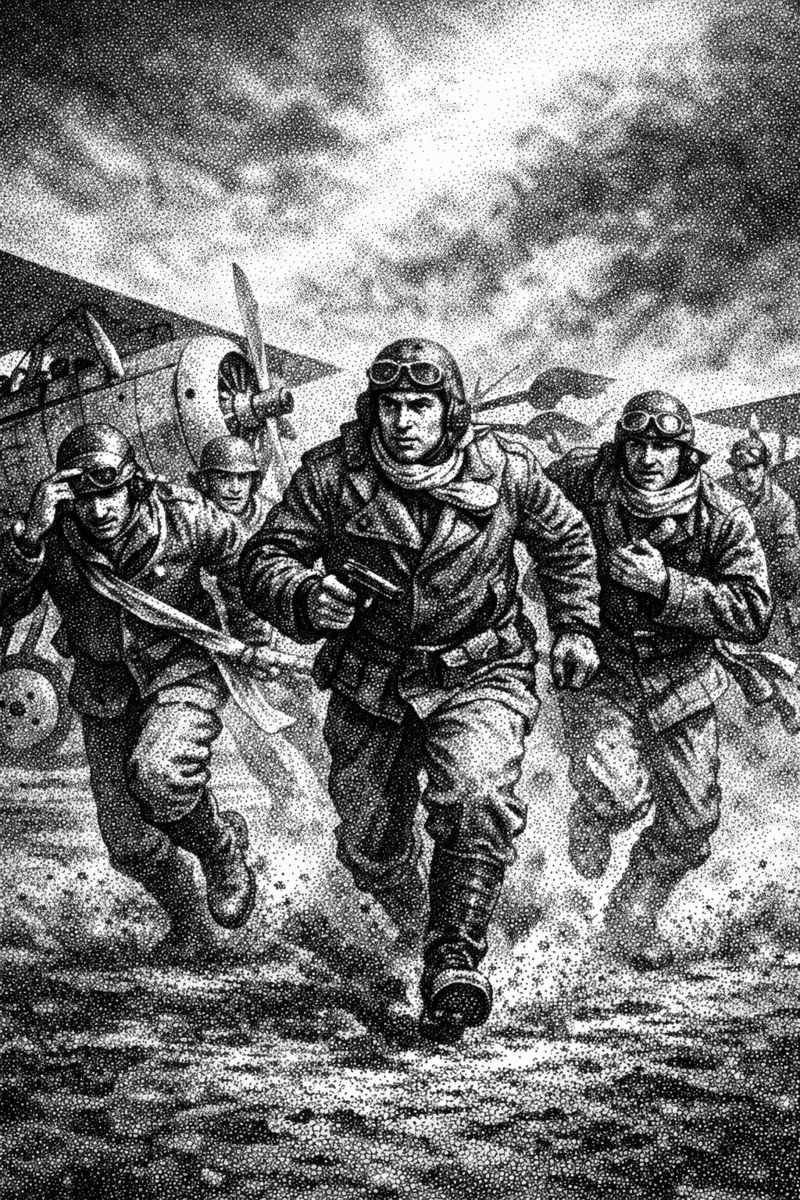
The engine coughs, clears its throat, then screams. Fabric wings shudder under the sudden violence of lift, and the sky opens like a wound that refuses to clot. Blue uniforms streak past in a blur of scarves and oil-stained bravado. On the ground, France is a chessboard of shell craters and graves. Above it, the Escadrille Lafayette climbs, light-framed aircraft clawing altitude with the arrogance of men who arrived early to a war they did not legally belong to.
They were Americans in French machines, flying under French command, bleeding for a republic that was not theirs. Their insignia, a Sioux warrior’s head borrowed from an imagined frontier, glared from fuselages as if daring gravity to argue. This was not a unit born of orders or conscription. It was a fever. A collection of volunteers who crossed an ocean to fight a war that most of their countrymen were still pretending could be ignored. They flew anyway. They died anyway.
The air war in 1916 was still a knife fight in a cathedral. Engines were underpowered, guns unreliable, wings held together by wire and prayer. The Lafayette pilots learned fast or vanished. Their patrols stitched lines over Verdun and the Somme, tracing the fronts where the earth itself had learned to scream. They came from prep schools and ranches, from Ivy League lecture halls and circus tents, bringing accents, debts, and romantic delusions into cockpits that had no patience for any of it. Combat stripped them down to reflex and nerve. What survived became culture.
France needed them. America pretended not to notice. The squadron existed in a legal fog, tolerated by Washington and quietly celebrated in Paris. Newspapers turned them into symbols. The men turned into mechanics of survival. In the air, there was no room for speeches. There was only the rattle of a Lewis gun, the smell of castor oil, the brief shock of seeing another human’s face at twenty meters while both of you tried to kill each other.
They flew because the war was there. They flew because the ground was worse. They flew because once the engine was running, stopping felt like treason against momentum itself. The Escadrille Lafayette did not charge trenches. It haunted the space above them, a thin, lethal brotherhood bound by altitude, speed, and the knowledge that if something broke, it broke alone.
Origins Without Permission
The Escadrille Lafayette began as Escadrille Américaine, a name that irritated German diplomats and delighted French propagandists. Official neutrality forced a rename, but the men remained stubbornly foreign. Backed by French aviation advocates and wealthy patrons, the unit formed in 1916 at Luxeuil-les-Bains, drawing Americans already serving in the French Foreign Legion or drifting through Europe with war in their eyes. The French Air Service supplied the machines, the training, the rules. The Americans supplied the bodies.
Their founding impulse was ideological but not pure. Some chased glory. Some chased absolution. Some chased the idea that modern war, fought in the air, might still allow room for individual courage. The squadron accepted them all, then let physics and enemy fire sort the useful from the dead.
The Psychology of Altitude
On the ground, the Lafayette pilots were loud, undisciplined, and prone to drinking like men trying to outrun tomorrow. In the air, they were meticulous predators. Patrol discipline hardened quickly. They learned spacing, lookout responsibility, and the quiet mathematics of energy fighting. The group developed a collective instinct for mutual support, not because it was noble, but because it was efficient. Lone wolves did not last.
Fear expressed itself sideways. Jokes sharpened into weapons. Nicknames stuck like shrapnel. Superstitions flourished. Scarves were worn a certain way. Mascots appeared in hangars. The Sioux head insignia became less symbol than talisman, a borrowed ferocity painted on linen and hope.
Machines That Forgave Nothing
They flew Nieuports mostly, fragile, nimble, and temperamental. The aircraft rewarded aggression but punished carelessness. A wing could fail under the wrong stress. An engine could seize without warning. The Lewis gun’s drum magazine demanded constant attention, and jams were frequent. Every patrol was a mechanical negotiation. Pilots learned to listen to vibrations, to feel airframe fatigue through their boots. The airplane was not a vehicle. It was a mood.
First Blood, Thin Margins
Combat came quickly. The Lafayette pilots tangled with German Albatros scouts flown by men who had already learned the war’s new grammar. Victories were claimed, confirmed when possible, disputed when not. Losses were certain. Accidents killed as efficiently as enemy fire. Training itself was lethal. The squadron’s casualty rate climbed, and with it, a reputation for recklessness that was only partly deserved.
French commanders saw in them a tool for morale as much as reconnaissance. The Americans flew hard, took risks, and wrote letters that newspapers loved. Germany noticed them too. Enemy pilots learned the insignia. Engagements sharpened. The sky above the Western Front became a ledger of grudges.
Discipline, Such As It Was
Formally, discipline was French. Informally, it was peer-enforced. A pilot who broke formation endangered everyone. That was not forgiven. Punishment was rarely official. It was colder. Ostracism. Silence. The refusal to fly close. In the air, distance was death. The brotherhood understood that without needing it explained.
Initiation was simple. Survive. Learn. Contribute. Those who did became part of the rhythm. Those who did not were remembered briefly, then replaced by the next arrival carrying a new scarf and old illusions.
Mythmaking Under Fire
The Escadrille Lafayette became a story while it was still bleeding. Posters, articles, and speeches turned it into proof of transatlantic destiny. The men themselves were less certain. They saw the gap between narrative and wreckage. They also understood the utility of myth. Morale mattered. Funding followed attention. The brotherhood learned to live inside its own legend without believing it completely.
Some stories hardened into tradition. Others were quietly ignored. Later chroniclers would argue over tallies and tactics, over who taught whom. The record is uneven, shaped by propaganda and memory. What remains clear is the tempo. The Lafayette pilots flew often, fought hard, and absorbed losses that would have broken a less voluntary unit.
Transition Without Triumph
In 1917, the United States entered the war. The Lafayette Escadrille dissolved into the American Expeditionary Forces Air Service, its pilots reassigned, its identity officially ended. The brotherhood scattered across new squadrons, carrying habits and scars with them. The myth transitioned more easily than the men.
Some adapted. Some did not. The war continued to chew through aviators with democratic efficiency. By 1918, air combat had evolved into something colder and more organized. The Lafayette style, born in improvisation, felt almost antique. Its influence persisted anyway, in training doctrines and attitudes toward aggressive patrol work.
What Remained
Measured strictly, the Escadrille Lafayette did not win the air war. No single squadron did. Its confirmed victories were modest compared to later units. Its losses were heavy. Its strategic impact lay elsewhere. It proved that airpower could attract volunteers willing to die for ideas not yet ratified by their governments. It demonstrated how quickly culture could form under pressure, and how myth could outpace fact without entirely losing touch with it.
The brotherhood left behind photographs of young men leaning against aircraft, smiling like the future was still negotiable. It left behind graves scattered across French soil. It left behind a template for how Americans would imagine air combat for decades, equal parts romance and math, courage and machinery.
The Escadrille Lafayette did not conquer territory. It occupied a moment. A thin band of sky where neutrality failed, engines ruled, and a borrowed emblem stared down gravity and dared it to blink.
Notable Members
Raoul Lufbery (1885–1918)
Lufbery was the squadron’s gravitational center, a mechanic turned killer who treated the airplane as a system, not a stage. He flew methodically, conserving energy, choosing angles, and surviving long enough to make others better by proximity. His calm bordered on eerie. When he died, jumping from a burning aircraft rather than burn with it, the act felt brutally consistent with a man who never trusted machines to finish anything cleanly.
Norman Prince (1887–1916)
Prince was money, influence, and stubborn will bundled into a fragile airframe. He pushed the squadron into existence through connections and charisma, then paid for it with his life after a crash following a night mission. His death early in the unit’s life hardened its tone. Idealism did not get refunds.
Kiffin Rockwell (1892–1916)
Rockwell claimed the squadron’s first confirmed aerial victory, then died weeks later. His arc became a cautionary legend about how fast the air war collected debts. He flew aggressively, believed in closing distance, and left behind a reputation that outlived his hours aloft.
Edmond Genet (1896–1917)
Named for a revolutionary ancestor, Genet flew with the intensity of someone trying to earn history rather than inherit it. He survived early fights, adapted, and was eventually killed in combat. His letters fed the myth machine even as his loss underlined the unit’s mortality rate.
James Rogers McConnell (1887–1917)
McConnell documented the squadron with a writer’s eye and a pilot’s fatigue. His accounts remain valuable precisely because they resist polish. He died in action, leaving behind prose that reads like a ledger kept under fire.
Resources
Service Historique de la Défense. Archives de l’Aéronautique Militaire: Escadrille N.124. Vincennes.
McConnell, James Rogers. Flying for France. Boston: Houghton Mifflin, 1917.
Hall, Bert. En l’Air! New York: George H. Doran, 1918.
Franks, Norman, Frank Bailey, and Russell Guest. Above the Lines. London: Grub Street, 1993.
Morrow, John H. The Great War in the Air. Washington, D.C.: Smithsonian Institution Press, 1993.
DuPont, Étienne. How to Paint Courage on Linen and Call It Strategy. Paris: Imprimerie Fantôme, 1921. A book that does not exist, but probably should.
The Escadrille Lafayette endures as a reminder that some wars are entered sideways, without permission, and paid for in sky.