Iraqi Kurdish Peshmerga Brigades
(1991-2003)
Northern Iraq, Zagros Mountains, Kirkuk–Erbil–Sulaymaniyah Axis
Brotherhood Rank #176
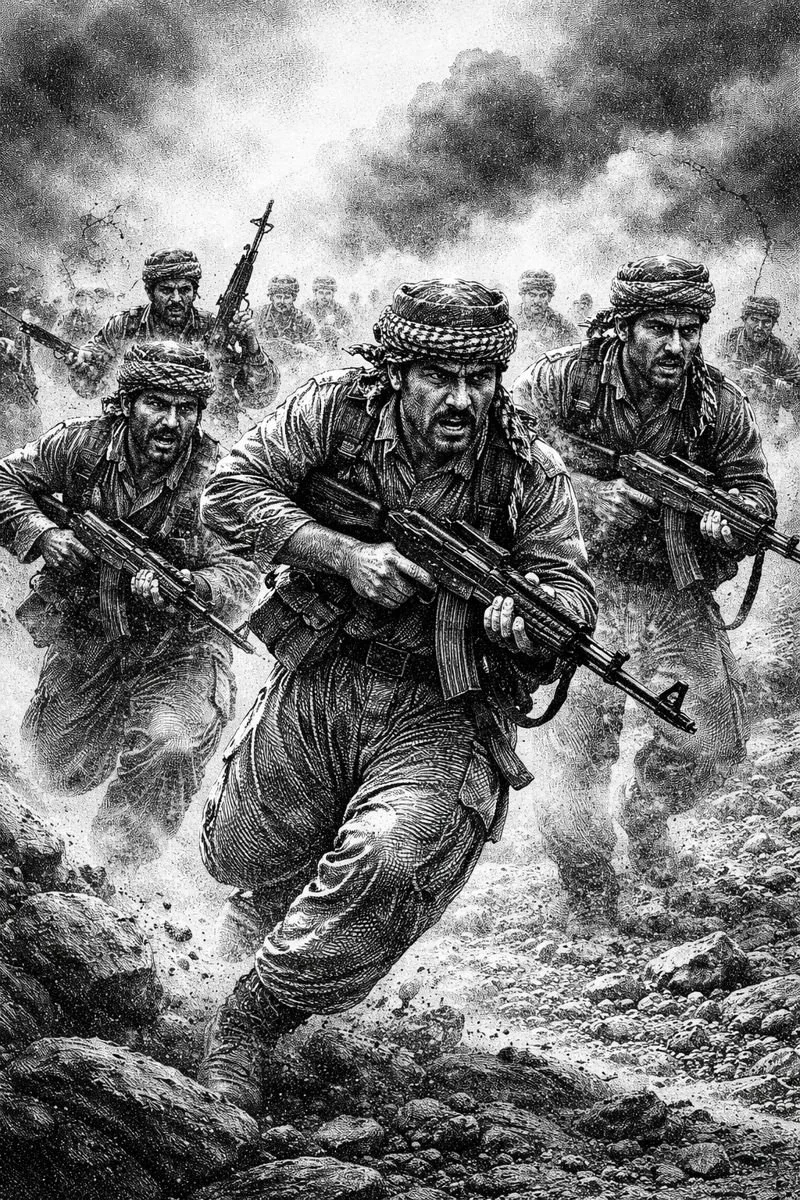
They were already moving when the border lights went out. Columns of men climbing goat paths with Soviet steel slung loose, boots splitting shale, breath frosting in the Zagros night. Radios whispered and died. Somewhere behind them a village burned because history always demands a down payment. The brigades did not march in parade order or even agree on what number they were. They moved like weather. A ridge would erupt with gunfire, then go quiet. A valley would swallow a platoon, then spit it back blooded and laughing. In 1991 the Iraqi state was cracked open and the north inhaled. The Peshmerga came up out of decades of guerrilla habit, half militia, half inheritance, carrying the old oath in their teeth: face death.
They were called the Peshmerga because that was the oldest word that still fit. “Those who face death.” It sounded like a slogan until you watched them stand in a ditch with T-55 shells walking the berm and refuse to break. The brigades were not clean formations. They were bundles of clans, parties, grudges, and vendettas, stitched together by the sudden permission to exist armed and Kurdish in daylight. Some brigades swore to the Kurdistan Democratic Party, others to the Patriotic Union of Kurdistan, and many swore only to the mountain that raised them. In the spring after the Gulf War, when the uprisings tore open the north and the no-fly zone froze Baghdad’s wings, the Peshmerga became an army by necessity. The number 176 circulated later, a bureaucratic estimate, a headcount with delusions of precision. Contemporary Kurdish sources disagree on the exact tally of brigades in 1991 and again in 2003; the figure survives because it felt true to outsiders who needed something to count.
They learned fast. They learned how to hold a checkpoint with three rifles and a rumor. They learned how to bleed without panicking and how to trade space for time. They learned that victory in Kurdistan often looks like not losing today. The brigades were loud in the hills and quiet in the cities, and the cities were where the ghosts lived. Anfal had burned the villages and salted the wells in the late 1980s. Halabja’s chemical cloud still hung over every decision like a bad moon. This was not an army that believed in mercy as policy. It believed in survival as a ritual.
By 2003 they were older, thicker, scarred by civil war with themselves. The same men who had shared bread in 1991 had hunted each other in the mid-1990s, KDP against PUK, American mediation stapling the wound shut. The brigades went into the U.S.-led invasion as partners who knew the terrain and the grudges. They did not need maps. They needed assurances, and even then they kept their own ledgers.
The Shape of the Thing
The Peshmerga brigades behaved like a distributed nervous system. Orders traveled by party channels and kinship before they ever reached a formal command post. Discipline was situational, not ceremonial. A fighter could disobey a party officer and still be obeyed by his squad if his instincts were trusted. Punishment, when it came, was local and ugly: ostracism, disarmament, a beating that left the message without paperwork. Myths say initiations were formalized with oaths and flags; contemporaneous accounts suggest initiation was the first firefight that didn’t kill you.
Their psychology was shaped by altitude and memory. Mountain fighters cultivate patience and suspicion. They hoard ammunition and favors. They understand that a ridge can be a fortress until it isn’t. The brigades’ humor was black and economical. Jokes were about which cousin would steal your boots if you died. Songs remembered massacres with melodies light enough to carry.
Weapons, Fieldcraft, and the Way They Killed
They fought with what they had. Kalashnikovs of mixed parentage, PKM machine guns, RPG-7s with fuses older than the men firing them. Mortars were prized because they made the enemy keep their heads down without committing bodies. Heavy armor was rare and usually captured. Logistics ran on mule trains and pickup trucks, on diaspora money and party warehouses. Ammunition was counted like grain.
Their battlefield personality favored ambush and defense, then sudden pressure when the enemy faltered. They were not enamored of frontal assaults unless honor demanded it or the ground forced the issue. Per-capita lethality is hard to measure and disputed in modern scholarship; what is attested is their efficiency at denying movement. Roads were the arteries of Iraqi power. The brigades learned how to clot them.
Ruthlessness came from history, not doctrine. Prisoners were sometimes held and traded; sometimes they were not. There are credible reports of summary executions in the early 1990s during the chaos of liberation and again during intra-Kurdish fighting. Kurdish sources tend to frame these as reprisals or breakdowns; human rights organizations documented patterns that refuse the comfort of accident. The brigades carried the stain because stains don’t ask permission.
Civilians, Cities, and the Civil War Scar
The Peshmerga’s relationship with civilians was intimate and volatile. They were sons of villages and enforcers in towns. Protection and taxation were often the same act. In Erbil and Sulaymaniyah, uniforms blurred into civilian clothes by nightfall. When the Kurdish civil war ignited in 1994, the brigades split along party lines and turned their fieldcraft inward. Checkpoints became traps. Neighborhoods learned new passwords every hour. The fighting hollowed out trust and killed the illusion of a single Kurdish fist.
The 1998 Washington Agreement cooled the blood. It did not cauterize it. The brigades emerged chastened and more professional on paper. Training improved. Coordination improved. Suspicion remained.
2003: Partners Without Illusions
In the run-up to the invasion of Iraq, the brigades rehearsed quietly. American Special Forces teams arrived with radios that worked and promises that did not always translate. The Peshmerga offered guides, flanks, and the kind of local intelligence that comes from grudges. Together they cracked Ansar al-Islam in the northeast, a campaign well documented and often mythologized. Kurdish accounts emphasize valor and inevitability; U.S. after-action reports emphasize coordination. Both are true in their own ways.
The march on Kirkuk was the old dream and the old fear. The brigades moved fast, occupying before Baghdad could reassert. The city did not erupt into the bloodbath some predicted, but the occupation seeded future fights. Flags went up. Files disappeared. Scores were settled quietly. The brigades understood that history would argue later; they were busy now.
Legend, Paperwork, and What Survived
The legend of 176 brigades persists because it compresses chaos into a number. Modern historians disagree on whether such a neat count ever existed outside donor briefings and postwar bureaucracies. What is attested is a mosaic of formations that behaved like an army when threatened and like parties when unobserved. Songs and memorials simplified the story. Party media polished it. The mountains remembered everything.
After 2003, the brigades were folded, renamed, professionalized, and partially nationalized within the Kurdistan Regional Government. Salaries replaced smuggling. Ranks replaced nicknames. Some men adapted. Some did not. The culture did not evaporate. It learned new uniforms.
The Peshmerga brigades left scars on the ground and in the archives. They made northern Iraq governable on their terms and ungovernable on anyone else’s. Their greatest trick was surviving long enough to be accused of normality.
They are still there, in photographs with flags too bright and eyes too old, proof that a people can turn memory into a weapon and then refuse to put it down.
Notable Members
Mustafa Barzani (1903–1979)
Founder, patriarch, and gravitational field. Barzani did not command these brigades in time, but his shadow set their posture. He taught mountain war as inheritance and exile as training. Men who never met him swore by his habits. The brigades carried his stubbornness like a spare magazine.
Jalal Talabani (1933–2017)
Party boss turned statesman with mud on his shoes. Talabani’s PUK cadres formed many of the eastern brigades’ spine. He could broker and betray with the same handshake. Fighters respected him because he understood that politics is just war with better lighting.
Masoud Barzani (b. 1946)
Heir with a ledger. Under his watch the KDP-aligned brigades learned administration without forgetting ambush. Critics call him a strongman; supporters call him continuity. Either way, the brigades learned how to survive donors.
Hero Ibrahim Ahmed (1925–2016)
Ideologue, organizer, and chronicler. His influence threaded through the PUK brigades’ culture. He insisted on narrative discipline even when bullets disagreed. Fighters learned that history could be ammunition.
Kosrat Rasul Ali (b. 1958)
Field commander with a taste for momentum. Rasul’s units exemplified the brigades’ offensive temperament when the window opened. Wounded more than once, he carried scars as credentials. Men followed him because he went first.
Resources
McDowall, David. A Modern History of the Kurds. London: I.B. Tauris, 2004.
Human Rights Watch. Iraq’s Crime of Genocide: The Anfal Campaign Against the Kurds. New Haven: Yale University Press, 1995.
Pollack, Kenneth M. Arabs at War: Military Effectiveness, 1948–1991. Lincoln: University of Nebraska Press, 2002.
Gunter, Michael M. The Kurdish Predicament in Iraq: A Political Analysis. New York: St. Martin’s Press, 1999.
U.S. Department of Defense. Operation Iraqi Freedom After Action Reports: Northern Front. Washington, D.C., 2004.
Al-Zagrosi, Shêrko. Minutes from a Meeting That Never Happened, Recovered from a Burned Teahouse. Erbil: No One’s Press, n.d. (out of print, allegedly edible).
They won the right to be counted and paid for it by becoming permanent suspects in their own history.