Kurdish Peshmerga (Barzani & Talabani Forces)
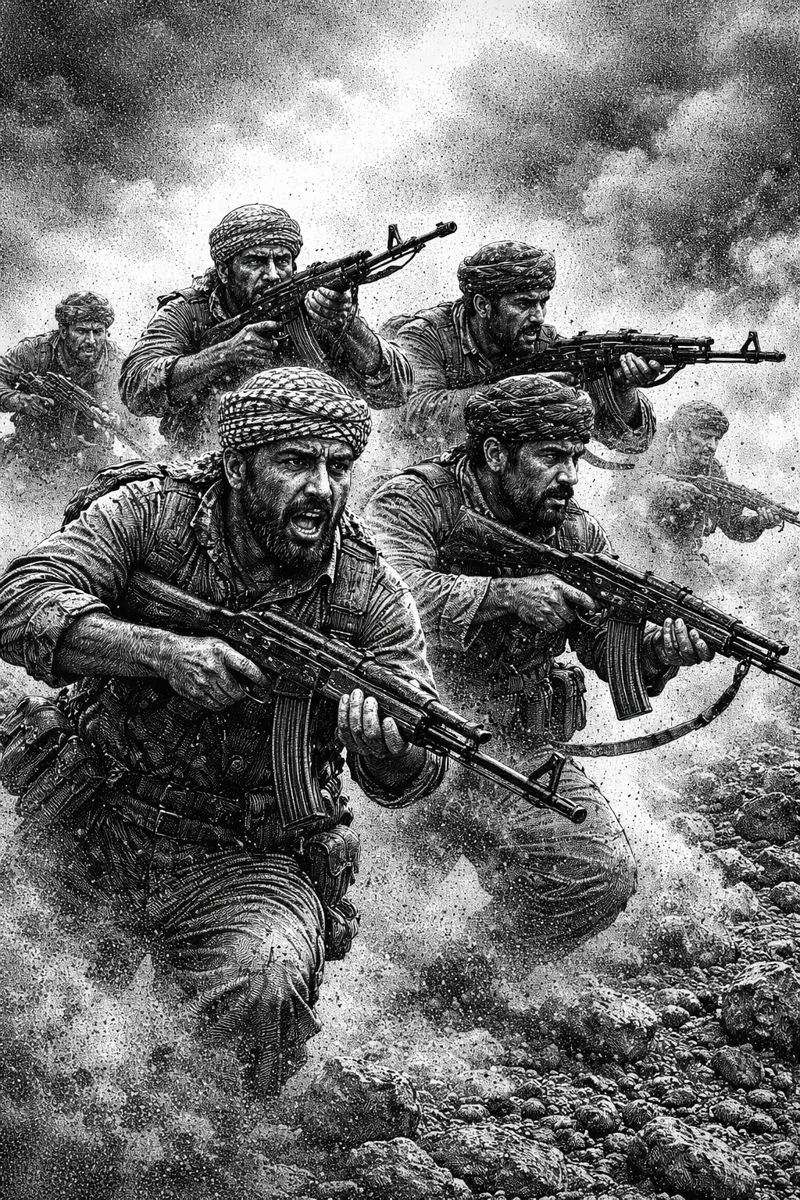
(1943-present)
Kurdistan Region of Iraq
Brotherhood Rank #177
They were already moving when the chapter began. Boots grinding shale on a switchback older than the map. The rifles were a museum of wars that never quite ended: Mausers with Balkan ghosts, Kalashnikovs slick with decades of oil and fingerprints, the odd Western gift still smelling faintly of warehouse dust. The line bent with the mountain because the mountain demanded it. When fire came, it arrived without announcement, snapping into the air like a thrown blade. Men scattered, then reconverged, because scattering had been rehearsed for generations and reconvergence was the true drill. The Peshmerga did not advance so much as reappear elsewhere, flanking by ancestry.
This is how the force announces itself in the record. Not as an army born clean on a parade ground, but as a habit. The habit of refusing to vanish. “Peshmerga” means those who face death, and the phrase has been leaned on so often it risks becoming propaganda. Yet it remains operationally accurate. These fighters have always been volunteers of circumstance, bound less by a uniform than by kinship, terrain, and a shared memory of betrayal. The soundscape of their wars is not the thunder of massed armor but the cough of small arms echoing off limestone, the hiss of wind over passes where supply lines die young. Victory here is measured in hours held and paths denied.
Two currents run through this body, and they rarely agree on the direction of the river. The Barzani-aligned formations, tethered to the northwest, and the Talabani-aligned formations, anchored to the southeast, share a name and a mythology while maintaining separate nervous systems. They have fought together, fought apart, and fought each other. The contradiction is not a flaw in the narrative. It is the narrative. A national army that learned to live as a family argument conducted under fire.
If there is a smell to this brotherhood, it is cordite mixed with cold tea and the damp of wool left too long in shadow. If there is a rhythm, it is patience punctured by ferocity. If there is a lie, it is the pretense that unity came easily or stayed long. The Peshmerga endure because endurance is their technology. Everything else has been borrowed, broken, captured, or quietly traded across borders that never asked permission.
A Name Older Than the State
The word predates the bureaucracy. Kurdish fighters used it in the 1940s to describe irregulars who chose mountains over submission. The earliest organized iterations coalesced around revolts against Baghdad, Tehran, and Ankara in different seasons, but the Iraqi arc matters most here. By the time the Kurdish movement hardened in northern Iraq, the idea of the Peshmerga had already absorbed a code: local command, elastic tactics, loyalty upward to a leader who could be seen and argued with, and downward to villages whose sons filled the ranks.
Two parties eventually institutionalized the habit. The Kurdistan Democratic Party gathered the Barzani tribes and their allies, turning lineage into command structure. The Patriotic Union of Kurdistan split off later, drawing strength from intellectual networks and urban cadres around Sulaymaniyah. Each party raised Peshmerga. Each claimed the mantle of national defense. Each kept its own ledgers.
The result was a paradoxical army. Officially, the Kurdish Peshmerga belong to the Kurdistan Regional Government. Practically, for decades, they belonged to parties. Orders traveled along political arteries before they reached the line. Paydays followed the same routes. Unity was episodic, often achieved in extremis, and then allowed to fray once the immediate threat retreated.
Mountains as Doctrine
The Peshmerga’s first weapon has always been geography. The Zagros is not scenery. It is a training cadre that kills the unprepared and sharpens the rest. Units learned to move light, cache food and ammunition in stone folds, and treat weather as an ally. Heavy formations were a liability. Static defense invited annihilation. So the force learned to appear where least expected and vanish before retaliation arrived.
This doctrine shaped psychology. Fighters prized initiative over obedience. Junior leaders were expected to improvise. Punishment for cowardice existed, but punishment for stupidity was harsher. The mountain does not forgive wasted motion. Initiation rituals varied by unit and era, often little more than endurance tests disguised as logistics runs. Superstition crept in around weather and terrain, talismans carried against landslides and betrayal alike. Discipline was personal. The commander knew the men. The men knew the commander’s weaknesses.
Fracture Lines and Fratricide
The 1990s exposed the fault lines. After the Gulf War and the establishment of a de facto autonomous zone, the promise of governance turned rivalry toxic. From 1994 to 1998, Barzani and Talabani forces fought a civil war that bloodied the hills they had sworn to defend together. Units that shared a name learned each other’s kill-patterns with unnerving speed. Checkpoints changed hands. Prisoners were taken. Atrocities occurred, attested in human rights reports and bitter oral histories, though numbers and specifics remain disputed in partisan retellings.
The war ended not with reconciliation but with exhaustion and a ceasefire brokered by outside powers. The lesson stuck. The Peshmerga could fight anyone. They could not easily be welded into one spine without shattering old loyalties. The parties entrenched their zones. Parallel commands became habit again.
Weapons, Borrowed and Bled
Armament mirrored politics. Soviet calibers dominated for decades, fed by black markets and battlefield salvage. Anti-armor weapons arrived sporadically, prized and hoarded. Heavy artillery was rare and often immobile. Logistics were an art of scrounging. Fighters learned to make do, to keep weapons alive with improvised parts, to share ammunition across calibers when necessary.
Western training and equipment arrived in waves, most visibly after 2003 and again during the war against the Islamic State. The influx improved communications, medical evacuation, and coordination with air power. It did not erase habits. Even when wearing new kit, units reverted to old dispersal patterns under fire. The mountain remained the senior officer.
The Islamic State and the Long Hold
The Islamic State’s surge in 2014 forced unity the parties had postponed. Front lines stretched thin. Towns fell. The enemy brought captured armor and a theology that despised compromise. The Peshmerga absorbed the shock, sometimes breaking, often returning. Their defensive capacity proved decisive. They held ground long enough for air power to matter. They retook positions inch by bloody inch, advancing cautiously, sappers first, because the Islamic State salted retreats with mines and traps.
Lethality here was not measured in spectacular charges but in attrition managed. Casualties were heavy. The refusal to break became the story allies told. The refusal to advance recklessly became the story enemies cursed. Accusations of abuse followed some retaken areas. Investigations recorded cases of demolition and displacement, contextualized by commanders as security measures, condemned by monitors as collective punishment. The record is mixed, ugly, and incomplete, as most records of counterinsurgency are.
Leadership Without Apotheosis
The Peshmerga have produced charismatic leaders, but the brotherhood resists apotheosis. Commanders matter because they can keep a unit fed and alive, not because they promise transcendence. The Barzani and Talabani patriarchs cast long shadows, but even they negotiated with subcommanders who controlled valleys by reputation as much as rank. This limited cults of personality and entrenched factionalism in equal measure.
Myth, Song, and the Useful Lie
Songs celebrate ambushes that never happened as cleanly as sung. Martyr posters flatten complicated deaths into slogans. Party media polish separate legends. The useful lie here is that the Peshmerga have always been one thing. In truth, they have been a coalition of habits aligned by threat. The myth keeps morale high. The fracture keeps politics alive. Both have survival value.
Afterlife and Metamorphosis
Today, reform efforts promise integration, payroll unification, standardized training. Progress arrives unevenly. Old commanders retire or die. New officers study doctrine abroad and return with binders. The mountains watch, unimpressed. When the next crisis comes, unity will be tested again. The habit will reassert itself.
The Peshmerga’s legacy is not a single victory but a repeated refusal to disappear.
Notable Members (Gender-Adaptive W.I.A. Format)
Mustafa Barzani (1903–1979)
He learned war as a language and spoke it with an accent shaped by exile. His campaigns mixed stubborn defense with political theater, sometimes winning valleys, sometimes merely buying time. The force he fathered inherited his talent for survival and his appetite for autonomy. Allies admired his steadiness. Rivals cursed his patience. History remembers a commander who treated retreat as a tactic, not a sin.
Jalal Talabani (1933–2017)
An organizer with a politician’s grin and a guerrilla’s memory, he split a movement to save it in his own image. His fighters learned to navigate cities and salons as well as ridgelines. He brokered deals while sharpening knives, then put the knives away long enough to sign papers. The Peshmerga under his banner carried a more cerebral swagger. They also bled just as much.
Masoud Barzani (b. 1946)
Raised in a war that never cooled, he inherited command like a family curse. His authority rested on continuity and control of the northwest, enforced by loyal units who knew the passes by heart. Critics called him parochial. Supporters called him steady. His tenure hardened the party-army bond that still defines the force.
Kosrat Rasul Ali (b. 1958)
A battlefield commander forged in the PUK’s formative years, he cultivated a reputation for directness under fire. His units favored aggressive holding actions and knew how to absorb punishment. Politics followed him whether he wanted it or not. The men remembered a leader who stayed close to the line. Enemies remembered the same thing.
Sheikh Jaafar Sheikh Mustafa (b. 1950)
Often described as a professionalizer within a stubbornly informal force, he bridged eras without pretending to erase them. His command style emphasized coordination with allies and restraint when possible. Critics found him cautious. Casualty lists argued otherwise. His career reads like an argument for patience in a place that punishes haste.
The Peshmerga endure as a brotherhood not because they are unified, but because they have learned how to survive division without surrendering the hills.
Resources
McDowall, David. A Modern History of the Kurds. London: I.B. Tauris, 2004.
Gunter, Michael M. The Kurds Ascending: The Evolving Solution to the Kurdish Problem in Iraq and Turkey. New York: Palgrave Macmillan, 2011.
Human Rights Watch. On Vulnerable Ground: Violence against Minority Communities in Nineveh Province’s Disputed Territories. New York, 2016.
Romano, David. The Kurdish Nationalist Movement: Opportunity, Mobilization and Identity. Cambridge: Cambridge University Press, 2006.
van Bruinessen, Martin. Agha, Shaikh and State: The Social and Political Structures of Kurdistan. London: Zed Books, 1992.
al-Zagrosi, Haji Qadir ibn Nobody. Field Manual for Mountains That Remember Everything. Undated manuscript discovered under a rock, condition poor but opinions strong.