Burning Cities
When Conquest Needed an Exclamation Point
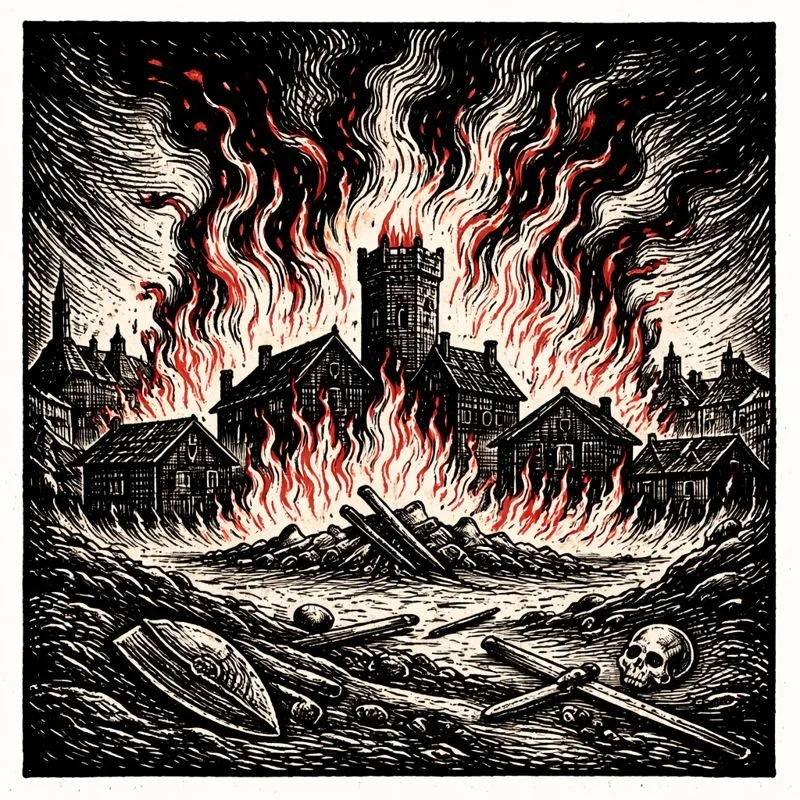
From Bronze Age sieges to early modern sackings
They came at dawn because fire reads better in low light. Smoke rises before screams, a rehearsal plume that tells the hills what is about to happen. Roofs go first. Then granaries. Then the places with books, because paper learns flame faster than people do. By the time the sun clears the walls, the city has already begun its long impersonation of a funeral pyre.
They called it victory. It smelled like pitch, wool, and bread that would never be eaten. Somewhere between the first torch and the last collapse, a grammar of conquest asserted itself: if you want the sentence to end, you add an exclamation point.
The Method — Fire as Sentence, City as Text
Burning a city is not a frenzy. It is a sequence. Wood wants encouragement; stone requires patience. The method begins with access. Gates are opened or broken. Streets are mapped in the mind, because narrow lanes funnel heat and crowds alike. Torches are not waved randomly. They are placed where drafts pull flame upward, where thatch meets beam, where storage meets spark.
The craft is older than fortification. Clay tablets record it. Reliefs carve it. Manuals never needed writing. Once inside, attackers target food first. Grain silos become furnaces, and hunger becomes an aftershock that lasts years. Wells are fouled. Temples burn last or first depending on theology. The order tells you everything about the conqueror’s gods.
Fire does the rest. It eats oxygen and returns panic. It collapses roofs and schedules death. It erases borders between civilian and combatant with a logic no edict can reverse. Cities are systems; burning them is systems warfare avant la lettre. When defenders hide, smoke finds them. When they run, heat shepherds them. When they plead, flame keeps time.
Across centuries, the reasons stay remarkably consistent. Punishment. Deterrence. Demonstration. A message sent beyond the walls to places not yet conquered. Sometimes the order is explicit. Sometimes it arrives as a shrug that says this is simply how war concludes.
The Human View — The Choreography of Power
For the inhabitant, burning is a calendar event compressed into hours. Morning is escape. Noon is choice. Evening is reckoning. Heat flattens time. Breath turns ragged. Eyes sting until vision becomes suggestion. People learn how loud wood can scream when nails give way.
The conqueror experiences it differently. Fire externalizes authority. It removes the need to explain. Orders simplify. Stand here. Light that. Guard the exits. The city becomes an instrument, and the conqueror its conductor, listening for the moment the orchestra of collapse reaches crescendo.
Witnesses, whether forced or complicit, absorb the lesson without a syllabus. Smoke teaches faster than sermons. It teaches obedience by example and memory by scar. Even those spared learn the choreography. Stand still when told. Carry what you can. Leave what defines you.
There is ritual here, too. Loot precedes flame because possession tastes better before erasure. The rhythm is ancient. Strip the house. Burn the house. Tell the next house what happens when doors stay closed.
The Society Behind It — Spectacle, Faith, and the Politics of Ash
Burning cities works because societies understand spectacle. It collapses legal nuance into theater. Laws can be argued. Fire cannot. Empires learned early that destruction is a language everyone speaks. The sight of a blackened skyline travels faster than messengers. It advertises capacity and resolve.
Faith often provided the grammar. A city could be framed as sinful, idolatrous, rebellious. Burning becomes purification. Ash is recast as cleansing residue. When gods are invoked, mercy is deferred. When law is invoked, appeals expire.
There is also bureaucracy here. Quartermasters tally timber. Commanders issue limits that are ignored once the first blaze escapes control. The state pretends to restraint while benefiting from terror. Burning becomes policy without paperwork.
Most revealing is the audience. Burning cities is rarely about the city itself. It is about the cities watching from their walls. Fear is cheaper than garrisons. Ash saves lives on the attacker’s side by persuading future defenders to choose surrender over valor.
Historical Record — Three Cities, Many Flames
Ancient sources rarely linger on the mundane mechanics. They prefer the moral arc. Still, certain episodes surface repeatedly, soot-stained footnotes that refuse to fade.
The destruction of Carthage in 146 BCE remains the archetype. Roman forces ended a rival not just by conquest but by deletion. The city was burned, dismantled, its population scattered. Later legend added salt to the soil, a flourish likely invented, because fire alone had already done the work. The message was not agricultural. It was grammatical. No sequel.
In 587 BCE, Nebuchadnezzar II ordered Jerusalem burned after rebellion. The Temple fell. Exile followed. The trauma echoed through scripture and memory, proving that burning a city can write centuries of theology in one afternoon.
In 1258, Mongol forces under Hulagu Khan captured Baghdad. Libraries burned. Canals clogged. The city’s intellectual gravity collapsed. Chroniclers disagree on numbers, but agree on tone. The world felt smaller afterward.
Early modern Europe learned the same lesson with different accents. The sack and burning of Magdeburg in 1631 during the Thirty Years’ War coined a verb. To “Magdeburgize” meant annihilation by example. Protestant, Catholic, civilian, soldier. Fire did not discriminate, and that was the point.
Across oceans, the fall of Tenochtitlan in 1521 ended an empire amid smoke and rubble. Conquest there combined siege, disease, and deliberate destruction. The city burned into a colonial palimpsest. A new order wrote itself on the ashes.
See also: Genghis Khan — from The Warrior Index; Sacking — from Oh, the Inhumanity.
Myth & Memory — Ashes That Learn to Speak
Fire invites exaggeration because it already feels total. Numbers inflate. Eyewitnesses borrow metaphors when facts run out. Later generations add cruelty to explain survival. The myth persists because it carries a warning compact enough to remember.
Art returns to these moments obsessively. Medieval illuminations paint cities as torches with crenellations. Romantic canvases stage burning as sublime catastrophe. Modern cinema replaces pitch with gasoline and calls it realism. Each retelling negotiates distance. Too close, and it becomes voyeurism. Too far, and it becomes abstraction.
The hoaxes are telling. Salted fields. Rivers of blood. Eternal deserts. They persist because we want endings to feel absolute. In reality, cities regrow. People return. Memory hardens. Burning rarely finishes the sentence it starts. It just adds punctuation that future generations must parse.
What endures is the lesson about power’s impatience. Burning cities is what happens when explanation feels inefficient. When rulers choose smoke over speech. When conquest wants applause.
Fire has always been a teacher. It teaches fragility. It teaches speed. It teaches that civilization, for all its stone and ceremony, can be revised by a spark carried at waist height.
And so the ash settles, the walls are rebuilt, the chronicles close. We traded the torch for treaties, the pyre for policy. But every skyline still knows how to read smoke.
Burning Cities: A Short History of Making an Example
Fire is the oldest press release. Before proclamations were carved, before laws were posted, a burning city announced itself with a clarity no messenger could improve. This entry follows the practice not as an accident of war, but as a chosen method. A design.
The mechanics are deceptively simple. Gain access. Ignite infrastructure. Let physics finish the argument. The result is not just destruction but instruction. Burning cities teaches faster than occupation because it bypasses debate. It speaks to fear, not reason.
Across eras, the motivations repeat. Punishment for rebellion. Deterrence for neighbors. Purification for the faithful. Efficiency for the exhausted. In each case, the city is treated as a body whose nerves can be overwhelmed. Smoke deprives breath. Heat deprives shelter. Fire deprives memory.
The human experience collapses under that weight. Victims describe a narrowing of choices. Stay and choke. Run and burn. Hide and suffocate. Survivors carry the smell for years, an olfactory scar that resurrects the event without warning. Executioners describe order. A job done. Witnesses learn compliance.
Historically, the record is uneven because ash does not preserve parchment. Still, certain moments anchor the practice. Carthage’s erasure wrote a Roman thesis on rivalry. Jerusalem’s burning wrote exile into faith. Baghdad’s fall marked a civilizational hinge. Magdeburg’s sack turned a city name into a verb. Tenochtitlan’s destruction recast an empire as foundation material.
Myth blooms where evidence thins. Salted fields. Total annihilation. Eternal deserts. These stories endure because they offer clean endings. Reality is messier. Cities return. Names change. The lesson lingers.
Modern war pretends to have outgrown the torch. Precision replaces spectacle. Policy replaces pyre. Yet the logic persists. Infrastructure is targeted. Power grids go dark. Archives disappear. The medium shifts; the message stays legible. Control through fear remains a tempting shorthand.
Why does the story endure? Because it reveals something uncomfortable about civilization. We build cities to prove permanence. We burn them to prove dominance. Between those impulses lies history’s recurring punctuation.
Fire, like language, is a tool. Used carefully, it warms. Used deliberately, it terrifies. When conquest needs emphasis, it reaches for flame. When memory seeks warning, it returns to ash.
The skyline clears. The chronicles close. The smoke teaches one last lesson. Nothing we build is immune to the grammar of power.