Crucifixtion
The Long Death of Empire
Roman Mediterranean World, 6th century BCE–4th century CE
They raised the timber early, while the air was still cool enough to pretend mercy might exist. Hammers rang. Ropes creaked. The condemned was stripped not for efficiency, but for clarity. This was not a killing meant to be quick or private. It was meant to be legible. From a distance. From a lifetime away.
They called it justice. It looked like carpentry.
A man hangs where roads converge, where traders pass, where children ask questions their parents refuse to answer. His breathing has already become an argument with gravity. Every movement costs something. Still, the body insists on living. That, above all, is the point.
The Method — A Death Designed to Take Its Time
Crucifixion was not a single technique but a family of variations unified by intent: prolonged, public, exemplary death. Its earliest forms appear in Assyrian and Persian punishment practices, but it was perfected, systematized, and exported by the Roman Empire, whose administrators understood theater as well as law.
The apparatus was deceptively simple. A vertical stake (stipes), often permanent, set along a road or city boundary. A horizontal beam (patibulum), carried by the condemned through jeering streets, was fixed at the site. Sometimes a simple T-shape, sometimes a †-shaped cross, sometimes no crossbeam at all. Variety mattered less than outcome.
The body was attached by rope, nails, or both. Contrary to centuries of tidy iconography, nails were not always driven through the palms but often through the wrists, where bone could bear weight. Feet might be nailed together, separately, or braced against a small wooden block (suppedaneum) not as mercy, but as delay. A seated peg (sedile) could be added, preventing collapse and extending the agony. The goal was not bleeding. Crucifixion kills slowly, not by loss of blood but by exhaustion.
Once raised, the mechanics began their quiet work. Hanging restricts breathing. To inhale, the victim must push up on nailed limbs, scraping torn flesh against wood or iron. Each breath is earned. Over hours or days, muscles cramp, joints dislocate, lungs fill incompletely. Carbon dioxide accumulates. Panic alternates with dissociation. Eventually, the body can no longer lift itself. Suffocation follows, assisted by dehydration, exposure, shock, and organ failure.
Death might take hours. More often, days.
If authorities grew impatient, they intervened. Legs were shattered with an iron bar (crurifragium), ending the upward push and hastening suffocation. But haste was a choice, not a requirement.
The Human View — What It Feels Like to Be Made an Example
For the victim, crucifixion is an education in limits. Hunger arrives early, then recedes. Thirst becomes total. The mouth dries, tongue swells, saliva thickens into glue. Sun scalds exposed skin by day; cold stiffens it by night. Insects arrive. Birds learn quickly.
Pain is constant but not uniform. It pulses, migrates, recedes, returns sharper. Nerve damage produces lightning strikes of sensation followed by numbness that feels like betrayal. Time stretches. Thoughts loop. Hallucinations are common. Some scream. Some bargain. Some fall silent long before the body gives up.
For the executioners, this is routine labor. Soldiers draw lots for clothing. Guards watch for friends or sympathizers who might interfere. Boredom is the enemy, not pity. Orders are orders. The cruelty is institutional, not personal. That distinction comforts those who need comfort.
For witnesses, the experience is calibrated confusion. The spectacle repels and instructs simultaneously. Children stare. Adults look away while absorbing the lesson. This is what happens when you defy the order that feeds you.
Crucifixion was never about the individual alone. It was choreography. Power arranging bodies in space.
The Society Behind It — Law, Faith, and the Geometry of Fear
Rome did not invent cruelty, but it bureaucratized it. Crucifixion was reserved primarily for slaves, rebels, pirates, and the stateless. Roman citizens were usually spared, granted quicker deaths. Status mattered. Humanity was tiered.
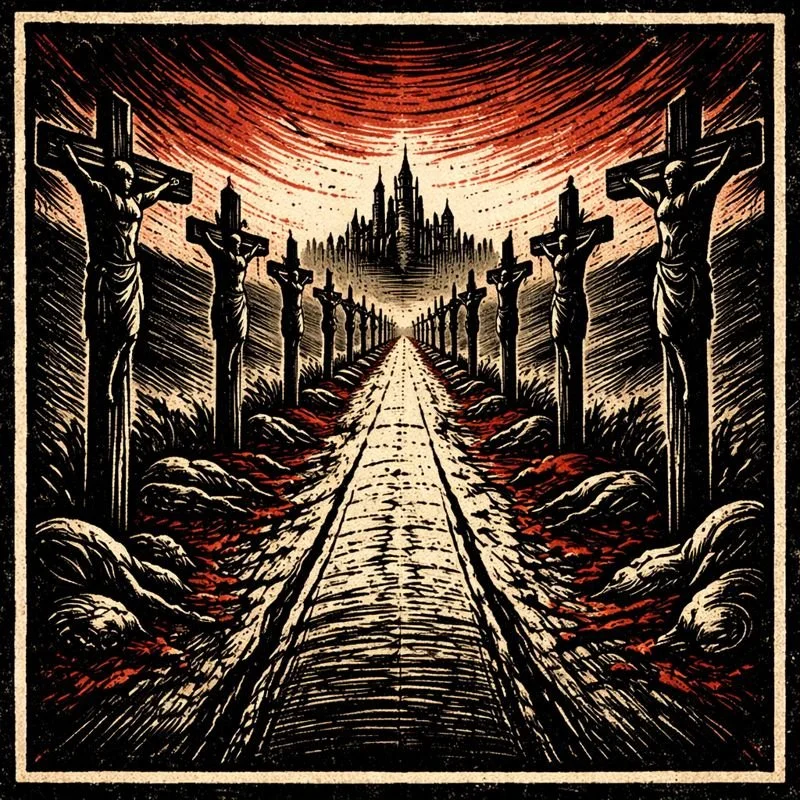
The punishment reinforced hierarchy with ruthless clarity. Slaves learned their replaceability. Provinces learned their limits. Rebellion learned its cost. Crucifixion transformed geography into warning: roads lined with bodies after revolts, hills studded with crosses like obscene orchards.
Religion absorbed the lesson too. To be crucified was to be cursed. In Jewish law, “cursed is anyone who hangs on a tree.” Rome understood this symbolism and exploited it. The cross was not just an instrument of death; it was an instrument of moral erasure.
Deterrence worked best when it lingered. Bodies were often left on the cross after death, denied burial, left to rot or be consumed by animals. This was not oversight. It was policy. To die was one thing. To be refused mourning was another punishment entirely, aimed at families and memory itself.
The Record — Famous Crosses and Forgotten Thousands
The most famous victim of crucifixion is Jesus Christ, executed around 30–33 CE under Roman authority in Judea. His death, intended as a routine suppression of dissent, became one of history’s great narrative accidents. The cross, meant to humiliate, was repurposed into a symbol of salvation. Rome lost control of the story.
Yet Jesus was one among countless others. Following the revolt led by Spartacus in 71 BCE, Roman general Crassus ordered approximately 6,000 captured slaves crucified along the Appian Way. Mile after mile of bodies marked the cost of challenging Rome’s economy. Travelers could not miss the message.
In 4 BCE, after the death of Herod the Great, Roman legate Varus crushed uprisings in Judea and reportedly crucified around 2,000 rebels. Josephus records mass crucifixions during the siege of Jerusalem in 70 CE, where space and timber eventually ran short. Improvisation replaced ceremony. The point had already been made.
These are the cases that survived ink and parchment. For every recorded crucifixion, thousands went unnamed, their bodies erased but their lesson retained.
(See also: **Spartacus — from The Warrior Index; Crurifragium — from Oh, the Inhumanity.)
Myth & Memory — From Instrument of Shame to Sacred Icon
Modern imagination has softened crucifixion with symmetry and restraint. Clean crosses. Modest wounds. Swift deaths. Reality was uglier and less merciful. Victims were often naked. Survival could extend beyond expectations. Mercy was optional.
Medical debates persist over the precise cause of death: asphyxiation, hypovolemic shock, cardiac rupture, exhaustion-induced respiratory failure. The truth is untidy. Crucifixion kills by accumulation. No single system fails first. The body simply runs out of ways to cope.
Art transformed the cross into a focal point of beauty and transcendence. Theology inverted its meaning. What was once Rome’s bluntest warning became Christianity’s central emblem. Empire built the scaffold. Faith claimed it.
Modern echoes linger in language and law. “Exemplary punishment.” “Making an example.” Public shaming. Slow bureaucratic deaths. We prefer cleaner methods now, quieter ones. But the logic survives.
The cross endures because it exposes a permanent human contradiction: our capacity to moralize cruelty while calling it order.
Civilization did not abandon the cross because it was cruel; it abandoned it because the message had already been learned.
Crucifixion: How to Kill a Body Without Killing the Lesson
Crucifixion is often remembered as a single story with a single victim. This is convenient. It allows history to tidy itself. In truth, crucifixion was a system, not an event. A technology of power refined over centuries to solve a specific problem: how to make disobedience unforgettable.
Unlike executions designed for efficiency, crucifixion prioritized visibility and duration. It required minimal equipment, little expertise, and abundant patience. Wood, iron, rope, and time. The Roman world had all four in surplus.
Physiologically, crucifixion is a masterclass in slow failure. The suspended body struggles to breathe. Muscles fatigue. Dehydration accelerates collapse. Exposure adds insult to injury. Infection follows. Consciousness flickers. The victim is forced into an intimate negotiation with gravity that cannot be won.
Psychologically, the punishment strips identity. Names are irrelevant. Crimes become secondary. The body itself becomes the message. This is why crucifixions occurred along roads, outside city gates, at borders. Movement was monitored by corpses.
After death, the punishment often continued. Bodies were left unburied, a violation of cultural and religious norms. This denial of rites was deliberate, aimed at families and communities. Grief was regulated. Memory was managed.
Famous cases draw attention, but they distort scale. Jesus of Nazareth’s crucifixion matters not because it was unique, but because it was typical. What followed was extraordinary. Rome intended deterrence. History delivered transformation.
Crucifixion faded not from moral awakening, but from administrative evolution. More efficient, less provocative methods replaced it. The spectacle became inconvenient. The lesson, however, endured. Power still performs. Fear still teaches.
Crucifixion reminds us that cruelty often wears a uniform, carries paperwork, and insists it is necessary. The wood may be gone. The design is not.
Cases Throughout History:
Spartacus - Crassus crucified six thousand survivors.