Starvation of Civilians
The Long Hunger as Policy
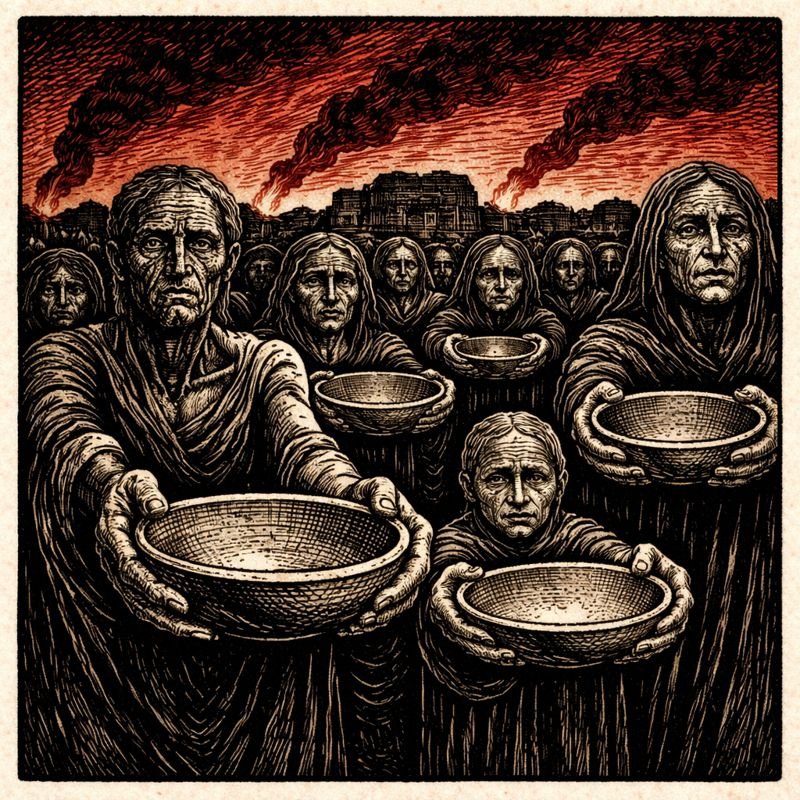
From Ancient Sieges to Modern Blockades
They noticed the bread first. Or rather, they noticed its absence. The ovens went cold before the people did. Markets emptied with a bureaucrat’s efficiency. Grain stores became rumors. Children learned a new sound at night, the wet, animal complaint of a stomach folding in on itself. Outside the walls, the enemy waited with patience sharpened to a science. Inside, time slowed, then thickened, then began to gnaw.
They called it siegecraft. They called it blockade. They called it security, necessity, leverage. The starving called it morning.
The Method — Hunger Engineered
Starvation of civilians is not an execution in the tidy sense. There is no scaffold, no blade, no sanctioned hour. It is a method that borrows the vocabulary of logistics and applies it to human biology. Cut the roads. Burn the fields. Sink the barges. Close the ports. Confiscate the stores. The tools are mundane, carts and ledgers, checkpoints and patrols. The mechanism is simple: deny calories long enough, and the body will collaborate.
Historically, the practice spans from Bronze Age sieges to twentieth-century blockades and twenty-first-century encirclements. City-states ringed by walls learned early that stone could hold only as long as grain did. Empires refined the lesson. Medieval armies understood that a patient camp could accomplish what an assault could not, with fewer dead on the attacker’s side and more leverage at the negotiating table. Modern states updated the kit with naval cordons, rail interdictions, and the language of sanctions. The physics did not change. The metabolism did not either.
Starvation as a method is attractive to power because it scales. It does not discriminate, and that is its efficiency. It reaches infants and elders, artisans and priests, the guilty and the unaccused, without ever requiring the executioner to meet their eyes. Time is the executioner. The calendar does the counting.
The Human View — Bodies Under Ration
From the inside, starvation is a series of small humiliations that add up to annihilation. Hunger begins as a signal, a sharp reminder. It becomes a constant companion, then a tyrant. The body sheds weight like a confession. Fat goes first, then muscle. The skin loosens. The mind narrows. Thoughts orbit food with religious devotion. The smell of boiling water can cause tears. People argue over peels, then steal them, then fight over the memory of them.
Psychologically, starvation is an eraser. Morality thins. Time fractures. Days blur into an endless present measured by ration lines and rumors. Parents calculate the unthinkable, who might eat today and who might wait. Witnesses watch neighbors change, cheeks hollowing, voices softening, eyes bright with a feverish focus. The ritual is not public, but it is communal. Everyone participates by surviving as long as possible.
From the outside, starvation allows distance. The soldiers man the perimeter. The officials draft notices. The diplomats discuss corridors and percentages. The violence is outsourced to biology. There is no splash, no scream, no spectacle to haunt the sleep of the besieger. Hunger dies quietly, in rooms and stairwells, behind curtains.
The Society Behind It — Order by Absence
Every society that deploys starvation against civilians tells itself a story. The story is always tidy. Hunger is leverage. Hunger is pressure. Hunger is unfortunate but necessary. Hunger will shorten the war, save lives, restore order. The logic is immaculate and bloodless, which is the point.
Culturally, starvation as policy reinforces hierarchy. It teaches who controls movement, who commands resources, who decides when mercy becomes economical. It converts food from sustenance into a political instrument. In religious frames, it is sometimes dressed as penance or trial. In legal frames, it is reframed as blockade, embargo, or sanction. In all frames, it performs the same lesson: obedience keeps you fed.
The theater of starvation is subtle. There are no gallows to gather around. The spectacle is duration. The message is sent not in a single afternoon but over months, in the slow collapse of bodies and the faster collapse of hope. It trains populations to associate survival with compliance and resistance with a shrinking plate.
Historical Record — The Long List
Antiquity provides early case studies. City sieges in the classical world regularly ended not with breached walls but with emptied granaries. Accounts describe inhabitants resorting to leather, vermin, and finally to each other, stories told with horror precisely because they were so common. Medieval chronicles repeat the pattern, adding a moral gloss. Hunger was God’s verdict delivered through men.
The early modern period refined starvation into strategy. Sieges were planned around harvest cycles. Armies marched to the calendar. The goal was not always surrender; sometimes it was depopulation, a quieter way to erase resistance. Colonial campaigns exported the method to wider landscapes, targeting fields and herds rather than walls.
The twentieth century industrialized the practice. Naval blockades starved cities an ocean away from the front. Wartime occupations rationed with deliberate insufficiency. Ideological regimes learned that controlling calories could discipline millions. The victims were named in reports, then reduced to numbers, then footnotes. The hunger remained personal.
Modern conflicts did not abandon the method; they rebranded it. Sanctions and sieges returned under humanitarian rhetoric, with exemptions and corridors that often existed more on paper than on roads. Civilians continued to lose weight while statements gained clauses.
Even in the modern era, starvation has not vanished into the archive. It has merely learned new paperwork. In the ongoing conflict involving Israel and the civilian population of the Gaza Strip, food, water, fuel, and medical supplies have repeatedly been restricted as instruments of pressure. Official language frames these measures as security controls or wartime necessity, yet the physiological outcome remains unchanged: civilians experience hunger not as collateral damage, but as a condition imposed by design. The method requires no scaffold, no executioner’s mask. It relies instead on control of borders, infrastructure, and time, proving that starvation remains one of the most administratively efficient forms of violence available to the modern state.
Myth & Memory — Hunger Remembered
Starvation leaves few monuments. There are no machines to display in museums, no blades to polish. Its artifacts are diaries, ration cards, bones, and recipes that stretch nothing into something. Artists and writers return to hunger because it is intimate. It makes villains of arithmetic and heroes of scraps.
Myths grow where records thin. Numbers swell or shrink. Intent is debated. Was it cruelty or consequence? Design or disaster? The argument itself becomes part of the memory, a way to manage guilt. Hunger narratives endure because they implicate everyone. You cannot watch without imagining your own kitchen.
In modern echoes, starvation appears as policy language stripped of verbs. Supplies are delayed. Access is restricted. Conditions are not conducive. The old method survives inside new sentences. Civilization insists it has progressed. Hunger keeps receipts.
The final irony is that starvation pretends to be invisible. It is not. It is written on the body, in the careful way the starving move, conserving energy, in the silence that replaces argument, in the way a city sounds when it is being eaten from the inside.
We learned to kill without blood and called it restraint, then waited for the hunger to finish the work.
Cases Throughout History:
Vercingetorix - Civilians starved in no-man’s land between barricades