Strangulation
the quietest sentence
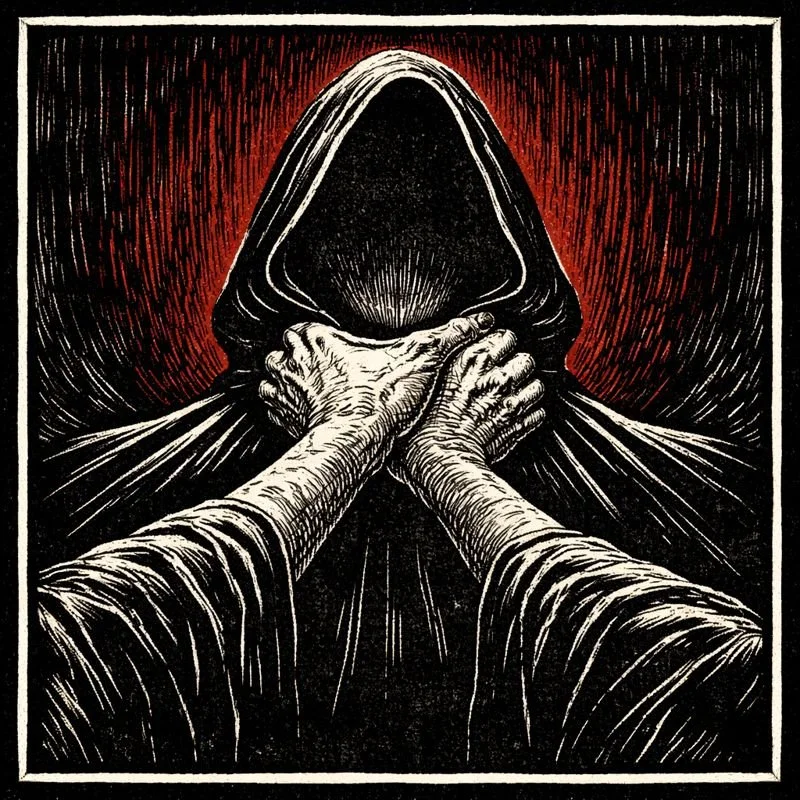
Across Eras and Empires
They learned quickly that death did not need spectacle. A rope, a pair of hands, a tightened cloth. No fire to tend, no blade to sharpen, no crowd required to keep its distance. Strangulation arrived without theater and departed without noise, a punishment that worked even when no one was watching. The condemned felt the world narrow. The witnesses felt relief. The authorities felt efficient.
It rarely looked like murder. That was the point. It looked like restraint that went a moment too long. Justice as a lingering touch. A correction that forgot to let go.
The Method | The Craft | The Design
Strangulation, distinct from garroting or hanging, requires no machinery and little preparation. It is the oldest execution method because it is the simplest. Pressure is applied to the neck by hands, rope, cloth, belt, or improvised cord. Death follows through one of three mechanisms, sometimes all at once. Occlusion of the carotid arteries starves the brain of oxygen. Compression of the jugular veins causes cerebral congestion. Direct pressure on the airway panics the lungs into futility. None of this needs force beyond what a determined adult can supply.
Timing matters. Ten seconds of carotid compression can cause loss of consciousness. Two minutes risks irreversible brain injury. Three to five minutes often completes the work. The executioner does not need anatomical training, only patience and the willingness to maintain pressure after resistance fades. That lingering is the signature of strangulation. It is not dramatic. It is procedural.
Historically, strangulation appears wherever formal apparatus is absent or undesirable. In ancient city-states, it was used for discreet political killings. In medieval Europe, it functioned as a preliminary mercy, ending life before burning or breaking. In prisons and camps, it was favored for silence. No blood. No blade. No explanation required.
Unlike garroting, which formalized the act with collars or screws, strangulation stayed informal by design. Its flexibility made it portable across cultures, eras, and moral frameworks. It could be punishment, assassination, execution, or accident, depending on who wrote the record.
The Human View
For the condemned, strangulation begins with surprise. The first sensation is pressure that feels temporary, almost negotiable. Breath becomes shallow, then frantic. Vision tunnels. Ears ring. The body thrashes not out of pain but instinct, a final argument made by muscle memory rather than thought. Panic arrives before suffering, and then the lights dim.
Loss of consciousness often precedes death, which is why strangulation was sometimes described as merciful. This is a half-truth. The brain panics even as it shuts down. The last moments are not agony so much as confusion, a frantic search for oxygen that ends in blackout. Survival narratives describe warmth, buzzing, the sense of falling inward. Execution leaves no room for survival narratives.
For the executioner, strangulation demands intimacy. Distance is impossible. One feels the pulse weaken, the resistance soften, the weight slacken. There is no clean end point unless one waits beyond doubt. Stopping too soon means revival, embarrassment, punishment. Continuing too long means certainty. Most choose certainty.
Witnesses experience discomfort rather than horror. There is little to see. The body collapses or slumps. No dramatic wound explains what happened. This ambiguity unsettles. It denies the audience a clear moral image. There is only absence where a person was.
The Society Behind It
Strangulation thrives in societies that value order without spectacle. It is punishment for systems that want results, not debate. Public executions teach through fear. Strangulation teaches through disappearance.
Its cultural logic rests on restraint. Power demonstrates itself by doing less, not more. No bloodshed suggests control. No spectacle implies inevitability. When authorities strangled, they did not perform justice. They administered it.
In religious contexts, strangulation occupied a strange middle ground. It spared the body from mutilation, preserving it for burial or ritual purity, while still delivering death. This made it acceptable in traditions uneasy with bloodshed but comfortable with authority. In secular systems, it appealed to bureaucratic sensibilities. It left fewer marks and fewer questions.
Strangulation also reinforces hierarchy. It requires proximity. Only those sanctioned to touch may do it. The method declares that the state, the ruler, or the law has the right to close a human airway. It is intimacy as dominance.
Historical Record
Ancient Greece employed strangulation quietly in political contexts, especially when poisoning failed or was unavailable. Roman sources mention strangulation in prisons, particularly for enemies of the state whose deaths required discretion rather than ceremony.
In medieval Europe, strangulation often preceded burning, especially for heresy. The condemned was sometimes choked to death before the pyre was lit, a gesture framed as mercy. Whether it was granted depended on status, confession, and the mood of the authorities. The fire burned regardless, teaching the lesson even if the victim did not feel it.
Early modern prisons across Europe and Asia recorded strangulation as an expedient method when gallows or swords were impractical. In Japan, forms of strangulation appeared in both judicial and ritual contexts, emphasizing composure over spectacle. In colonial settings, strangulation was favored for suppressing rebellion quietly, avoiding martyrdom and public unrest.
The twentieth century did not abandon it. Concentration camps, secret police, and detention centers used strangulation for its silence and deniability. Death certificates cited natural causes. Files closed cleanly. The method survived because it left so little to document.
See also: execution by hanging from Oh, the Inhumanity, and political elimination practices from The Warrior Index.
Myth & Memory
Strangulation suffers from invisibility in popular memory. It lacks the iconography of racks or guillotines. Films prefer spectacle. Art prefers blood. As a result, strangulation is often misremembered as hanging or garroting, absorbed into more theatrical categories.
This erasure reflects discomfort. Strangulation reminds us that death does not require invention, only permission. It is too close to ordinary violence, too similar to murder, too reliant on human hands. Myth prefers machines because machines absolve.
Modern discussions often exaggerate its gentleness or brutality, depending on agenda. Some frame it as humane due to rapid unconsciousness. Others emphasize panic and terror. Both are true, and neither tells the whole story. The truth is procedural. It works because bodies work the same way across centuries.
Its endurance in fiction and rumor speaks to a fear deeper than spectacle. Strangulation suggests that civilization’s thin veneer can be peeled back with a tightening grip. No technology required. No progress achieved.
We built empires, laws, and rituals, and still returned to the oldest sentence of all: silence by pressure, administered until the world goes dark.
Cases Throughout History:
Vercingetorix - Executed in Rome