Civilians Burned in Sanctuary
sacred walls
worldwide
all time
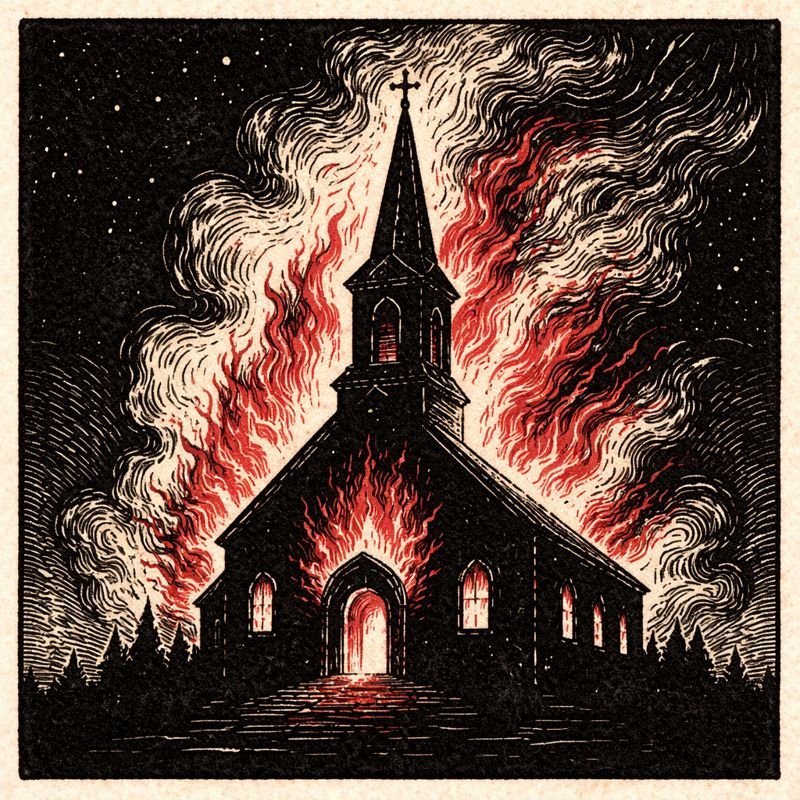
They ran toward the holy place because holiness had always been a coordinate on the mental map of safety. Stone meant permanence. Altars meant rules. Doors meant order. When the doors shut, the rules inverted. Fire entered the building like an argument no one could refute, and the sanctuary learned the physics of betrayal: smoke rises, crowds don’t.
Across centuries and continents, the method repeats without needing a manual. Gather. Seal. Ignite. What changes are the gods invoked and the uniforms outside. The architecture stays loyal to its purpose long enough to finish the job.
The Craft
There is no single machine here, only an exploit. Sanctuaries are designed to gather bodies, amplify sound, and keep weather out. Those virtues become liabilities under command. Thick walls trap heat. High ceilings bank smoke. Narrow doors control flow. The “device” is the building itself, activated by intent.
The choreography is grimly efficient. Civilians are directed inside for protection, judgment, or ritual. Bells may ring. Priests may speak. Then exits close. Fuel arrives in whatever era provides: thatch and benches in antiquity, furniture and accelerants later. Fire is set where it will climb. The goal is not speed but certainty. Flames do not have to reach everyone; smoke will. The lesson travels farther than the heat.
The Human View
For those inside, the senses reorganize. Sound goes first. Prayers fracture into coughing, into the percussion of fists on doors that do not answer. Light follows, turning red and unreliable as smoke eats it. Breath becomes a rationed commodity, traded for panic. People kneel because they were taught to kneel here. They pile because exits are narrow. The body’s logic collides with the building’s.
Outside, the executioners experience distance. Stone walls muffle screams. Fire reads as a task accomplished, not a face confronted. Witnesses, when permitted, receive the message whole. Authority can reach you even where you thought it could not. Faith is not armor.
The Society Behind It
Burning civilians in sanctuary is a declaration that no law competes with power. It tells a population that there is no appeal, no neutral ground. In religious societies it weaponizes sacrilege; in secular ones it weaponizes trust. The spectacle works because it violates a social contract everyone understands without reading it.
Empires use it to erase resistance. Insurgents use it to terrify occupiers. States use it to cauterize memory. The moral arithmetic is always the same: an enclosed crowd produces a louder silence afterward. Order is taught by demonstrating that even the places designed to restrain violence can be drafted into it.
Historical Record
The record is older than churches.
In the first century CE, during the revolt against Rome, Boudica led a coalition that sacked Roman centers in Britain. Ancient sources describe towns put to the torch, civilians trapped in public buildings and temples as fire consumed Londinium and Verulamium. Roman stone, meant to civilize the province, became a furnace. The method was not refinement; it was clarity. Rome’s gods could not save Rome’s subjects.
In 1209, at the opening of the Albigensian Crusade, the city of Béziers fell. Refugees crowded into churches seeking mercy. Accounts differ on the mechanics, but the outcome is fixed in memory: sanctuaries were breached and burned, and the distinction between believer and heretic dissolved in smoke. (See also: Béziers — from The Warrior Index; Massacre as Policy — from Oh, the Inhumanity.)
Across the Atlantic in 1519–1521, Spanish conquest in Mesoamerica produced its own sacrilegious inversions. During campaigns led by Hernán Cortés, temples were stormed and burned as acts of domination and purification. At Cholula, a massacre unfolded around sacred precincts; later sieges saw buildings associated with worship set ablaze to break resistance. The message traveled ahead of the army: your gods will burn with you.
The twentieth century industrialized the lesson. On 10 June 1944, in Oradour-sur-Glane, German troops herded women and children into the parish church, locked the doors, and set it alight. Men were shot elsewhere. The ruins stand preserved, a sanctuary emptied into a monument. The method needed no theology; obedience sufficed.
Other instances dot the map: villages in the Balkans where churches became traps during ethnic cleansing; synagogues burned with congregants inside during pogroms; mosques set aflame during counterinsurgency. The pattern persists because the variables are simple and the effect is reliable.
Myth & Memory
Stories accrete. Numbers inflate. Motives harden into slogans. Some accounts romanticize ancient burnings as righteous fury; others sanitize modern ones as unfortunate excess. Art lingers on the flames because flames are legible. Smoke, which does the real work, is harder to paint.
Modern memorials often keep the walls and remove the roofs. Sky replaces ceiling. Visitors stand where doors once failed. The lesson shifts from terror to testimony, but the architecture still speaks. It asks a question without asking it: if this could happen here, where else?
The persistence of the story reveals a human shortcut. We believe rules are spatial. That harm cannot cross certain thresholds. Burning a sanctuary is the fastest way to correct that belief.
The cruelty is not that fire was used. It is that trust was.