Garroting
The Iron Embrace of “Mercy”
Worldwide
( 1st century BCE – 20th century CE)
They called it merciful because the fire never touched the flesh.
In truth, the iron simply did the burning from the inside.
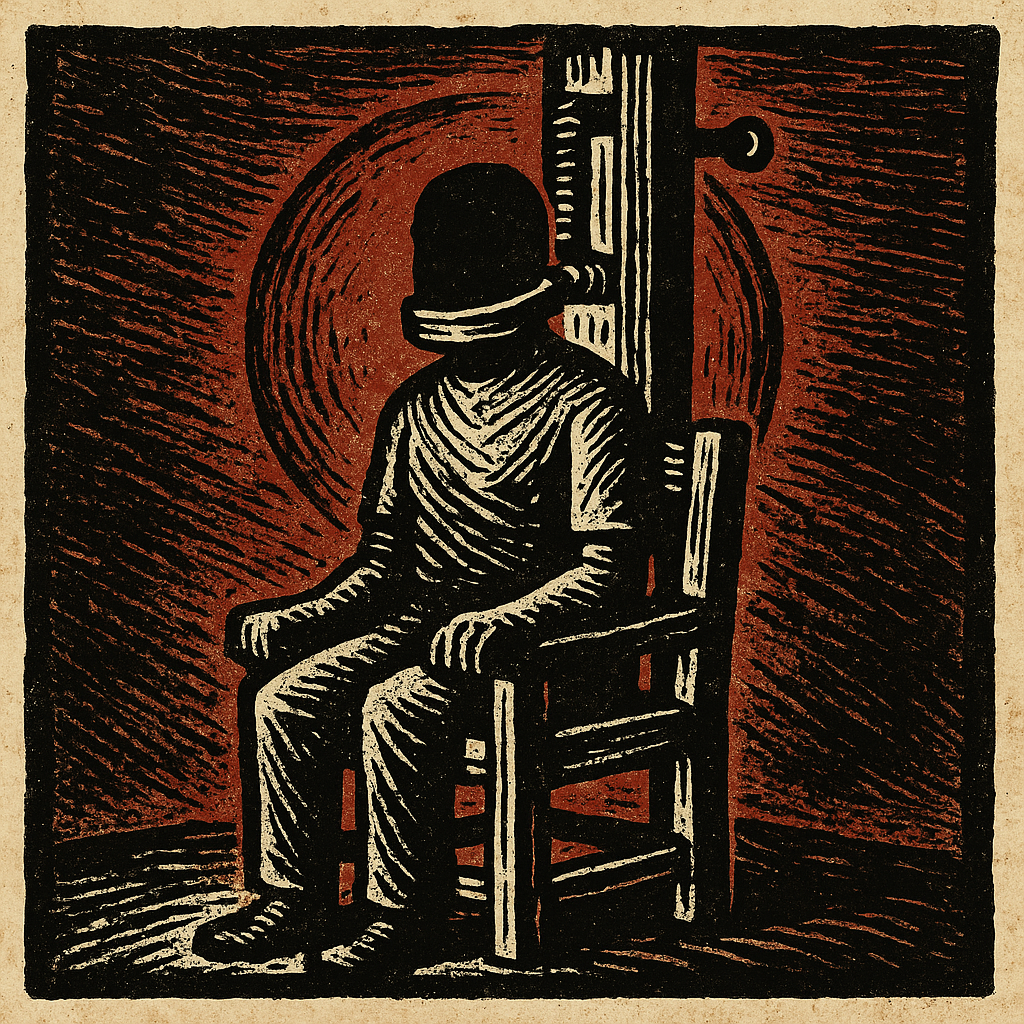
Picture a public square somewhere in the Spanish Empire: humid air, restless crowd, soldiers bored enough to look theatrical. At the center sits a wooden chair with a vertical post rising behind it. A collar of metal glints in the sun. When the condemned is seated, the ring is shut around the throat with the same casual certainty one might use when locking a stable door. An executioner steps behind, hand on a screw-turning garrote handle polished by centuries of identical tragedies. The crowd leans closer. The priest opens his book. The iron waits.
And when the screw begins to turn — slowly, deliberately, mathematically — the world narrows to the creak of wood, the compression of cartilage, and that final, terrible stillness that looks too neat to be called violence.
People once said it was a kinder death. They often said this while watching.
The Method
At its simplest, garroting is the art of controlled strangulation, elevated into a state technology. The mechanics changed little from ancient Rome to 19th-century Spain: a seated victim, an iron collar, a tightening mechanism applied from behind. Variants appeared everywhere human hierarchies required a quiet yet decisive ending.
Rome used the laqueus, a looped cord or iron collar, to dispatch traitors and failed generals.
Medieval Europe deployed rope garrotes for assassinations and dungeon executions, where silence mattered more than spectacle.
The Spanish crown, beginning in the late medieval period and refining the device through the 17th–19th centuries, perfected the chair-and-collar garrote — a machine of calibrated pressure.
The Spanish garrote vil (“vile garrote,” an admirably honest name) standardized the ritual. A circular iron collar hinged at one side was locked around the neck. Behind the chair, a handle attached to a threaded screw pressed a metal spike or tightening bar into the cervical vertebrae. It crushed the trachea, severed the spinal cord, or both. Death could be fast or slow depending on the executioner’s competence and the model of the device.
In the Philippines, Cuba, Mexico, and across Spanish-ruled Central America, the garrote traveled as dutifully as any bureaucrat, becoming the empire’s preferred method for ending rebellions without the disorder of mass burning.
It was, in administrative terms, “clean.”
The Human View
To the condemned, the experience began long before the iron closed. There was the approach to the chair — a short walk that history somehow makes feel longer than any march to a scaffold. The chair itself was intimate, domestic. No height, no drop, no rope — just a seat and a collar like a parody of hospitality.
The sensations unfolded in three stages.
First: pressure. A tightening around the throat, unignorable, like a giant thumb testing the shape of the neck.
Second: distortion. The collapsing airway produced choking coughs, splintered breaths, the metallic rasp of cartilage folding. If the spike variant was used, the victim sometimes felt a sudden hotness at the base of the skull moments before consciousness dissolved.
Third: silence. The body, denied air and nerve signals, slackened in a posture that looked almost peaceful — a designed aesthetic that soothed spectators and bureaucrats.
The executioner’s experience was dual: part technician, part priest. His hands performed calibrated violence; his face remained still so the crowd could believe the state acted without passion. The screw-turning was slow, steady, inevitable — a choreography of control. His job was to extinguish life at a rate that satisfied both law and audience. Too quick looked careless. Too slow looked cruel.
Witnesses experienced it differently. Some watched for justice. Others watched for closure. Many simply watched because this was what towns did when the crown called for presence: gather, judge, and go home with something vivid to talk about at supper.
The psychology of garroting is not the frenzy of the battlefield but the cold arithmetic of administration — which is precisely why it lingers in the imagination.
The Society Behind It
Garroting thrived where order needed to be affirmed without the messy spectacle of fire or the political symbolism of hanging. In Spain, it became the enlightened alternative to medieval pyres — a death deemed compatible with Christian burial. The idea was simple: destroy the rebel, not the corpse.
Empires and kingdoms used garroting to project a message of rational authority. It was supposedly “bloodless,” a virtue repeated often enough that people came to believe it. Crowds could watch without being splattered; priests could stand close without smoke staining their vestments. And rulers could claim moral sophistication.
Garroting expressed a theme recurring throughout human history: the state prefers methods that hide the body’s ruin. A death that looks tidy implies that power itself is tidy.
It was the bureaucratic execution — perfect for regimes that wanted their cruelty quiet, polished, and dignified. Some colonies used it to terrify populations with a calm that burning could not supply.
The lesson: the more civilized a society declares itself, the more precise its instruments of killing become.
Historical Record
1. Ancient Rome (1st century CE):
Sejanus, the infamous Praetorian commander, was reportedly dispatched by garrote after his spectacular fall from power. Rome used the method frequently for disgraced nobles — an indoor execution for indoor politics.
2. Spanish Empire (15th–19th centuries):
The garrote vil became synonymous with royal justice. Rebels in Granada, political prisoners under Ferdinand and Isabella, and countless Indigenous resistors in the Caribbean and Central America met the iron collar. Bartolomé de las Casas condemned its use in his chronicles, pairing it with mutilation and enslavement as tools of conquest.
3. Philippines (1872):
The three priests Mariano Gómez, José Burgos, and Jacinto Zamora — collectively “Gomburza” — were executed by garrote for sedition. Their deaths ignited nationalist fervor and influenced José Rizal, placing garroting squarely in the prelude to revolution.
4. Spain, 1974:
The final legal garrotings in Europe — Salvador Puig Antich, an anarchist revolutionary, and Heinz Chez, a murderer — were executed late in Franco’s dictatorship. Spain abolished the method in 1978.
Myth & Memory
Garroting acquired a reputation for swiftness and gentility, but this was half-myth. In practice, incompetence could make the process agonizing. Accounts describe botched executions where the spike missed the vertebrae, requiring repeated turns while the victim thrashed. The illusion of serenity was part stagecraft, part wishful thinking.
In literature and film, the garrote became a symbol of clandestine death — the assassin’s whisper, the spy’s quiet exit. This is its other life: from political tool to noir accessory. Fiction prefers the rope version because it is portable; history prefers the chair because it was official.
The method’s survival in memory reflects something uncomfortable: humans are reassured by violence that appears organized. The contraption looked like furniture, the executioner like a craftsman, the death like a tidy formality. It reassured onlookers that civilization had boundaries — even when enforcing those boundaries required an iron ring around a human throat.
We trusted the collar because it was clean, forgetting that silence can kill as surely as flame.