Corpse Desecration
When the Dead Became Messages
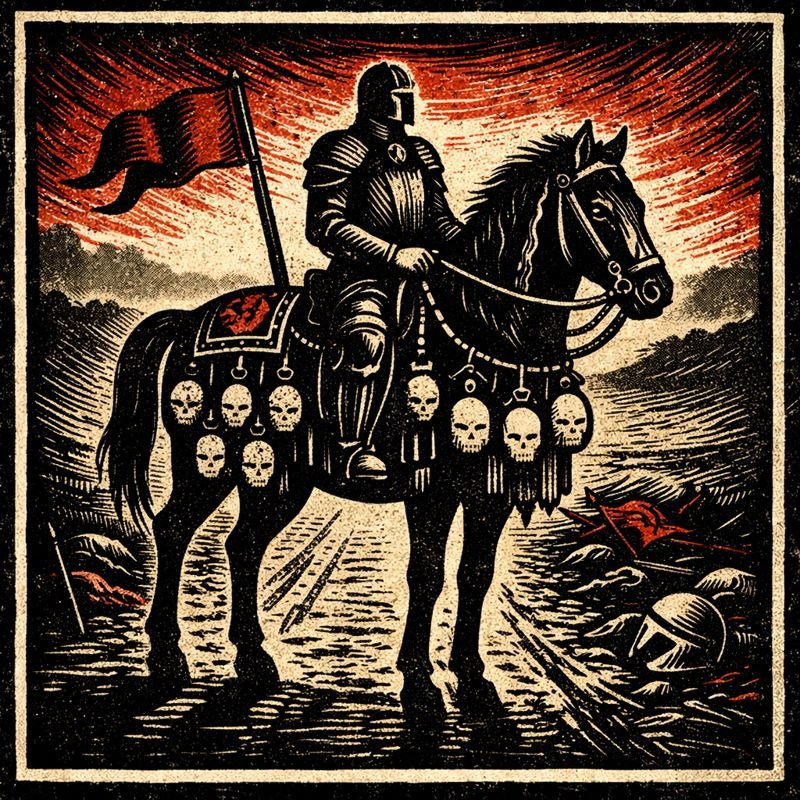
Across empires and centuries
They were already dead when the work began.
The killing had finished its brief, utilitarian task. Breath stopped. Muscles slackened. The body, suddenly useless as an enemy, became useful as a sentence. Someone stepped forward not with a blade raised in fury but with tools chosen for clarity. This was not combat. This was editing. The crowd understood the difference instinctively. Violence ends a life. Desecration edits the meaning of death and sends it back into the world.
They called it warning. It looked like signage.
The Method — Turning Bodies into Language
Corpse desecration for psychological effect is not a single technique but a grammar. It takes the human form and rearranges it so survivors understand what happens next. Heads are separated and elevated. Limbs are removed and repurposed. Skin, hair, teeth, or bones become trophies, garments, or decorations. The point is not bloodshed. The point is legibility.
Across history, the tools are basic. Knives, hooks, cords, stakes, walls, gates. Sometimes fire or sun finishes what hands begin. Time is an accomplice. A body left where it will be seen and slowly altered by weather becomes a message that refreshes itself daily. Smell replaces proclamation. Birds become heralds.
This practice appears wherever power needs to travel farther than its soldiers. In the reliefs of the Assyrian Empire, severed heads are counted and stacked like coin. In the frontier zones of the Roman Empire, crucified bodies were sometimes left to decay in place, their alteration by animals part of the deterrent. In medieval Europe, city gates learned to carry faces. In the steppe, enemies wore enemies. In early modern rebellions, the dead were rearranged so the living would remember who owned the future.
Desecration does not require invention. It requires agreement. Once a society decides that a corpse may be used, anything becomes permissible so long as the message is clear.
The Human View — Victim, Agent, Witness
For the dead, there is no sensation. That fact never softened the act. Desecration is not about pain. It is about identity. The first thing taken is wholeness. The second is dignity. The third is memory. A body altered after death is meant to stand in for a person and then contradict them. You were brave, it says. Now you are parts. You were defiant. Now you are property.
For the agent, this is labor, often ritualized. Someone has to decide where the head goes, which wall bears it, how high it should be, how long it stays. This work is frequently delegated downward. Officers issue orders. Others carry them out. The division of responsibility matters. Desecration becomes banal when it is procedural. It becomes terrifying when it is careful.
For witnesses, the effect is immediate and delayed. Immediate shock gives way to interpretation. Is this what happens to traitors? To outsiders? To anyone unlucky enough to lose? Children learn by passing through gates. Merchants learn by counting spikes. Travelers learn by turning back. The message spreads without speech.
There is a particular cruelty in post-mortem alteration because it denies the victim even the narrative of suffering. Martyrdom depends on endurance. Desecration denies endurance by arriving afterward, erasing the moment when meaning could have been claimed.
The Society Behind It — Why This Works
Desecration thrives where authority needs theater. Executions kill one person. Desecration disciplines thousands. It operates on three beliefs shared across cultures.
First, that the body represents the self even after death. Alter it, and you alter reputation. Second, that visibility creates obedience. A hidden corpse is a private act. A displayed one is public law. Third, that fear is more durable when it is impersonal. You do not threaten an individual. You threaten a category.
Religion often cooperates. Some traditions emphasize bodily integrity after death. Others emphasize shame. Desecration exploits both. By denying burial, by rearranging remains, by placing the dead in liminal spaces like gates and crossroads, societies weaponize metaphysics. The punishment does not end. It lingers in belief.
Empire, especially, favors these methods. Distance weakens authority. Desecration compresses distance. A line of heads along a road is a map of control. A body turned into clothing is a uniform of terror. This is governance without paperwork.
Historical Record — Patterns and Particulars
The archive is extensive. A few documented patterns recur so reliably that they function like chapters in a manual.
Assyria, 9th–7th centuries BCE: Royal inscriptions and reliefs depict enemy heads stacked, counted, and displayed after sieges. The imagery is not chaotic. It is inventory. The point was to discourage revolt before it began.
Rome, 1st century BCE–1st century CE: While crucifixion killed publicly, its aftermath mattered. Bodies were sometimes denied burial or left exposed near roads. The alteration by animals was not an accident. It was part of the sentence.
Steppe and frontier warfare: Trophy-taking practices included wearing enemy remains or displaying them on mounts. The body becomes armor. The message travels with the warrior.
Medieval Europe: Heads on gates, walls, and bridges became civic furniture. After rebellions, leaders were quartered not for efficiency but for distribution. Each piece instructed a different audience.
Wallachia, 15th century: The reign of Vlad III is remembered less for execution itself than for arrangement afterward. Forests of impaled bodies were positioned along approaches so visitors would understand the landscape before they entered it. (See also: Vlad III — from The Warrior Index.)
Colonial and counter-insurgency contexts: Displayed remains communicated racialized power. Desecration here taught hierarchy as much as obedience.
Across these examples, the method varies. The intent does not. Kill the body once. Use it many times.
A Taxonomy of Desecration
Without indulging in anatomy, the practices fall into recognizable categories.
Elevation: Heads or bodies placed above eye level on spikes, walls, or poles to assert dominance and permanence.
Fragmentation: Bodies divided so their parts can speak to different places simultaneously.
Incorporation: Enemy remains worn or carried, collapsing the boundary between victor and victim.
Denial: Withholding burial so time and environment continue the punishment.
Recontextualization: Positioning remains to mock identity, rank, or belief. Gates for leaders. Roads for soldiers. Fields for civilians.
Each category teaches a different lesson. Together, they form a curriculum of fear.
Myth and Memory — What We Choose to Remember
Modern retellings often exaggerate numbers and invent excesses. The temptation is understandable. Desecration resists understatement. But the truth is already sufficient. The danger in mythologizing is that it turns systems into spectacles. We remember the tyrant and forget the administrators. We remember the spikes and forget the permits.
Art returns to these images because they compress meaning. A single altered body can stand in for an entire regime. Film and literature borrow the iconography while softening the context. The head becomes a prop. The gate becomes a set. What is often lost is the banality. Someone scheduled the removal. Someone cleaned afterward. Someone decided when it was time to take the remains down.
In modern states, the practice retreats but does not vanish. Photographs replace gates. Leaks replace spikes. The body is no longer needed when reputation can be dismembered instead. The logic persists. Make an example. Make it visible. Make it linger.
The Long Echo
Corpse desecration endures because it exploits a stubborn human truth. We believe the body matters even when we insist it does not. We believe that how the dead are treated reflects the health of the living. When power wants to teach fear efficiently, it turns to the most legible object it has ever governed.
The dead were never the audience. They were the medium.
Civilization congratulates itself on leaving such practices behind, but it still understands the lesson. Change the body, and the story changes. Replace the spike with a screen. Replace the gate with a feed. The grammar remains intact, only quieter, only cleaner, only easier to deny.
We stopped hanging heads on walls. We still hang meanings where everyone can see them.
Cases Throughout History:
Boudica - intestines worn as a necklace.
Oliver Cromwell - head removed post-mortem and displayed
Leonidas - Xerxes orders his head displayed on a stake.