Tonte Publique
Cleansing the Nation by the Head
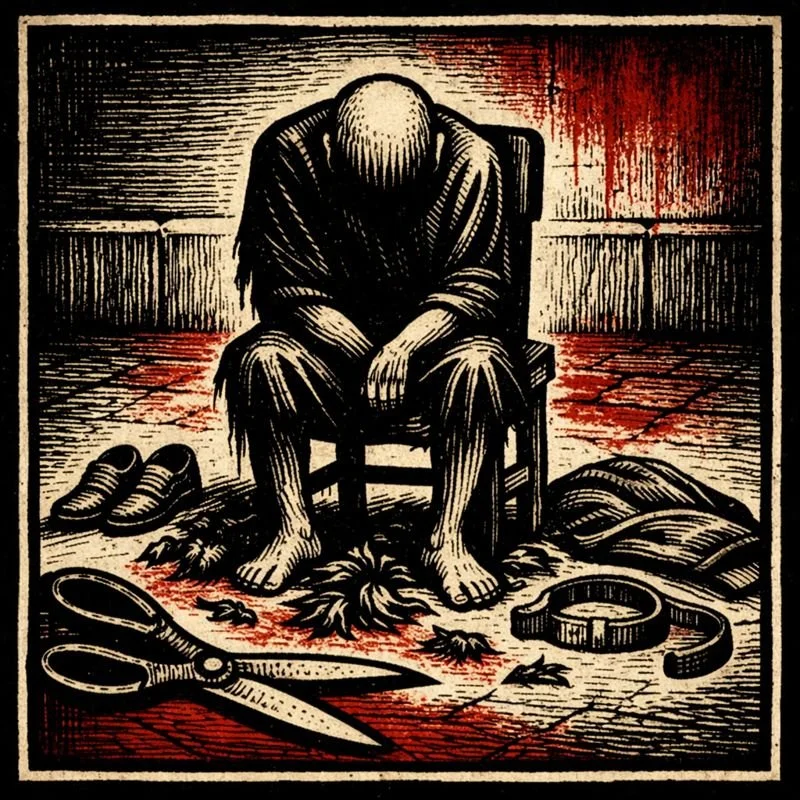
France, 1944–1945
They did not build a scaffold. There was no warrant, no judge, no hooded executioner with a measured voice. The square itself did the work. A chair scraped stone. A pair of shears flashed like a modest tool suddenly promoted to history. Hair fell in uneven drifts, catching in cobblestones and boots, darkening with spit. Cameras clicked. Someone laughed. Someone prayed. Someone said nothing and remembered everything.
They called it liberation. It looked like grooming.
The Method — The Craft of Erasure
Tonte publique, literally “public shearing,” was not an execution in the technical sense. No blood was required. No pulse stopped. The method was simple and terrifyingly efficient: identify a woman accused of collaboration horizontale—an intimate relationship with a German soldier, real or rumored—seat her in a public place, and remove her hair. Sometimes eyebrows followed. Sometimes clothing was torn or marked with crude symbols. Occasionally a placard was hung around the neck, the language of accusation condensed into a few cruel nouns.
The tools varied. Scissors borrowed from kitchens. Barbers’ clippers reclaimed from normal life. Razors when zeal outran care. Timing mattered. The act had to be visible, communal, photographed. It worked best in daylight, with witnesses pressed close enough to smell soap, sweat, and the metallic tang of fear. The purpose was not correction but conversion: a woman transformed into a warning.
This ritual surged in the wake of France’s liberation in 1944 and lingered into 1945, part of the épuration sauvage—the wild purge—that accompanied the collapse of occupation before formal courts could reassert themselves. It was extrajudicial by design. The law would come later, men said. The hair could go now.
The Human View — From the Chair, the Hand, the Crowd
From the chair, the experience compressed into minutes that felt like hours. The first cut was the worst. Hair carries identity in a way flesh does not. It is tended, recognized, touched by lovers and mirrors. When it falls, it makes a soft sound, a betrayal of expectations. The scalp prickles. Cold air finds skin that has never known it. Shame arrives before pain, because the audience is already there.
From the hand holding the shears, the sensation was lighter than expected. A job easily learned. The performer could tell himself he was doing something necessary, something civic. The blade slid. The crowd approved. In a country bruised by years of occupation, approval was a rare currency. Many hands shook. Many did not.
From the crowd, the act became theater. It allowed the release of anger without the mess of corpses. It allowed the rewriting of roles. Neighbors who had been silent now shouted. Those who had compromised quietly could point loudly. The woman in the chair absorbed what the square needed to forget.
The Society Behind It — Purity Without Due Process
This was gendered punishment, nakedly so. Men accused of collaboration faced trials, prisons, executions. Women were shorn. Their alleged crime was intimacy, not ideology. Their bodies became texts upon which the nation could scribble absolution. The logic was ancient: control the visible markers of femininity to restore moral order. Hair, long associated with virtue and seduction, became the lever.
The tonte offered symbolic purification at bargain cost. No courts clogged. No appeals delayed the satisfaction. The act taught lessons efficiently: collaboration stains; the community cleanses; the state watches later. It reinforced boundaries between public heroism and private desire, between masculine resistance and feminine transgression. It also offered plausible deniability. After all, no one died.
Yet death is not the only measure of violence. Social erasure leaves a long wake. The shorn woman carried her sentence with her until hair grew back, and then beyond. Photographs froze the moment permanently. Memory did the rest.
The Record — Names, Places, Silences
The practice spread unevenly across France, most visibly in 1944 as towns were liberated by Allied forces and local resistance. Historians estimate tens of thousands of women were shorn. Some had indeed formed relationships with German soldiers for survival, affection, coercion, or love. Some had not. Proof was optional. Accusation was sufficient.
In Chartres, a young woman named Simone Touseau was photographed carrying her infant, head shaved, a swastika scrawled on her face. The image traveled far, becoming an icon of the purge’s cruelty and ambiguity. In other towns—Rennes, Bordeaux, small villages without names that endure—the ritual repeated with local variations. Sometimes the Resistance organized it. Sometimes it was neighbors with borrowed tools. Sometimes it was boys trying on authority.
The record is incomplete by nature. Extrajudicial acts leave gaps. What survives are images, testimonies, and the uneasy consensus that this, too, was part of liberation. (See also: Public Shaming — from Oh, the Inhumanity.)
Myth & Memory — After the Hair Grew Back
In later retellings, the tonte publique is often softened or sensationalized. Some accounts frame it as a necessary catharsis, a bloodless alternative to worse violence. Others inflate its uniformity, as if every shorn woman were guilty, every crowd righteous. The truth resists tidy edges.
Artists and filmmakers return to the image because it sits at a crossroads of justice and vengeance. The shaved head is unmistakable, a silhouette of disgrace that reads instantly across cultures. Modern echoes surface whenever communities turn to public exposure as punishment—digital shaming replacing scissors, feeds replacing squares. The tools evolve. The logic remains comfortingly old.
What endures is the lesson embedded in the act: societies under strain often choose symbols over systems. Hair grows back. Trust does not.
The square emptied. The chair was carried away. The hair was swept into a bin. And for a moment, a nation felt clean, until it remembered what it had done with its hands.