Cher Ami
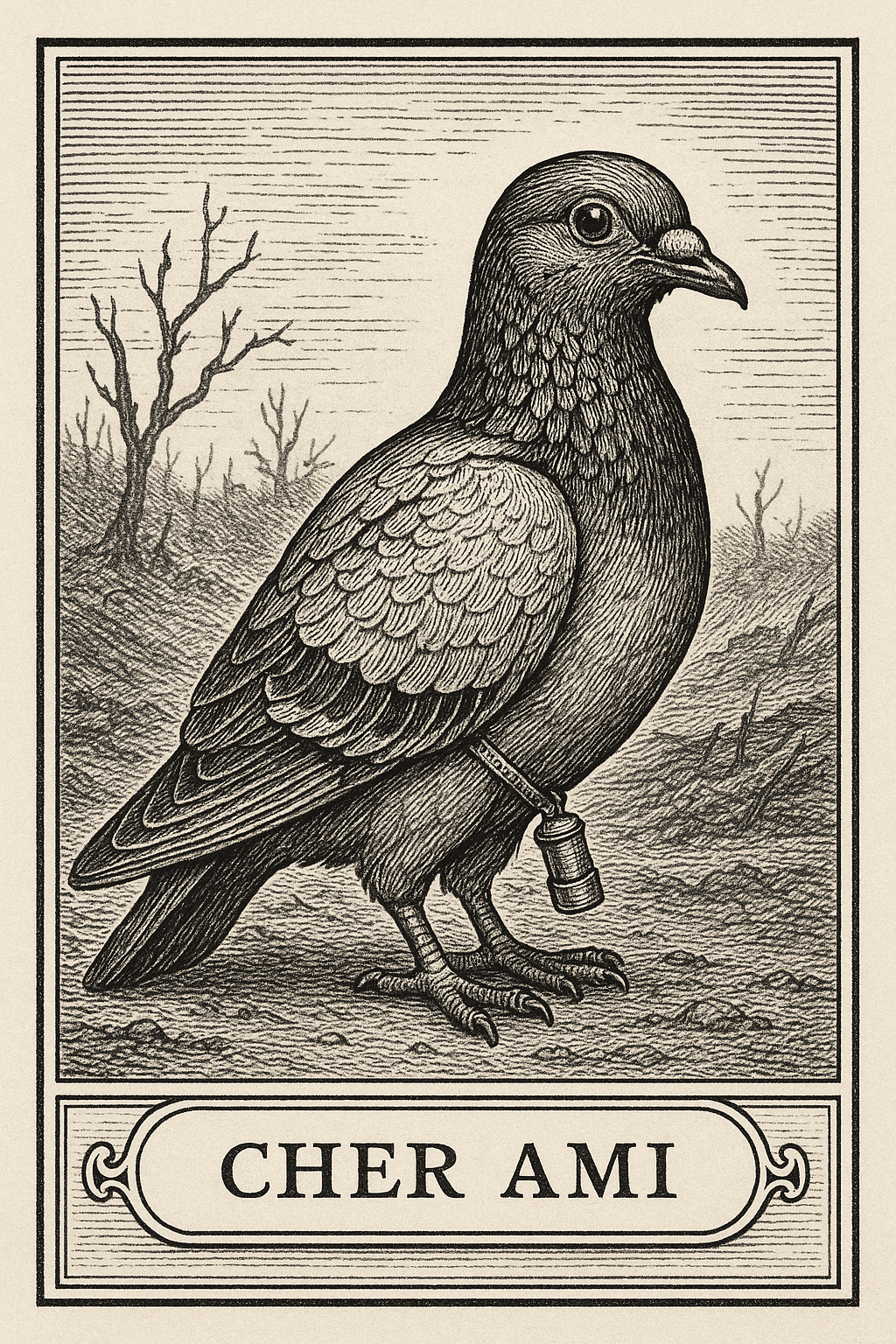
The Bird Who Outran A Battlefield
October 4, 1918 — the Argonne Forest, France. The trees were stripped to splinters, the air thick with cordite and panic. Below the ridge, nearly 200 men of the U.S. 77th Division were trapped behind German lines, shelled by their own artillery. Radios were gone, runners shot, flares lost to the smoke. In a makeshift trench, Major Charles Whittlesey scribbled a message on a scrap of paper: coordinates, plea, profanity. He slipped it into a tiny canister and tied it to the leg of a gray pigeon already trembling from the concussions. Its name, painted on its band in chipped black ink, was Cher Ami — “Dear Friend.”
The first birds had been blown from the sky before they cleared the trees. Cher Ami didn’t wait for ceremony. The handler lifted his hand; the pigeon burst upward into gunfire. Within seconds the Germans saw it, shouted, and aimed. Machine-gun tracers shredded the air. She was hit in the breast, blinded in one eye, and dropped fifty feet before righting herself. One wing hung loose; one leg dangled by a tendon with the capsule still attached. She kept flying. It was twenty-five miles to the nearest U.S. battery. She made it in twenty-five minutes.
The message she carried read:
“We are along the road parallel to 276.4. Our own artillery is dropping a barrage directly on us. For heaven’s sake stop it.”
When the note arrived, the coordinates matched. The barrage ceased within minutes. Whittlesey’s “Lost Battalion” was relieved the next day — 194 men still breathing out of 554 who’d entered the forest. Cher Ami was found at the battery post, collapsed, feathers matted with blood, the canister crushed but intact. Medics splinted the leg with a matchstick and fed her from a dropper. She lived.
The Army shipped her to the States in a small wicker crate marked “Patient.” A taxidermist would later say the body bore sixteen pellet scars. General Pershing awarded her the Croix de Guerre with Palm for “heroic service delivering important messages under fire.” Newspapers called her “the most famous bird in the world.” Children wrote letters to her care of the War Department. No one mentioned that she never flew again.
She died in 1919 at the Army Signal Corps breeding loft in New Jersey, buried first in a cigar box, later mounted for display at the Smithsonian. There she still stands — small, glass-eyed, one leg bandaged, message canister gleaming under museum light. People press against the case expecting grandeur and find instead something fragile and absurd: six ounces of flesh that carried a battalion’s life.
A century later the military still names communications programs after her, as if to borrow luck from wings that no longer exist. The coordinates she carried remain on record, a few lines of ink that stopped friendly fire and started a legend.