Oi
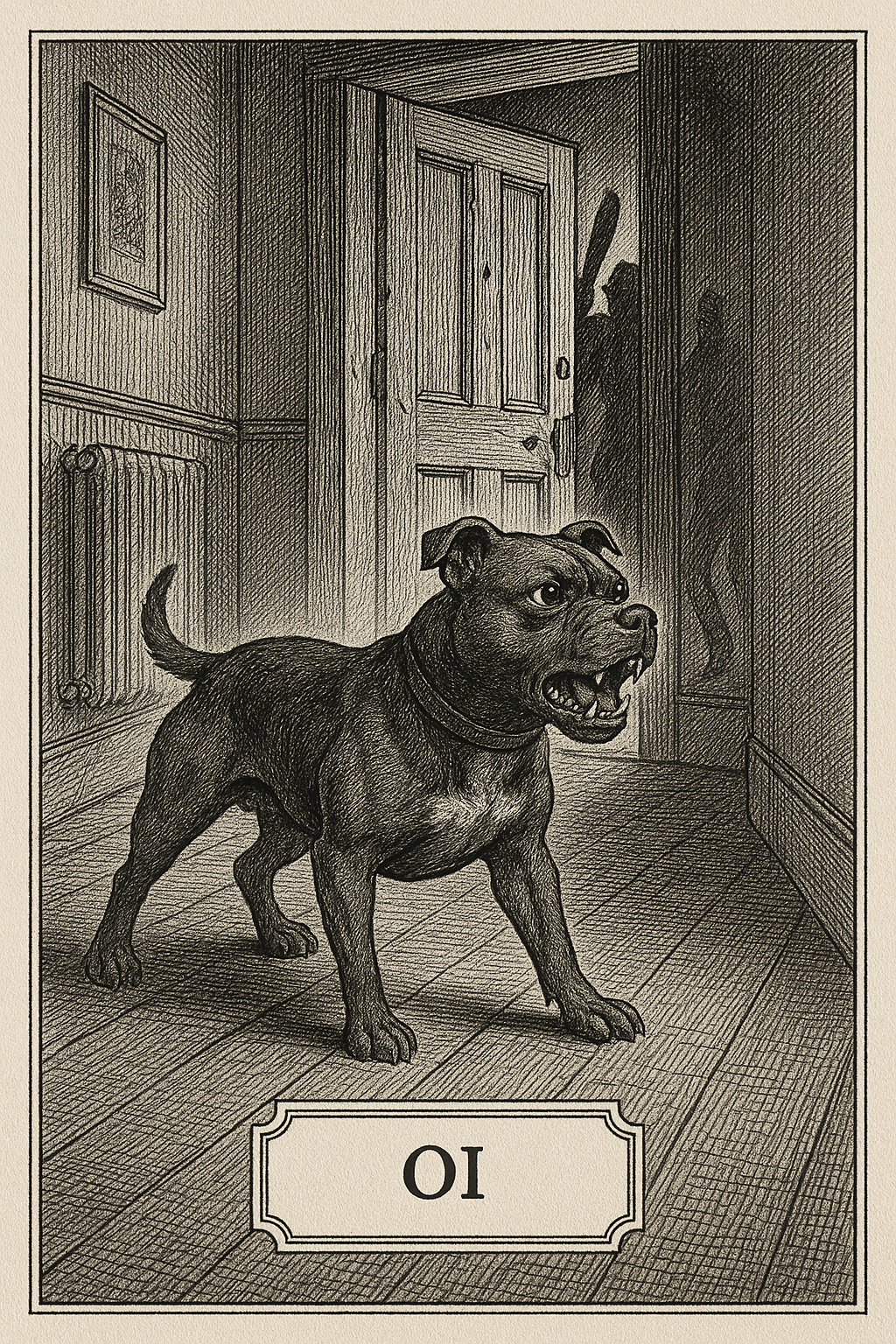
A dog whose courage is recorded, but whose story lives between the lines
Southeast London, 2008 — The story of Oi begins the way many acts of heroism begin: quietly, in a place no one was watching.
She was a Staffordshire Bull Terrier — compact, muscled, the kind of dog built like a clenched fist with a heartbeat inside. The kind of dog bred for loyalty more than legend. She lived with her family in southeast England, in a house like any other, with radiators that pinged in winter and a front step that collected mail and muddy shoes. Nothing about her life suggested that she would one day be counted among the country’s bravest animals.
But legends rarely announce themselves ahead of time.
There was a night — that much is certain. A night in June of 2008, long past the hour when a street falls quiet. Armed men forced their way into the house. The official record says “assailants,” nothing more. It does not describe their faces, their voices, their weapons. It does not say how many came or why they chose this home. What survived in writing is only the barest skeleton: intruders entered; the family was in danger; the dog intervened.
Everything else survives only in the stories that spread afterward.
Some say the door had been kicked in, the frame splintered. Some say there were three intruders, one holding a blade long enough to catch the hallway light. Some say Oi charged them head-on, teeth bared, body lowered like a battering ram of muscle and devotion. Some say two men were injured, another fled. In some versions, the fight spilled onto the street; in others, it ended before the neighbors could wake.
And then there are the darker whispers — that the injuries Oi sustained were fatal, that she collapsed before the police arrived, that her muzzle was red, and that someone stayed with her as she struggled to breathe.
None of that appears in the official citation. The institutions that keep animal bravery records are tidy in their language, careful not to expose private grief. The PDSA Gold Medal entry speaks in a single sentence:
“For lifesaving bravery and courageous devotion to her family in the face of armed assailants.”
That’s all.
It doesn’t tell you how long she fought, or what sound she made when she lunged, or whether she hesitated — though anyone who has lived with a dog like Oi knows she probably didn’t.
What we do know is this: she did not survive her injuries.
Her family lost her that night.
Two years later, in 2010, her name appeared on the honor roll of the PDSA Gold Medal — the highest civilian award for bravery a UK animal can receive. Most medal entries come with photographs of the ceremony, of handlers in uniforms, of proud owners standing beside their living companions. Oi’s entry came with a photograph of her owner holding not the dog but a picture of the dog — the closest thing to her presence anyone would ever see again.
Some say the family buried the medal with her. No record confirms that. But the rumor persists because it feels right — because some honors belong to the one who earned them alone.
And so Oi remains a strange kind of hero: one part confirmed fact, one part missing record, and one part shared imagination. Her courage is unquestioned, but the shape of the night she died has become something fluid — told in different postures, different shadows, different versions of the same truth.
In a way, that’s fitting. Human heroes leave testimonies and court transcripts; animal heroes leave the memories of those who loved them, and sometimes the silence of those who couldn’t bear to say more.
What lies beyond the written facts is the simple, unadorned truth:
A dog stood between her family and the men who meant to harm them.
She did what she could.
She paid the price that loyalty sometimes demands.
And whatever the exact details of that night — whatever the door looked like, or the weapon, or the number of shadows in the hallway — Oi’s final act was the same in every version:
She faced danger so her family wouldn’t have to.
That is the part no rumor can exaggerate. That is the part that needs no clarification.
The rest is just the darkness around her — and the light she left in it.