Wojtek
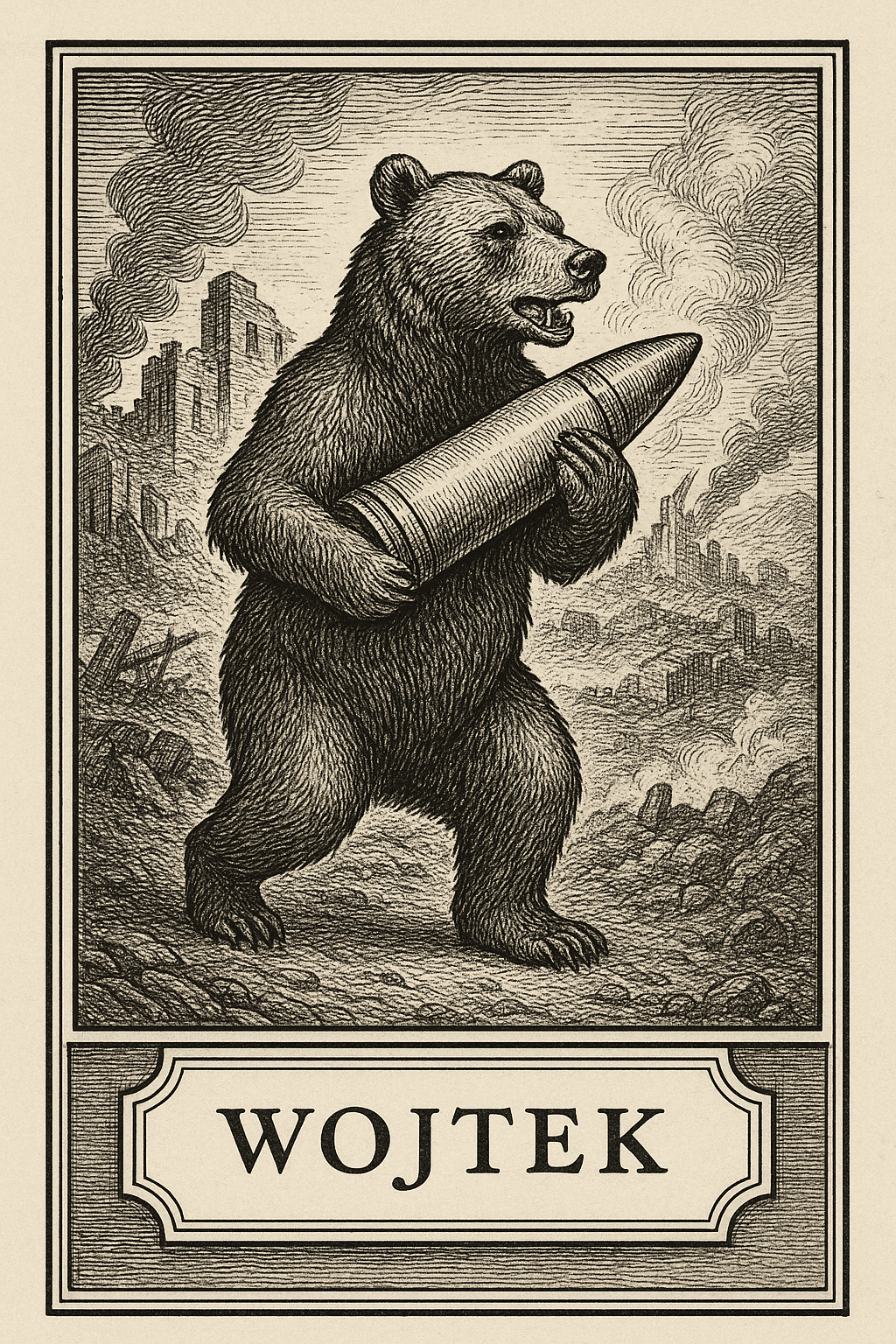
The soldier who forgot he wasn’t supposed to be one.
Spring, 1944 — Monte Cassino, Italy. The valley trembled under constant shellfire. Smoke drifted like dirty silk over the monastery ruins while Polish troops of the 22nd Artillery Supply Company strained under the weight of crates too heavy for men and too important to leave behind. And there, amid the shouting and mortar dust, trudged a Syrian brown bear on his hind legs, carrying twenty-five-pound shells to the guns. The troops called him Wojtek — “joyful warrior” — though by that point no one was particularly joyful. He didn’t flinch at gunfire. He didn’t need orders. He just kept hauling ammunition up the hill like gravity owed him an apology.
Wojtek had been born in 1942 somewhere near Hamadan, Iran — an orphaned cub sold to a group of Polish soldiers for a few coins and a can of condensed milk. He grew up on army rations and beer, sleeping in tents, stealing laundry, and learning to salute for fruit. By the time the Polish II Corps shipped out to the Italian front, he was already a private in everything but paperwork. Soldiers taught him to carry crates, climb into trucks, and open bottles with his teeth. Officially, he was “property of the Polish Army.” Unofficially, he was the only soldier they trusted not to steal cigarettes.
At Monte Cassino, the ammunition lines broke under bombardment. Trucks couldn’t move. Men fell under fire. Wojtek simply walked into the chaos, stood upright, and began carrying shells from the supply dump to the guns. The sight was so improbable that British officers demanded confirmation. The Poles responded by enlisting him formally — rank, number, paybook, and rations included — so no one could argue. Somewhere in the archives of Allied logistics, there’s a ledger that lists “one (1) bear, active duty.”
The bear worked twelve hours straight, his fur singed, his handlers shouting encouragement between explosions. He didn’t drop a single crate. When the guns finally fell silent, he sat down, drank a beer, and tried to eat a helmet. The soldiers, not to be outdone, gave him a promotion. Wojtek became a corporal.
After the battle, he was a celebrity. Newspapers called him “the soldier bear,” as if the whole war had been a circus and he was the only act worth remembering. He traveled with his unit through Italy, then to Scotland, where demobilization caught up with him in 1947. The Polish soldiers couldn’t take him home — their country was now behind the Iron Curtain — so Wojtek was turned over to the Edinburgh Zoo. Bureaucracy filed him under “demobilized.” Visitors filed past daily to see the bear who’d served in combat. When his old comrades came to visit, he’d reportedly perk up at the sound of Polish voices, stand upright, and make the motion of lifting a crate. Some said he remembered. More likely, he simply never stopped working.
He lived there for sixteen more years. His diet became beer, fruit, and nostalgia. Children waved, veterans saluted, and zookeepers filled out maintenance reports that read like obituaries. When he died in 1963, his ashes were buried somewhere under the zoo grounds. A bronze statue stands there now, showing a young bear carrying an artillery shell — a memorial to a soldier who never understood the paperwork.