Faith
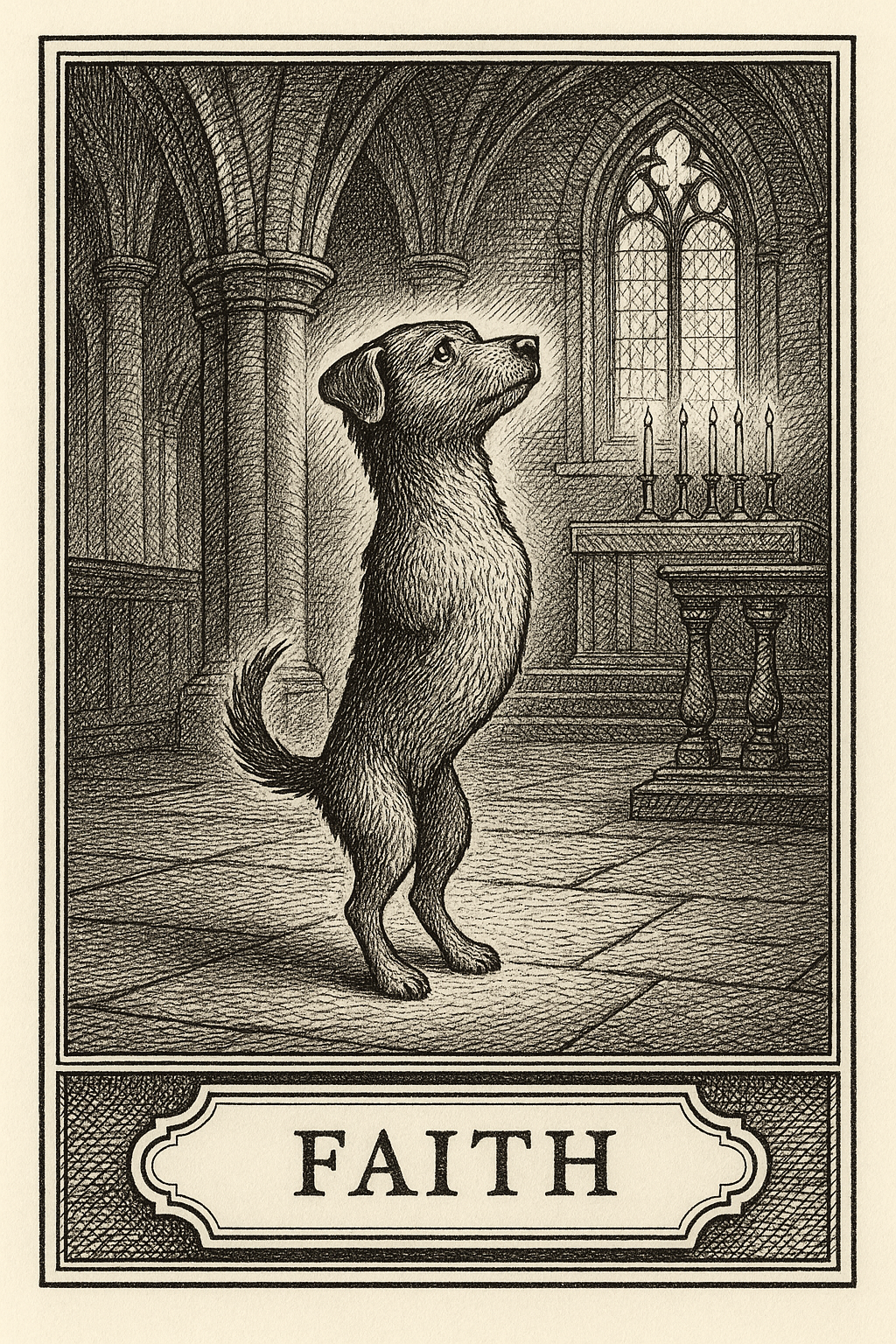
The dog who stood when the city couldn’t.
London, 1940 — the Blitz in full voice. The air tasted of dust and cordite, the kind of metallic fog that settled between ribs and stayed there. The sirens wailed, the streets emptied, and in a small parish near St. Dunstan’s, something small and ridiculous was walking on its hind legs toward the altar. A mongrel terrier, front paws missing since birth, balancing on two legs like a half-drunk soldier keeping formation. The congregation called her Faith. When the bombers came, she stood through it all — tail wagging, head up, as if posture alone could hold the roof in place.
She’d been born in 1936 in a scrap yard, one of a litter of misfortunes. The owner had intended to drown her — a two-legged dog wasn’t good for anything, least of all appearances. But a local woman, Mrs. London (and yes, that was her name), saw her wobbling across the floor and took her home. The dog learned to hop, then to walk upright to reach the table. Within months she was navigating stairs, parading down the street like an evolutionary prank, and following Mrs. London to church every Sunday. “If she’s going to walk like us,” the vicar supposedly said, “she may as well worship like us.”
By the time the Luftwaffe began turning London into rubble, Faith was a fixture. Parishioners claimed she could sense the raids coming — her ears pricking a moment before the sirens. When the bombs fell, she refused the shelter. Instead, she stood in the aisle, upright, trembling but stubborn, as if refusing to let gravity win. One witness described her as “the most English thing I’ve ever seen.” Another said she was proof that faith had legs, though fewer than usual.
The newspapers found her eventually, as they always do. Photographers posed her beside hymnals and headlines: “Two-Legged Dog Walks by Faith Alone.” The story ran across the Atlantic. Letters poured in — prayers, donations, marriage proposals (for the owner, not the dog). Faith became the Blitz’s unofficial mascot: a small, limping rebuttal to despair. She was invited to meet Winston Churchill, though there’s no record of what was said — likely mutual grunts of determination.
Through the war she made appearances at hospitals, visiting amputee veterans and children burned in the raids. She’d climb onto beds, balance on her hind legs, and wag until the room laughed or cried, sometimes both. Doctors called her therapy before the word existed. Soldiers patted her head and swore they’d seen worse odds walk into battle.
When victory finally came, Faith marched — literally — in the church parade. The brass band played; she led the procession, upright as ever, chest out, tail swaying to the rhythm of resurrection. The newspapers called her “London’s Little Miracle.” The vicar called her “a sermon with fur.”
She lived another decade, aging into a slow, dignified shuffle. Her photograph hung in St. Dunstan’s for years, between portraits of rectors and plaques for the fallen. A small caption beneath read: “She walked by Faith.”