Happy
The test case who stood for legal personhood and loneliness.
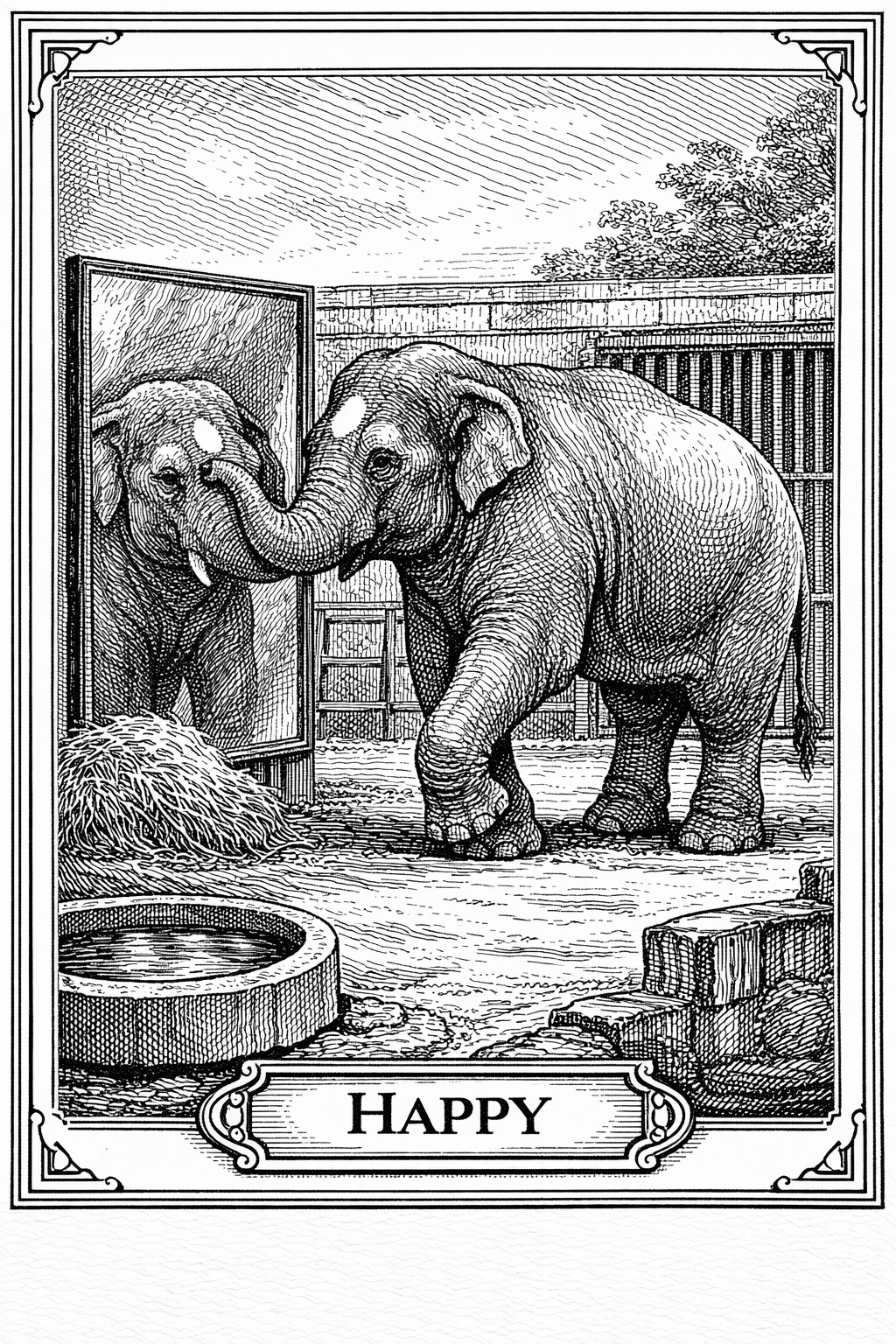
May 2018 — Bronx Zoo, New York. The air smelled of wet hay and chlorine. Behind the glass, an Asian elephant stood still in her pen, one foot shifting gently over the other, the slow dance of animals with nowhere left to go. Her name was Happy. She had lived there since 1977.
She was the first elephant known to recognize herself in a mirror. The test was simple: a dab of white paint on her forehead, a mirror on the wall. When she touched the mark with her trunk, the researchers cheered. Self-awareness — the thin border between animal and person — had been crossed. The applause faded, and the gates closed again.
For decades she lived with other elephants, then without them. Companions died or were moved away. By the 2000s she was alone, pacing the half-acre that had once seemed vast to the children who visited her. Activists petitioned the courts, arguing she was not property but a being — a sentient individual with the right to liberty. Her case, Happy v. Wildlife Conservation Society, became a moral experiment disguised as law.
In 2022, New York’s highest court ruled five to two against her. The dissenting judges called her “an autonomous, cognitively complex nonhuman animal” who deserved better than “indefinite solitary confinement.” The majority called her an elephant — legally distinct, spiritually irrelevant.
Happy stayed in her enclosure. The zoo issued statements about her care, her diet, her toys. The activists filed new briefs, citing philosophy, neuroscience, empathy. The world scrolled past.
Today she remains where she has always been: a mirror turned inward, proof that consciousness alone is not enough to earn a key.