Koko
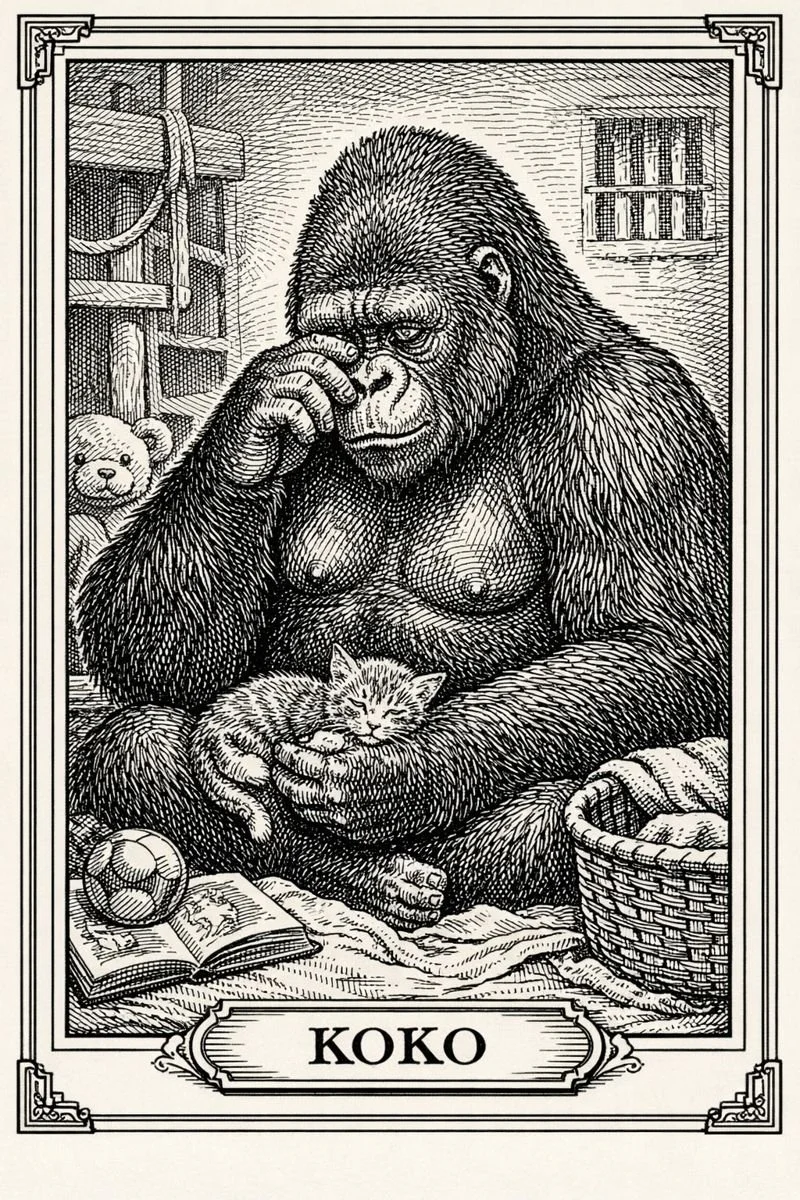
The gorilla who signed “sad” when her cat died.
1984 — Woodside, California. The morning smelled of sawdust and fruit. Koko, a western lowland gorilla, sat in her enclosure surrounded by toys, picture books, and the remnants of breakfast. Her trainer, Penny Patterson, held up a kitten — small, gray, trembling — and signed, soft cat. Koko touched its fur, then signed love. They named the kitten All Ball.
Koko had been raised since infancy as part of a language experiment. Using American Sign Language, she learned over a thousand signs, recognized hundreds of spoken words, and combined symbols into rough grammar: finger-bracelet for ring, white-tiger for toy. Some accused the researchers of anthropomorphism. Others saw the borders of language begin to shift.
She wore birthday hats, demanded Christmas presents, and asked for kittens every year. All Ball became her favorite — she carried it, groomed it, tucked it into her sleeping nest. One night, it slipped under a car. When handlers told her, she signed bad sad cry. Then sleep cat.
For a decade, she continued to sign, to paint, to communicate emotions that blurred the line between mimicry and meaning. She grieved when Robin Williams, whom she had met once, died. She laughed at slapstick, sulked when scolded, mourned when told of extinction.
When she died in 2018 at forty-six, the foundation she’d inspired released a statement calling her “an ambassador between species.” The photos showed her hands mid-gesture, eyes steady, expression unreadable.
The scientists still debate what she truly knew. The rest of us already do: that even if she never spoke our language, she made us listen to our own.