Harold G. “Hal” Moore
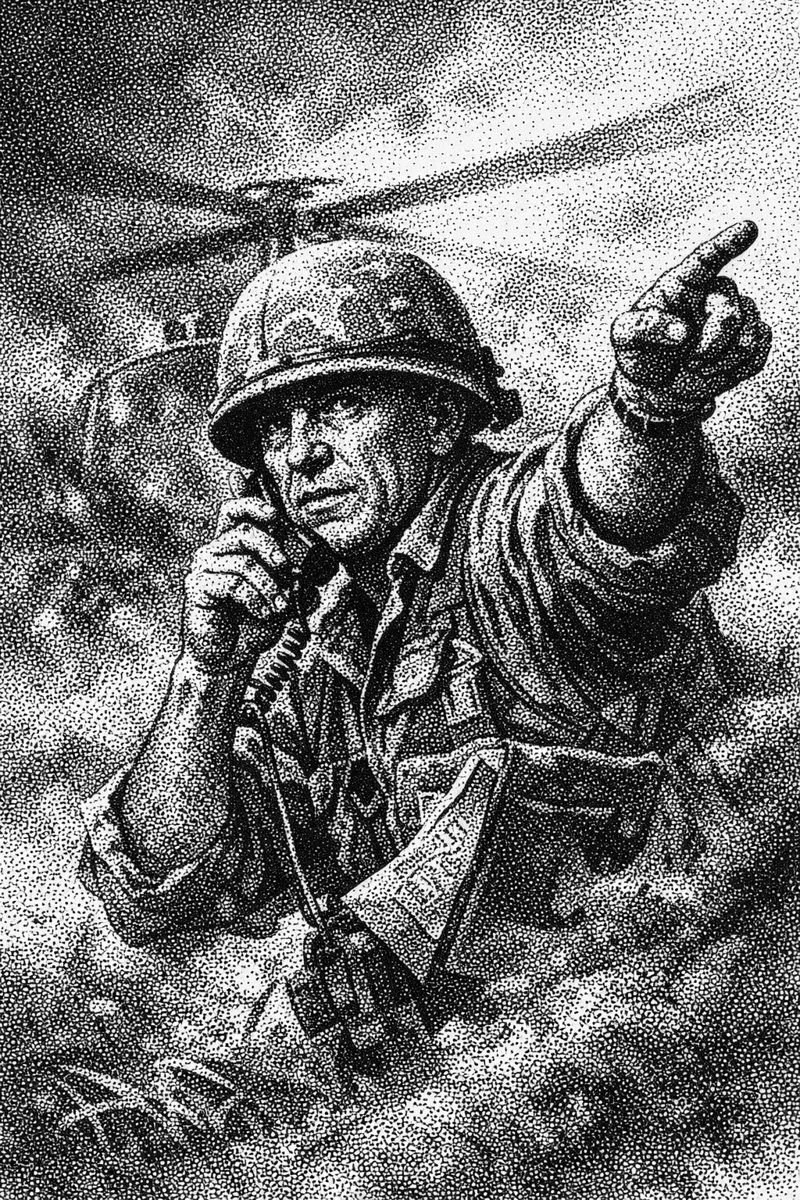
(1922-2017)
Calm commander of chaos at Ia Drang.
“If we survive this, it will be because the enemy runs out of bullets or we run out of men.”
Attribution disputed. Accuracy not.
The jungle at LZ X-Ray was breathing that morning. Not metaphorically. Literally. The elephant grass heaved as if it had lungs, and the hills exhaled AK fire like a cough that had been waiting all night. Helicopter rotors chopped the air into nervous confetti. Men spilled out, boots sinking into red dirt that had never met an American before and would soon meet too many. Somebody was already screaming. Somebody else was already dead. The calendar said November 1965. The map said Ia Drang Valley. The truth said Welcome to Vietnam, please keep your hands inside the war at all times.
Hal Moore stepped into it like a man walking into church with a shotgun and a hymnal. He was calm, which is another way of saying terrified but disciplined enough to hide it. He had a clipboard brain and a preacher’s cadence, a voice that could tell you to charge a machine gun and make it sound like a favor. His men called him “Sir.” History would call him “legend.” The jungle called him “target.”
Before he was a name carved into after-action reports, Moore was a farm boy with math in his bones and West Point polish on his boots. Born in 1922, he came up in a century that treated young men like spare parts. World War II taught him that courage was contagious and stupidity was fatal. Korea taught him that hills have opinions and winter is a collaborator. By the time Vietnam came calling, Moore had already been introduced to the idea that wars do not care about résumés. He believed in preparation the way some men believe in God. He believed in taking care of soldiers the way other officers believed in medals.
Ia Drang was the test case for a new American religion: airmobile warfare. Helicopters were the gospel. Speed was the sacrament. Surprise was the miracle. Moore’s 1st Battalion, 7th Cavalry would be dropped into the Central Highlands like a thrown knife and told to make sense of it. Intelligence suggested a couple of enemy battalions nearby. Intelligence also suggested the war would be quick, which should tell you how reliable it was.
The first landing was textbook. The second landing was history biting back. The North Vietnamese Army came down from the hills like accountants with rifles, meticulous and furious. They hugged the Americans so close the artillery couldn’t tell friend from foe. The sky filled with tracers that looked festive until you remembered what they did to lungs. Moore ran the perimeter like a man trying to keep a leaking ship afloat with a whistle and authority. He put platoons where they needed to be, moved wounded under fire, and spoke into radios that crackled with other men’s fear.
At one point, a chunk of Moore’s battalion was cut off, surrounded, and reduced to a stubborn rumor. The enemy pressed. The grass burned. Bodies accumulated opinions. Moore ordered “Broken Arrow,” the code that meant every aircraft in the neighborhood should show up armed and angry. Jets screamed overhead. Bombs stitched the jungle. The air smelled like gasoline, blood, and bad decisions.
This was the moment that made him immortal. Not because he won. He did not win. He survived, which in Vietnam was the deluxe package. He kept his men together long enough for the math of air power and stubbornness to outweigh the math of ambush. He refused to leave the field until the last wounded was lifted out, which sounds obvious until you watch how often it is not done. When the helicopters finally came back, the clearing was a ledger of names and numbers. Moore counted them like a priest counting rosary beads. He had brought too few men into a place that wanted more. He brought most of them out anyway.
The battle raged on after X-Ray, because Vietnam did not believe in endings. Another landing zone named Albany turned into a slaughterhouse without Moore’s hand on the wheel. The lesson was written in blood and promptly misfiled. The war went on, because wars always do when they are profitable to abstraction.
Moore went on too. Promotions came. So did the weight. He retired a lieutenant general, which is the rank you get when the Army decides you are done absorbing shrapnel. He spent his later years telling the truth as carefully as he once planned assaults. He wrote about Ia Drang with Joseph Galloway, a journalist who bled the same dirt. The book was not a victory lap. It was a receipt. It said what happened and who paid.
Then pop culture showed up with a camera and a square jaw. Hollywood sanded the rough edges, taught the helicopters to pose, and cast Moore as a marble bust that could talk. The movie needed heroes. The war needed none. The audience needed a way to feel proud without feeling responsible. Myth obliged. Moore became a symbol of the Good Officer, the one who did it right in a war that did almost everything else wrong. It is a comforting story, and therefore incomplete.
Here is the irony that stings. Moore did not die screaming in a jungle with a radio clenched in his teeth. He did not catch a stray round in a place nobody could pronounce. He died in 2017 at home, old, full of stories, surrounded by family. This is not a punchline. It is a fact that refuses to be cinematic. The men he led did not all get that ending. The war did not get that ending. History rarely does.
If there is madness here, it is the quiet kind. The belief that discipline can out-argue chaos. The hope that care can blunt cruelty. The stubborn insistence that leadership matters even when the cause is crooked. Moore was not a saint. He was an officer in a war that burned villages and lied to itself. He was also a man who stood where the bullets were thickest and made decisions that kept other men alive. You can hold both truths without dropping either.
The jungle at Ia Drang has grown back. It always does. The elephant grass breathes again. Somewhere under it, the ground remembers. Moore’s name is carved into books and stones, into a story that America tells itself when it wants to believe there was honor in the mess. There was. There was also mess. The trick is not confusing one for the other.
Warrior Rank #139
Sources and Suspects
Moore, Harold G. and Joseph L. Galloway. We Were Soldiers Once… and Young.
Galloway, Joseph L. Field reporting from the Ia Drang Valley, 1965.
U.S. Army after-action reports, Battle of Ia Drang.
Hollywood, which should always be cross-examined.
The jungle, which never testifies twice.

Alexander Nevsky was a 13th-century Russian prince famed for defeating invading forces at the Battle on the Ice in 1242. He became a national hero and later a saint, remembered as both warrior and shrewd diplomat.
Rank - 115