Albert Jacka
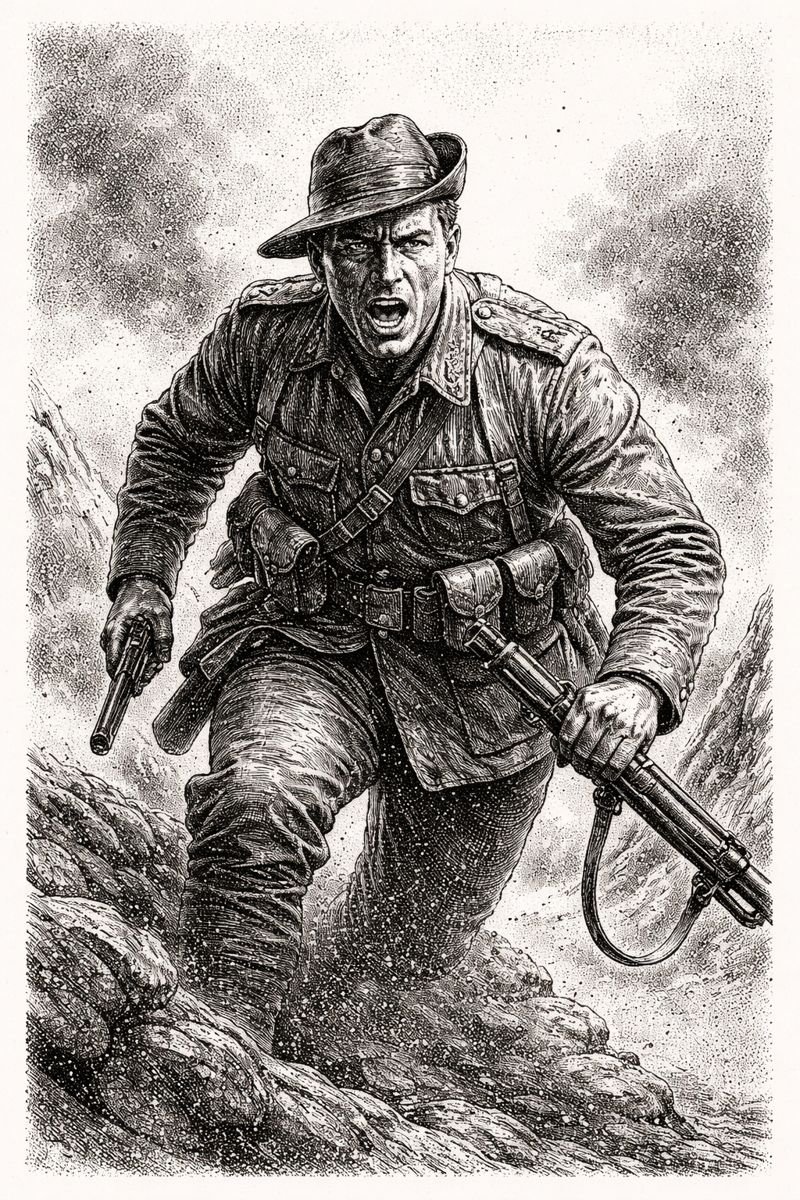
(1893-1932)
Australian soldier whose reckless courage at Gallipoli forged legend forever.
“If you want heroes, bring a shovel.”
Attributed to no one in particular, because the dead rarely bother correcting us.
The trench is choking on smoke and bad decisions. Dawn is a rumor. The Turks have just finished taking the trench and the Australians are deciding whether this war will be a long list of excuses or a short list of graves. Somewhere in the mess stands Albert Jacka, a private with a bad haircut and the sort of face that says he has already forgiven you for what you are about to do to him. He is twenty-two. He has a rifle. He has enough ammunition to ruin a morning.
Gallipoli does not care about your plans. Gallipoli is a meat grinder bolted to a cliff, humming patriotic tunes while it eats boys. Jacka’s trench has been rolled, the enemy inside it like an argument you cannot win politely. So Jacka does not argue. He vaults the parapet with two mates, bullets stitching the air like angry tailors. The Turks fire. Jacka fires back. Then he fires again. He moves like a man late for his own funeral. When the smoke thins, the trench is Australian again and the bodies are mostly not. Jacka is alive, which is a statistical error the army decides to decorate.
That is the moment the legend pretends it all began. It didn’t.
Jacka grew up in Winchelsea, Victoria, the kind of place that teaches you how to work and how to shut up. He joined the army because the world was burning and because the posters promised adventure and because young men are a renewable resource. He was not tall. He was not rich. He did not have a voice that filled rooms. He had a spine that refused to fold. The army likes spines like that. It can strap rifles to them.
The Victoria Cross citation would later polish the blood off the story. “Conspicuous bravery.” “Outstanding gallantry.” Words like medals, bright and round and good at hiding holes. The truth is simpler and uglier. Jacka charged into a trench because retreat is sometimes more dangerous than stupidity. He killed men at close range because war is intimate even when it pretends to be grand. He survived because the universe occasionally flips a coin and lands it on its edge.
Australia needed a hero. Gallipoli needed a distraction. Jacka became both. Newspapers minted him. Speeches borrowed him. Mothers slept easier with his name on their lips. The army promoted him, which is what you do to men who prove they can absorb punishment. He did not turn into marble. He turned into an officer, which is worse. Officers get to lead from the front and die with paperwork unfinished.
France came next, because if Gallipoli was a knife, the Western Front was a factory that manufactured knives and tested them on the workforce. At Pozières, in the Somme, the ground itself had PTSD. Shells fell until the earth forgot how to be earth. Jacka ran messages through barrages like a courier for Hell. He took shrapnel, bullets, bad luck. He kept going. Men followed him because someone had to go first and because Jacka did not ask for anything he would not bleed for.
Then Bullecourt. April 1917. Snow. Wire. Machine guns chewing through optimism like a woodchipper. Jacka led an attack that went wrong the way attacks go wrong, with precision. He charged German posts, revolver barking, grenades popping like obscene punctuation. He was hit again and again. He refused to lie down, which the army admires until it doesn’t. He was recommended for another Victoria Cross. Bureaucracy, that final boss, said no. He received a bar to his Military Cross instead, a consolation prize shaped like a shrug.
The decisive act had already been done back on the peninsula. Immortality is not a cumulative score. It is a spike. Jacka’s spike was that trench, that morning, that refusal. Everything afterward was interest on the debt.
The war did not kill him. It simply took notes. When the guns stopped, Jacka came home with medals and pain and a nervous system tuned to explosions. He tried to live like a civilian, which is to say he tried to sleep without listening for footsteps that weren’t there. He married. He worked. He broke down. Shell shock was the polite term, as if his mind had been gently tapped instead of rearranged with a sledgehammer.
In 1932, the body finished what the war had started. A brain hemorrhage took him at thirty-nine. No enemy bullets. No last stand. Just a quiet room and the long echo of things that never really end. The newspapers wrote it up nicely. The funeral was large. The myth was comfortable. Heroes, it turns out, are easier to bury than the wars that make them.
Afterward, the story did what stories do. It slimmed. It shined. Jacka became the first Australian VC of the Great War, a statue with a rifle, a name on schools and parks. The trench lost its smell. The bodies lost their faces. Propaganda tucked him into a narrative where courage is clean and death is a comma. Pop culture kept the good parts and left the rest in a footnote labeled “context.”
The joke, if you like jokes with teeth, is that Jacka never wanted to be a symbol. He wanted the trench back. He wanted his mates alive. He wanted the noise to stop. Instead, he got immortality, which is a kind of afterlife run by committee.
So remember him correctly. Not as a bronze saint, but as a man who sprinted into a stolen trench because waiting felt worse. Remember that bravery is not a personality trait. It is a decision made in bad light with worse options. Remember that medals are cold and heavy and they do not keep you warm at night.
And if you need a moral, bring a shovel.
Warrior Rank #128
Sources, because even legends need receipts:
• Charles Bean, Official History of Australia in the War of 1914–1918
• Australian War Memorial archives on Albert Jacka
• Peter Stanley, various lectures and essays on Gallipoli and the Western Front
• Rumors whispered by trenches that never quite filled in
Immortality came cheap that morning; the interest has been compounding ever since.

Alexander Nevsky was a 13th-century Russian prince famed for defeating invading forces at the Battle on the Ice in 1242. He became a national hero and later a saint, remembered as both warrior and shrewd diplomat.
Rank - 115