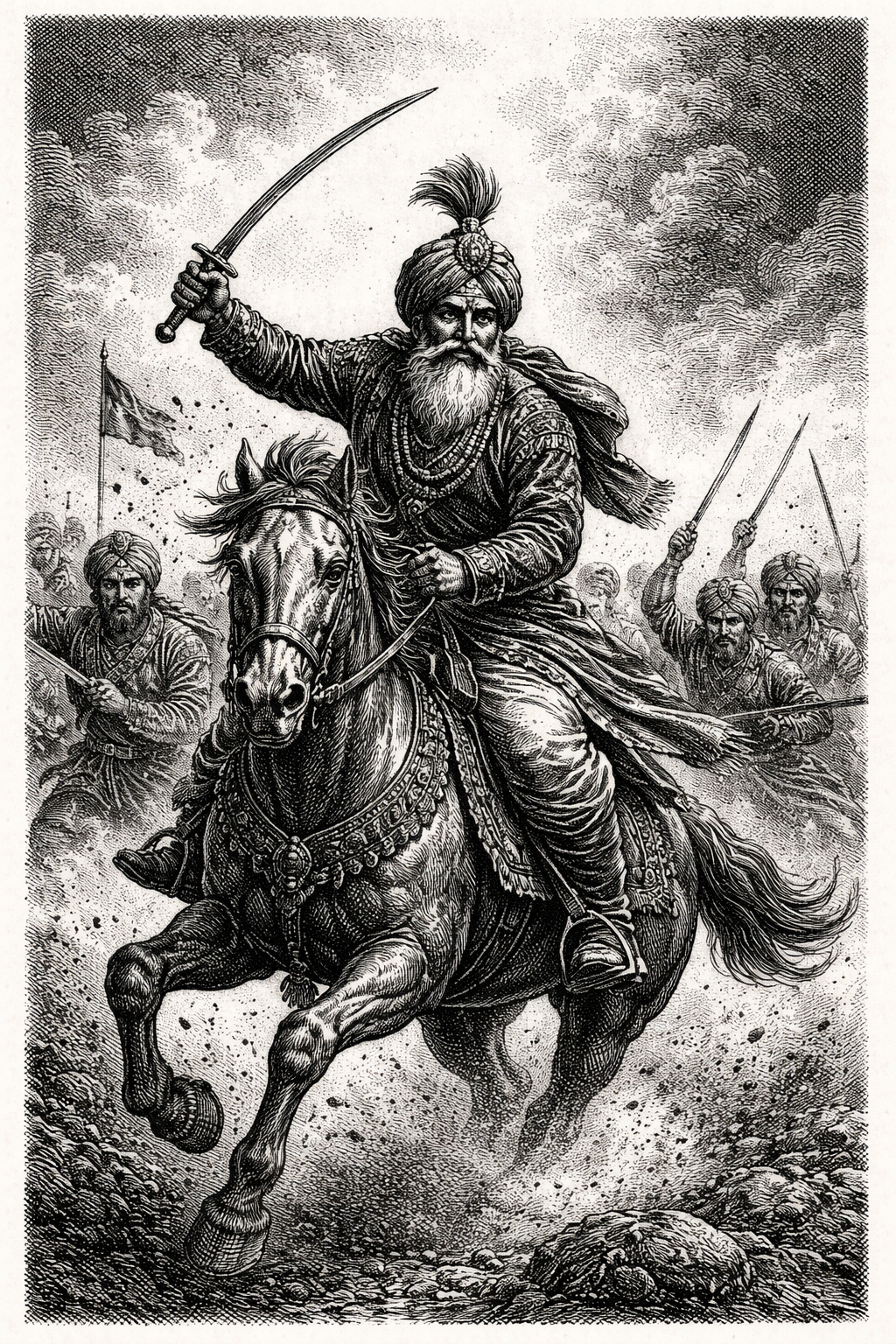
(1780-1839)
One-eyed lion forged empire, balanced faith, defied empire’s shadow.
“God intended the sword to be drawn, not polished.”
— Attributed to Ranjit Singh, who preferred results to etiquette
The cannon smoke hangs low over Multan, thick as overcooked porridge, and somewhere in it a one-eyed king is smiling.
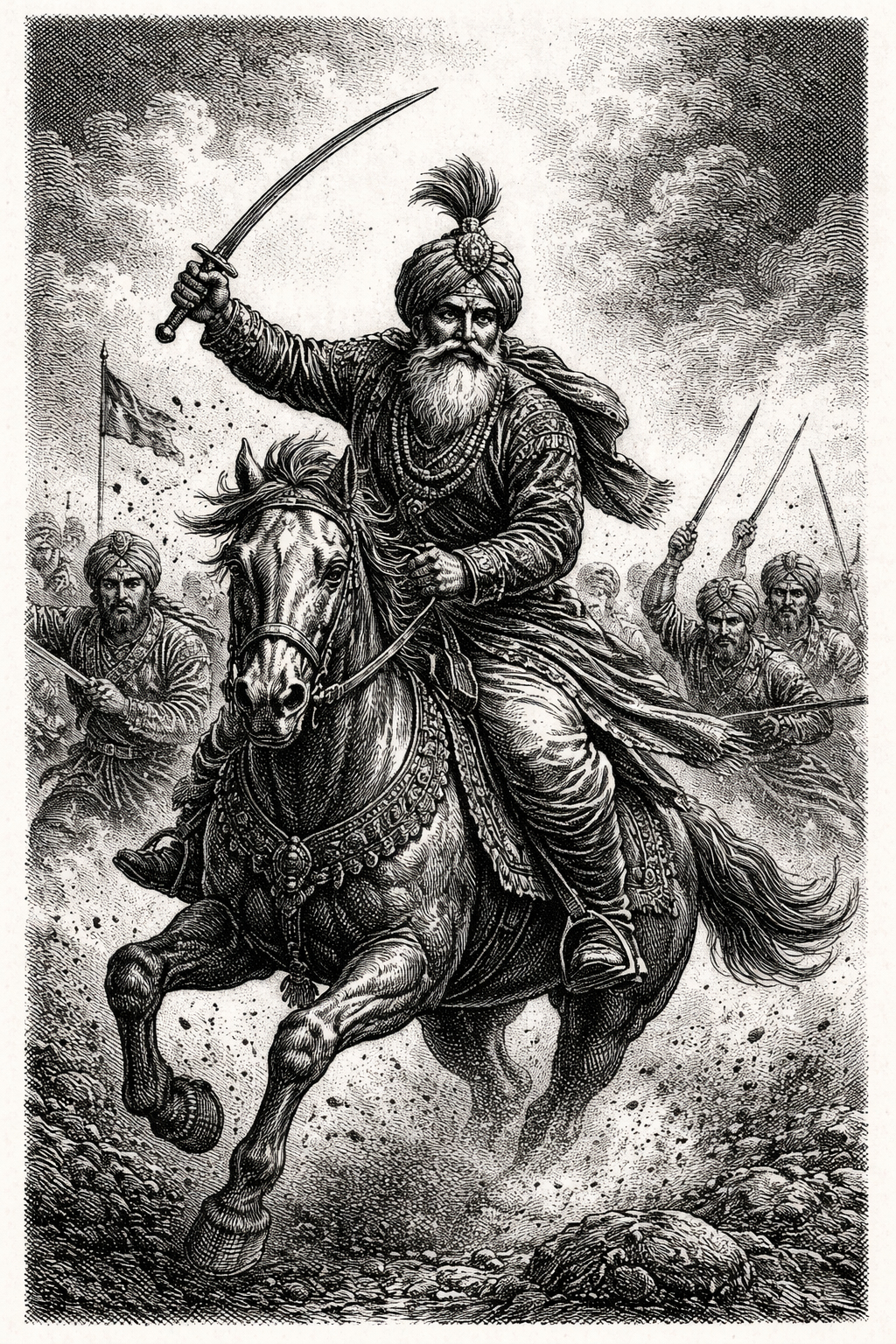
It is 1818. The fortress of Multan has been sulking in the Punjab heat for centuries, walls baked brick-hard, banners fluttering with stubborn theological confidence. Inside, Afghan defenders pray loudly. Outside, Sikh artillery answers with mathematics. The Maharaja sits his horse like a man who has already calculated the outcome and merely waits for the paperwork to catch up.
He has one good eye. The other was taken by smallpox when he was a child, leaving his face pitted and lopsided, as if the gods had tried to erase him and ran out of ink. He does not look like destiny. He looks like a warning label.
The guns thunder. Dust rises. A breach yawns open in the wall. Sikh infantry surge forward, turbans flashing like a field of defiant sunflowers. Men die in languages that share no verbs. The Maharaja watches without flinching. He does not waste expressions on the inevitable.
This is not a holy war. It is bookkeeping with bayonets.
The One-Eyed Cub
Ranjit Singh was born in 1780 into the Sukerchakia misl, one of the fractious Sikh confederacies that turned Punjab into a competitive sport. His father, Mahan Singh, died when the boy was barely ten, leaving him a saddle, a sword, and a region that functioned like a bar fight without a bartender.
The Punjab of his youth was a geography of grudges. Afghan warlords rode in from the west. Local chiefs raided one another for honor and cattle, often confusing the two. The great Mughal Empire was wheezing toward its exit, leaving power scattered like broken crockery.
The boy with one eye learned early that sentiment is a luxury item. He grew up in the saddle. He negotiated when possible and conquered when bored. By his teens, he was leading men twice his age into skirmishes that felt less like battles and more like auditions for survival.
He was not conventionally handsome, nor conventionally gentle. He drank heavily. He kept multiple wives. He collected European officers like exotic cutlery. But he possessed the rare talent of seeing a map not as it was, but as it could be rearranged.
Building an Empire with One Good Eye
In 1799, at nineteen, he rode into Lahore. The city had been passed around like a ceremonial cup for decades. Ranjit Singh took it and did not pass it back.
He declared himself Maharaja in 1801, not of a tribe, not of a faction, but of a kingdom. The Sikh Empire was not yet an empire. It was an argument with aspirations.
He did something radical: he stabilized it.
Ranjit Singh did not massacre for sport. He preferred incorporation. Muslims, Hindus, Sikhs served in his court. He repaired mosques. He patronized temples. He gilded the Harmandir Sahib, the Golden Temple at Amritsar, until it gleamed like a theological disco ball. His rule was stern but pragmatic. Taxes were collected. Roads were secured. Trade moved.
He modernized his army with European drillmasters, including veterans of Napoleon’s wars. Infantry marched in tight formations. Artillery roared with professional enthusiasm. Cavalry still rode like the apocalypse on horseback.
The Afghans tested him. He tested back. Peshawar fell under his sway. Multan fell in smoke and brick. Kashmir joined the ledger. Each conquest was less a blaze of fanaticism than a quiet note: acquired.
The British East India Company hovered to the east, sniffing the subcontinent like a patient hyena. Ranjit Singh understood this. In 1809, he signed the Treaty of Amritsar with the British, freezing expansion south of the Sutlej River. He chose containment over collision.
It was not cowardice. It was calculus.
The Decisive Act
If there is a single act that made him immortal, it was not a single charge or duel. It was restraint.
In an era when most regional rulers either flung themselves suicidally at the British or collapsed into polite irrelevance, Ranjit Singh held them off without fighting them. For decades, the Sikh Empire stood as the last major independent power in northern India.
He maintained a disciplined army, a centralized administration, and a treasury that did not resemble a hole in the ground. He kept the Afghans at bay. He kept the British at arm’s length.
This is less cinematic than dying under a hail of musket balls, but far more impressive. He created a state that worked.
Multan’s walls crumbled. Kashmir bowed. Lahore glittered. The empire stretched from the Khyber Pass to the edge of British influence, a muscular buffer state carved by a man half-blind and fully stubborn.
He was called Sher-e-Punjab, the Lion of Punjab. Lions, it turns out, are often bureaucrats with better marketing.
The Rot Beneath the Gold
Power, however, is a banquet with a built-in hangover.
Ranjit Singh aged into excess. He drank more heavily. His court grew ornate and treacherous. Factions sharpened their knives behind velvet curtains. He had sons, but succession planning was apparently a hobby he meant to start tomorrow.
When he died in 1839, likely from complications of stroke and a body thoroughly marinated in alcohol, the empire did not shatter immediately. It cracked.
The crack widened.
Within a decade, the Sikh Empire imploded in a series of court intrigues, assassinations, and civil strife that made earlier chaos look like rehearsal. The once-formidable Khalsa army, proud and disciplined, became a political actor with opinions and cannons.
The British, patient as ever, stepped in.
The Anglo-Sikh Wars followed. By 1849, Punjab was annexed. The Lion was gone. The hyena inherited the field.
Ranjit Singh did not die in battle. He died in a palace, diminished by illness, watching an empire he had welded together begin to loosen at the seams. His funeral saw several of his wives commit sati, immolating themselves on his pyre in a final blaze of ritual devotion. Fire, smoke, and spectacle. A monarch’s exit wrapped in both grandeur and grief.
He had conquered cities with artillery. In the end, fever and faction conquered him.
The Afterlife of a Lion
History treats Ranjit Singh kindly, sometimes too kindly.
In Sikh memory, he is the golden age incarnate. A just ruler. A defender of the faith. The man who made Punjab stand tall between Afghan raids and British ambition. His image appears in paintings, statues, textbooks, heroic and resolute, the missing eye rendered as character rather than damage.
British chroniclers, grudgingly respectful, described him as shrewd, energetic, and formidable. They preferred him alive and reasonable to his successors, who were less predictable and therefore more convenient to defeat.
Modern nationalism polishes him further. He becomes the template for lost sovereignty, the ruler who proved that an indigenous state could modernize, administer, and compete without foreign supervision.
The drunkenness fades in retelling. The court intrigue is softened. The administrative genius is burnished. The inconvenient fact that his empire collapsed almost immediately after his death is treated as betrayal rather than structural fragility.
He is remembered as a lion.
Lions, of course, rely on the pride. Remove the lion and see what remains.
Smoke Clears
Back at Multan, the smoke thins. The breach is secured. The Afghan banners fall. Ranjit Singh’s artillery crews wipe soot from their faces. The fortress that had stood for centuries now belongs to a one-eyed king who refused to blink first.
He does not cheer. He nods.
Cities fall. Empires rise. Empires rot. Even lions eventually cough.
Ranjit Singh built something rare in his time: a state that functioned. He held chaos at bay with discipline, diplomacy, and the occasional well-aimed cannon. He stared down Afghans and outmaneuvered the British without firing a shot at them.
He proved that in a century of imperial appetites, survival could be a form of defiance.
And then he died, and survival died with him.
In the end, the Lion of Punjab discovered what all empire builders learn too late: it is easier to take a kingdom than to make it outlive you.
Gunpowder fades; the paperwork remains.
Warrior Rank #120
Sources
Khushwant Singh, Ranjit Singh: Maharaja of the Punjab
J.S. Grewal, The Sikhs of the Punjab
Patwant Singh & Jyoti M. Rai, Empire of the Sikhs
Jean-Marie Lafont, Maharaja Ranjit Singh: Lord of the Five Rivers
“Official Guide to Empire Building with One Eye Closed,” unpublished, probably for the best

Alexander Nevsky was a 13th-century Russian prince famed for defeating invading forces at the Battle on the Ice in 1242. He became a national hero and later a saint, remembered as both warrior and shrewd diplomat.
Rank - 115