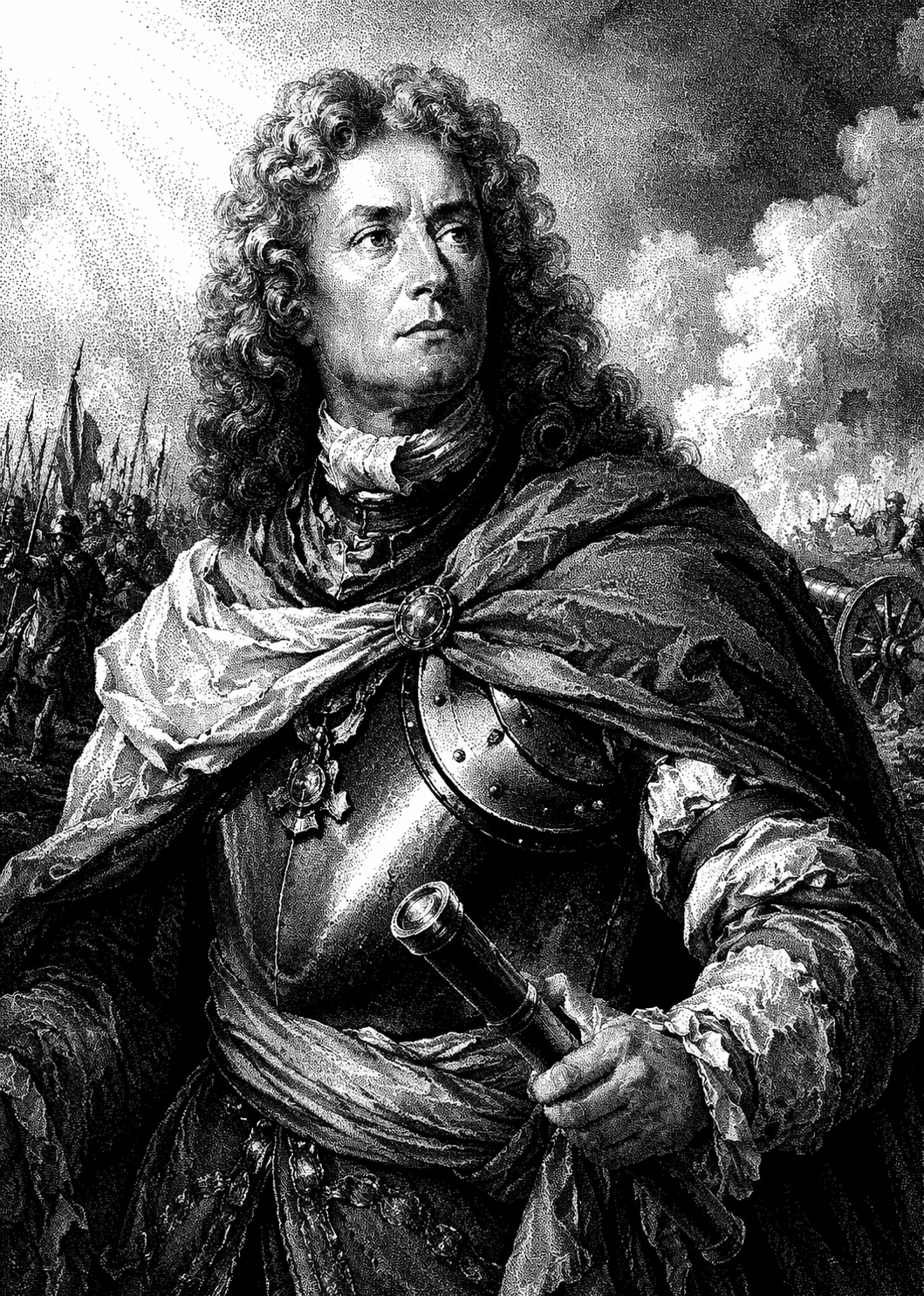
(1663-1736)
Rejected by France, he conquered Europe with surgical violence.
“The Turks said I was too small to matter. Then they met the mathematics of artillery.”
— attributed to Prince Eugene of Savoy, probably after several victories and one excellent bottle of wineThe morning at Zenta in 1697 began the way many famous disasters do: with confidence, paperwork, and a river crossing.
The Ottoman Empire army, huge and glittering, was strung across the Tisza River like a jeweled centipede. Wagons, cannon, janissaries, cavalry, servants, cooks, mules, banners, accountants, and whatever bureaucratic species produces seventeen seals for one bridge permit. Half the army was over the water, half still waiting, all of it vulnerable in the most expensive traffic jam in Europe.
Then Eugene arrived.
He was not built like a heroic statue. He was small, thin, pale, and looked less like a conqueror than a clerk who had been denied lunch. France had rejected him for military service years earlier, deciding this undersized nobleman lacked the proper martial glamour. This was a catastrophic hiring error on the level of passing on fire because it looked too warm.
Born in Paris in 1663 to the exiled House of Savoy, Eugene had spent youth amid court scandal and polished venom. His mother was entangled in the poisons and gossip of Louis XIV’s court. Eugene himself was intended for the church, because aristocratic families often handled surplus sons the way people handle spare socks. But Eugene wanted war, not vestments. Louis looked him over and declined. Somewhere in heaven, irony began warming up.
So Eugene took his sword to the enemies of France, joining the Habsburg Monarchy. If Louis XIV built Versailles, Eugene built a long and personal revenge letter in smoke.
At Zenta, he saw what many commanders miss: opportunity wearing a stupid hat.
He attacked immediately. No long debate. No elegant memorandum. No committee on bridge etiquette. Imperial guns opened, cavalry hit the flanks, infantry drove into the trapped Ottoman masses. Men drowned, horses screamed, cannon overturned, officers vanished under panicked crowds. The bridge became a machine for turning rank into corpse. The Grand Vizier died. The Sultan barely escaped. Thousands were killed. Treasure, standards, artillery, prestige, all swept away in one afternoon of disciplined murder.
Europe called it genius. The dead called it a scheduling issue.
Zenta made Eugene immortal, but it was not his only masterpiece. He fought the Louis XIV’s armies in the west and the Ottomans in the east, because some men diversify portfolios while others collect enemies. During the War of the Spanish Succession, he partnered with John Churchill, 1st Duke of Marlborough, producing one of history’s great buddy-cop pairings if buddy-cop films ended with entire regiments shredded by grapeshot.
At Battle of Blenheim, they smashed the French and Bavarians so hard the myth of French invincibility needed reconstructive surgery. At Battle of Oudenarde and Battle of Malplaquet, Eugene displayed his favorite talents: persistence, nerve, and the ability to continue functioning while surrounded by noise, blood, and the kind of staff work that causes ordinary men to fake illness.
Then east again. In 1716 at Battle of Petrovaradin, he defeated another Ottoman army despite being outnumbered. In 1717 came the siege of Belgrade, where plague stalked camps, shells fell nightly, and morale was a rumor. Eugene responded by launching a surprise assault through fog and chaos. It worked, because sometimes the line between genius and lunacy is measured only afterward.
Belgrade fell. Europe cheered. Somewhere an Ottoman clerk began drafting a memo titled Concerning This Horrible Little Man.
Yet greatness is a taxidermist. It preserves the hide and hides the smell.
Eugene’s campaigns were feats of logistics, brutality, and relentless administration. He knew supply mattered more than speeches, artillery more than ancestry, timing more than costume. He also knew victory required spending men like coins. This was not unusual for the age. It was merely efficient. Kings praised him because he won. Soldiers praised him if alive. Widows were unavailable for comment.
He became wealthy, powerful, and cultivated. Built palaces. Collected art. Sponsored architecture. The same hand that signed orders sending grenadiers into cannon smoke also selected tasteful ceilings. Civilization often rests on beams planed by butchers.
As for downfall, it was disappointingly tidy. No dramatic stabbing in a tent. No mutiny. No horse launching him into a ditch. Eugene died in Vienna in 1736, aged seventy-two, after illness and gradual decline. The body that had ridden through campaigns, fevers, sieges, and politics was finally defeated by the oldest assassin: time. It is a rude ending for men who expect artillery.
His estates were disputed. His treasures scattered. His political influence faded almost immediately, because governments mourn heroes the way cats mourn furniture.
Then came the afterlife of myth.
The Austrian Empire turned him into marble competence. Patriotic songs praised him. Paintings enlarged him several inches and improved the jawline. Later Europe remembered him as the Christian shield against the Turk, a simplification historians loathe and propagandists adore. In German lands, the marching song “Prinz Eugen, der edle Ritter” polished him into a stainless knight. Real Eugene, who navigated intrigue, money, vanity, slaughter, and alliance politics, was more interesting and less singable.
Modern memory does this often. It turns difficult men into easy statues.
Still, beneath the varnish remains a startling fact: the French king rejected a frail young nobleman, and that rejected applicant spent the next half-century humiliating France and breaking Ottoman armies. Human resources has rarely authored such comedy.
He was too small for the parade ground, too sharp for the court, too cold for sentiment, and too competent for mercy.
Some men are born giants. Others are manufactured by insult, then sharpened on battlefields.
Prince Eugene was the latter, and Europe paid for the lesson in blood.
Warrior Rank #118
Sources, reputable and otherwise:
Derek McKay, Prince Eugene of Savoy
John A. Lynn, The Wars of Louis XIV
Christopher Duffy, The Military Experience in the Age of Reason
The Prince of the Marshes
Several terrified Ottoman witnesses who suddenly respected short people

Alexander Nevsky was a 13th-century Russian prince famed for defeating invading forces at the Battle on the Ice in 1242. He became a national hero and later a saint, remembered as both warrior and shrewd diplomat.
Rank - 115