Roy Benavidez
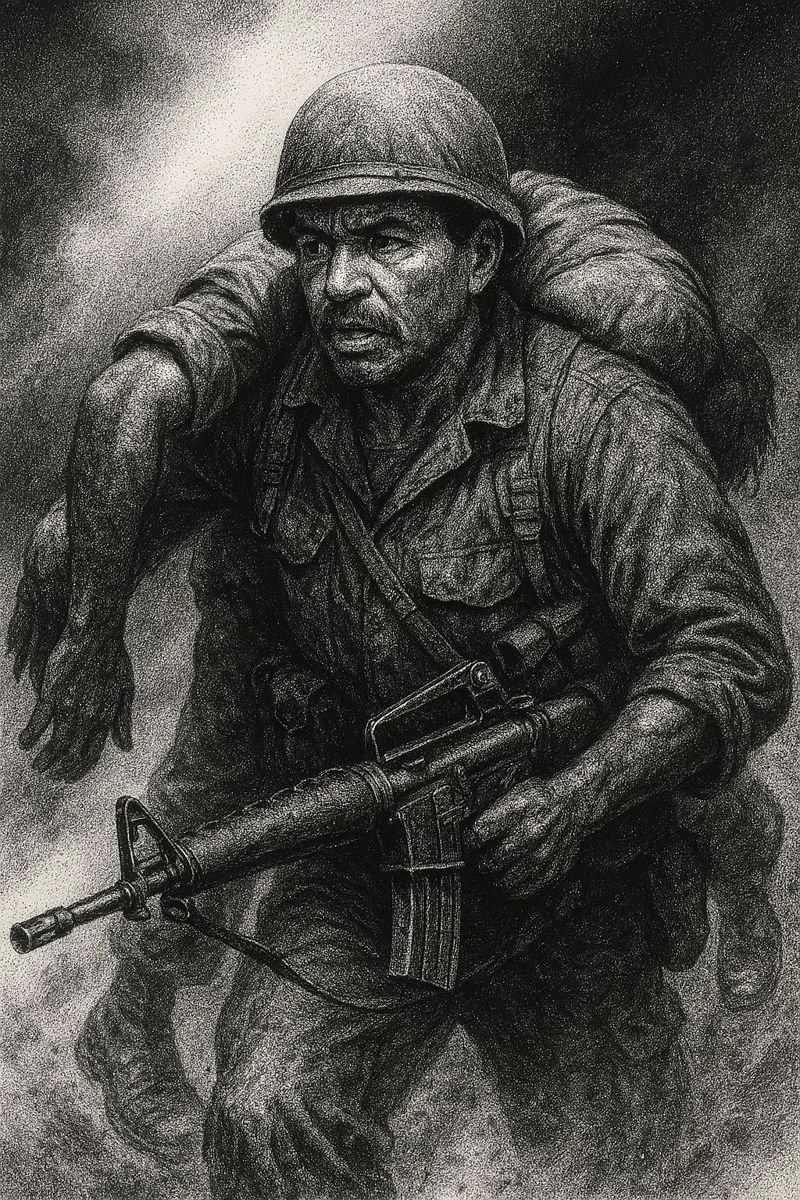
(1935-1998)
Medal of Honor medic who defied mortal limits rescuing comrades
“When you’re this deep in it, you don’t pray for life. You pray for better aim.”
— attributed to an unnamed Green Beret
It starts with the sound of bees.
Not the soft, summer kind—these are 7.62-millimeter bees, angry, endless, and carving through jungle humidity thick enough to choke God himself. A helicopter shudders overhead, dragging its tail through tracer fire. Inside it is Master Sergeant Roy Benavidez, half-dead from a Saturday hangover and about to audition for sainthood with bullets for applause.
The call came over the radio: a 12-man reconnaissance team surrounded somewhere west of Loc Ninh, deep in Cambodian no-man’s-land. Extraction impossible. Enemy count: “hundreds.” American response: “Send Roy.” Because when Hell throws a party, there’s always one guy who kicks the door in without an invite.
Benavidez didn’t hesitate. He grabbed a medic bag, a knife, and a rifle that wasn’t his. No body armor. No helmet. No plan. He sprinted straight into the helicopter as it spun up, told the crew chief, “Let’s go get my boys,” and jumped into history like it owed him rent.
Roy Benavidez wasn’t born a legend; he was born in Texas, which is close. 1935, a half-Mexican, half-Yaqui kid in Cuero, raised picking cotton and fighting whoever looked at him wrong. Orphaned young, schooled by fists and hunger, he learned early that pain was negotiable. He joined the Texas National Guard at 17, partly for a uniform, partly for three meals a day. Later, the Army took him to Korea, then Vietnam.
In 1965, a land mine introduced him to the concept of career-ending injuries. They said he’d never walk again. Roy disagreed. He dragged himself out of his hospital bed at night, crawling along the floor until he could stand. Months later, he limped back into active duty, saluted the doctors who’d written him off, and went straight to the Special Forces. Because when you tell Roy Benavidez “you can’t,” he hears “hold my beer.”
Flash forward to May 2, 1968. The jungle smells like old blood and bad choices. The rescue helicopter hovers low over a clearing full of corpses and muzzle flashes. Benavidez looks down and sees his friends dying, one by one. He doesn’t think. He just jumps.
He hits the ground, instantly catches a bullet in the leg, and keeps running. Gets hit again in the face, again in the arm. Doesn’t matter. The man is held together by hate and habit. He reaches the team, bleeding from everywhere, and starts patching holes—his and theirs. He throws grenades, fires bursts, drags men into a perimeter that barely qualifies as one. The NVA keep coming, because that’s what the script says they have to do before someone gets a medal posthumously.
Benavidez calls in air support with a radio soaked in blood. He gets hit again—bayoneted this time. He kills his attacker with a knife, stitches another man’s artery shut with a torn T-shirt, then runs back into the open to haul another body to safety. Repeat, repeat, repeat, like a meat grinder running on faith.
At some point the first helicopter goes down. He pulls survivors from that wreck too. Then he steals another bird to keep the evac going. By hour six, he’s holding his intestines in with one hand and a rifle with the other, mumbling prayers that sound suspiciously like threats.
When the last chopper lifts off, Benavidez climbs aboard, blood pouring from twenty-eight separate holes. He’s so shredded that the medics zip him into a body bag. Someone tags his toe. Roy, not one for paperwork, spits blood in the doctor’s face to remind him he’s not done yet.
Most people would’ve retired at that point to a quiet life of fishing and morphine. Roy went on the talk circuit. He told the story—not for glory, but to remind people that heroism isn’t a comic book panel; it’s six hours of screaming and dirt and trying to keep your friends from dying one minute longer.
The Medal of Honor came years later, after bureaucratic purgatory and the usual paperwork screwups. President Reagan handed it to him in 1981, saying, “If the story of Roy Benavidez were a movie script, you would not believe it.” Which was true—Hollywood wouldn’t have bought it. Too implausible. Too much blood, not enough survival.
By then, Benavidez was walking proof of something the military still doesn’t have a field manual for: the line between courage and madness. He lectured soldiers, students, and Congress with the same mix of humility and quiet fury. “I
In the decades that followed, the myth calcified. His story became patriotic currency—America’s Lazarus, the guy who took death out for a spin and brought it back smoking. Textbooks softened the edges, museums bronzed the grit. But listen to the men who were there and you’ll hear it differently: Benavidez wasn’t divine. He was human, just unreasonably so. Pain was a language he spoke fluently.
He died in 1998, not from bullets but from diabetes—proof that life, not death, is the crueler sniper. At his funeral, the Special Forces honor guard carried his coffin like it weighed nothing, because compared to the day he’d carried half a platoon out of the jungle, it didn’t.
If you want to understand Roy Benavidez, forget the medals and speeches. Picture a man, half-conscious, covered in blood that isn’t all his, dragging the wounded through fire and bamboo while swearing at the sky. Picture him laughing when the helicopter door finally slams shut, because he knows the joke: you don’t survive something like that—you just delay the paperwork.
He didn’t cheat death; he just made it file a change-of-address form.
Warrior Rank #127
Sources:
Benavidez, Roy P. Medal of Honor Citation, U.S. Army Archives (1981).
Reagan, Ronald. Medal of Honor Presentation Speech, White House, February 24, 1981.
Clarke, Jeffrey. Advice and Support: The Final Years, 1965–1973. Center of Military History, 1988.
Oral histories from the 240th Assault Helicopter Company, Vietnam Center & Archive, Texas Tech University.
“The Man Who Wouldn’t Die,” Soldier of Fortune Magazine, Vol. 5, No. 4 (1982).
“He Spit in Death’s Face and Lived to Tell It,” Possibly Every Texan Ever.

Alexander Nevsky was a 13th-century Russian prince famed for defeating invading forces at the Battle on the Ice in 1242. He became a national hero and later a saint, remembered as both warrior and shrewd diplomat.
Rank - 115