Francis Pegahmagabow
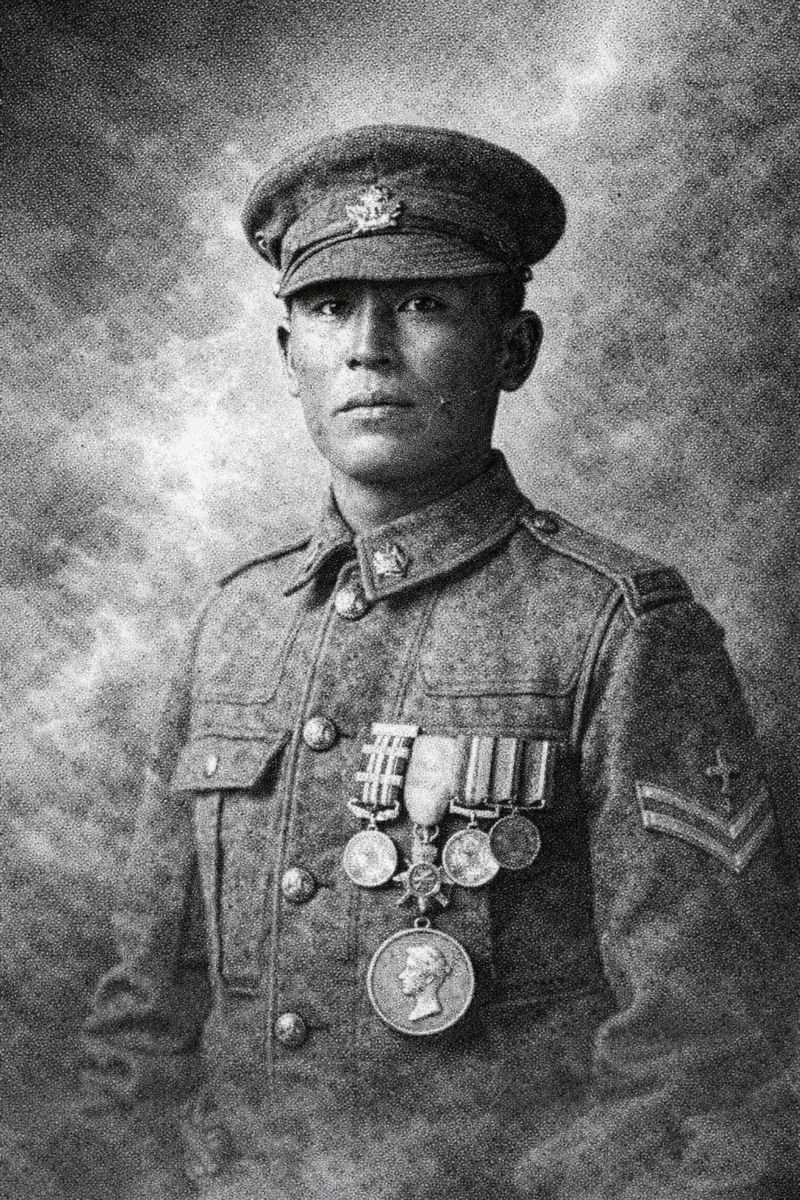
(1889-1952)
Silent hunter, Ojibwe warrior, war’s nightmare, medals heavy, justice ignored.
The fog rolls low over the Somme like a bad habit that won’t quit. Somewhere a flare goes up, white as a priest’s collar, and the night blinks. A German runner sprints between shell holes, boots slurping mud. He makes it five steps. Then nothing. No bang. No heroics. Just a body discovering gravity again.
Pegahmagabow lowers the rifle and exhales, as if the world had been holding its breath on his behalf. He does not grin. He does not pray. He notes the wind and waits. The war keeps coming.
This is not the kind of war that sings. It gargles. It smells like iron filings and wet wool and the future’s regrets. And in this throat of Europe, where nations choke on their own ambitions, a quiet Ojibwe man from Ontario is conducting a master class in disappearance. He is not hunting so much as editing the enemy out of the page.
The men around him whisper the nickname like a superstition. He prefers silence. Silence is how you hear footsteps. Silence is how you live long enough to learn that medals weigh less than survival and lie flatter in the dirt.
Origins, or How to Learn the Language of Trees
Francis Pegahmagabow grew up near Georgian Bay, raised by forests that taught patience and rivers that taught aim. Long before Europe taught him how to kill in straight lines, the land taught him how to wait without rotting. Tracking, shooting, reading weather as if it were a note passed in class. These were not tricks. They were manners.
When the Great War came calling in 1914, it did not ask politely. It demanded men. Canada obliged. Pegahmagabow enlisted, because history rarely consults the people it plans to use. The army taught him drills and salutes and the useful fiction that courage looks the same on everyone. He nodded and kept his own syllabus.
Rise, or The Mathematics of Vanishing
On the Western Front, Pegahmagabow becomes an arithmetic problem the enemy cannot solve. He racks up confirmed kills that climb past three hundred, plus hundreds of captured prisoners taken with a rifle, a bayonet, and the confidence of someone who understands fear better than the people currently experiencing it. He slips into no man’s land at night like a thought you try to forget. He crawls. He waits. He corrects errors.
The war tries to kill him again and again. He answers by refusing to be where the shell lands. He is wounded, gassed, stitched, sent back. He returns with a patience sharpened by survival. Medals arrive. The Military Medal. Then another. Then a bar on top like punctuation. He accepts them with the expression of a man receiving a receipt for something he already paid for in blood.
Men die loudly. Pegahmagabow kills quietly. It unnerves the generals. It terrifies the enemy. It saves lives on his side, which is the only statistic that matters to the people who have to go back out tomorrow.
The Decisive Act, or Immortality by Whisper
Pick a night. Any night. The rain is falling sideways, and the trenches are arguing with gravity. Pegahmagabow slips forward with a scout, ghosting through wire and crater. A German position coughs. He coughs back with a bullet that answers the question. Prisoners come willingly. Why wouldn’t they. The dark belongs to him.
This is how legends are made. Not with a charge. With subtraction. With the calm knowledge that you can end a life without announcing it, and therefore choose not to announce yourself either. The myth grows because fear loves a face even when it cannot see one. By war’s end, he is a rumor that walks.
After the Guns, or The Quieter Violence
The armistice arrives with trumpets and paperwork. Pegahmagabow goes home to a country that enjoys his medals at a distance and forgets the man attached to them. He finds that the war did not end so much as change uniforms. The silence he once used as a weapon becomes a wall.
He fights again, this time for his people, serving as a chief and an advocate. He argues with bureaucrats who mistake policy for morality. He petitions a nation that applauds the dead more enthusiastically than it listens to the living. The irony is surgical. The greatest sniper in Canadian history cannot hit a moving target called justice.
His body carries the war like a mortgage. Lungs that remember gas. Nerves that remember nights. He ages. The forest remains patient. The river keeps its aim.
Death, or The Cruel Joke
Pegahmagabow does not die in a blaze. He does not collapse theatrically under a flag. In 1952, his heart simply stops, as if it had decided it had already done enough. It is an anticlimax so perfect it hurts. After surviving machine guns and artillery and the geometry of hate, he is claimed by the same quiet that once saved him.
No gore. No irony for the newspapers to chew on. Just a man who outlived the war and was still outlived by the peace.
Afterward, or How the Story Gets Sanded Smooth
Time does what time does. It polishes. It simplifies. Pegahmagabow becomes a statistic, then a headline, then a paragraph in a textbook that forgets to mention the parts that do not fit. The army remembers the medals. Canada remembers the hero. It takes longer to remember the Ojibwe man who came home to a country that did not extend the same courtesy he once extended to enemy soldiers.
Pop culture likes its killers loud and its heroes uncomplicated. Pegahmagabow was neither. He was a lesson in restraint mistaken for savagery, a master of violence who understood its cost. The myth turns him into a cartoon sniper with a kill count. The truth is harder to merchandise. The truth waits.
And somewhere in a foggy field that now grows wheat instead of wire, the night still listens for the man who taught it how to be quiet.
Closing line: History applauds the shot, forgets the silence, and wonders why the echoes never learned to say thank you.
Warrior Rank #126
Sources and Ammunition
Tim Cook, Clio’s Warriors
Veterans Affairs Canada profiles and service records
Indigenous Veterans Association of Canada, oral histories
Regimental histories of the 1st Canadian Infantry Battalion
Trench rumors, survivor bias, and the ghosts who still refuse interviews

Alexander Nevsky was a 13th-century Russian prince famed for defeating invading forces at the Battle on the Ice in 1242. He became a national hero and later a saint, remembered as both warrior and shrewd diplomat.
Rank - 115