Wiliam Wallace
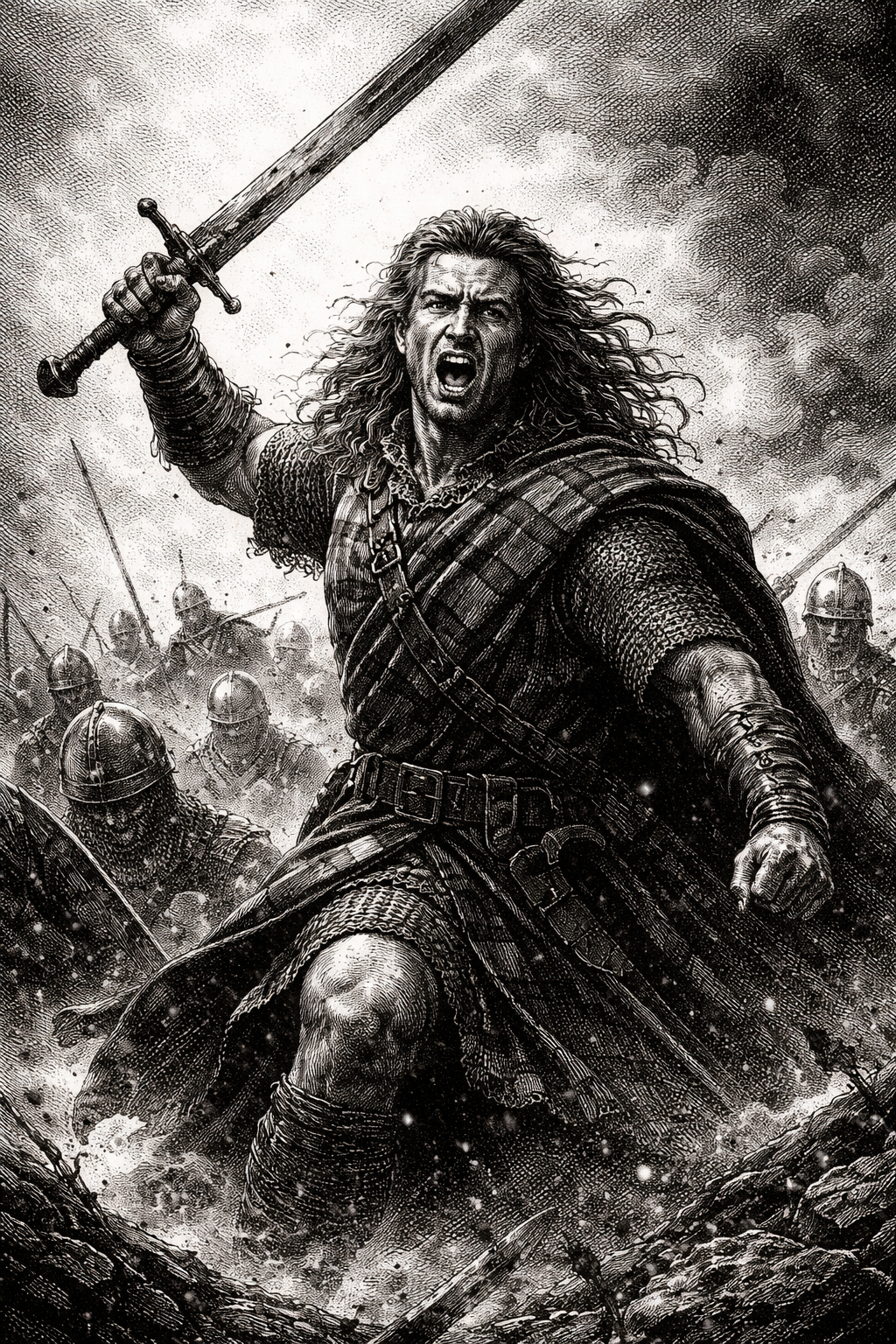
(c. 1270–1305)
Scottish rebel and Guardian; ambushed England at Stirling Bridge, lost to longbows at Falkirk, and was hanged, drawn, and quartered.
“I could not be a traitor to Edward, for I was never his subject.”
— attributed to William Wallace
The first thing you notice is the mud.
Not poetic mud. Not patriotic mud. Just brown, sucking, peasant-grade filth swallowing boots and pride in equal measure. It is September 1297 at the Battle of Stirling Bridge, and the English army has done something very English: formed up beautifully on the wrong side of a bottleneck.
Across the narrow wooden bridge over the River Forth, the Scots wait like unpaid bills.
Wallace is there somewhere in the smoke. Tall, they say. Or average. Or enormous. Medieval sources are allergic to tape measures. What we know is this: he understands timing. He lets the English pour across the bridge in tidy ranks, armored and confident, a column of steel threading itself into a trap. Then he closes the door.
The Scots charge.
It is less Braveheart ballet, more agricultural riot. Schiltrons bristle like homicidal hedgehogs. Pikes punch through mail. Horses scream in a register usually reserved for theological arguments. The bridge becomes a slaughterhouse conveyor belt. Men tumble into the river, dragged down by armor that cost more than their villages.
An English commander, Hugh de Cressingham, is killed. Later, according to hostile chroniclers, Wallace has a strip of the man’s skin made into a belt. Medieval propaganda often confuses bookkeeping with cannibalism, but the story sticks because it feels right. This is not a gentle rebellion.
By the end of the day, the river runs red and the Scots have accomplished something previously considered impossible: they have humiliated the crown of Edward I of England, also known as Longshanks, also known as the Hammer of the Scots. Hammers are not accustomed to being bent.
Wallace becomes a headline written in blood.
The Making of a Problem
He is born around 1270, probably in Renfrewshire. Son of a minor knight, not a king, not a mystic chosen by prophecy. A landholder’s child in a country increasingly annexed by English paperwork. Scotland in the 1290s is less freedom-roaring epic and more probate dispute. After the death of Alexander III and the Maid of Norway, the throne becomes a vacancy sign. Edward I steps in as “arbitrator,” which in medieval terms means “landlord with an army.”
Wallace grows up in this simmer. His father is likely killed in skirmishing with the English. By 1297, Wallace is not yet a national hero. He is a fugitive with a grievance and a talent for ambush.
One early story has him killing an English sheriff in Lanark, William de Heselrig. The reasons vary depending on who is writing. Some say it was revenge for the execution of Wallace’s wife, Marion Braidfute. Contemporary sources are thin. Later romantic accounts thicken like stew left too long on the fire. What we can say is this: a local killing escalates into insurgency.
Wallace is suddenly the face of a rebellion that had already begun under other nobles. He joins forces with Andrew Moray in the north. Together they wage a campaign of hit-and-run warfare that makes English garrisons nervous about leaving their tents to urinate.
Stirling Bridge is their masterpiece. After it, Wallace is knighted and declared Guardian of Scotland in the name of King John Balliol, who at this point is less king and more decorative hostage in England.
For a brief, dangerous moment, Wallace is not just a bandit. He is the state.
The Hammer Swings Back
Edward I does not appreciate improvisational sovereignty.
In 1298, at the Battle of Falkirk, the English army returns with patience and longbows. The Scots form their schiltrons again, circular fortresses of pikes. It works beautifully against cavalry. It works less beautifully against clouds of arrows.
The Welsh archers step forward. The sky darkens.
Arrows rain down in disciplined sheets, punching through gaps, killing horses, piercing men who cannot chase what they cannot reach. The English cavalry then smashes what remains. It is industrialized misery.
Wallace survives. Many of his men do not.
After Falkirk, he resigns as Guardian. This is the part Hollywood forgets. The rebellion does not die, but Wallace’s political capital does. He reportedly travels to France seeking support. The French king, busy with his own chessboard, offers polite sympathy. The Pope is petitioned. Letters are written. Europe nods thoughtfully and continues having lunch.
Wallace returns to Scotland to wage smaller campaigns. He is now less general, more ghost.
The Betrayal
In 1305, Wallace is captured near Glasgow by Sir John Menteith, a Scot loyal to Edward. It is not a battlefield death. It is paperwork catching up.
He is taken to London. The trial is swift. The charge is treason.
Wallace replies, according to chroniclers, that he cannot be a traitor to Edward because he never swore allegiance to him. It is a legally elegant middle finger.
Edward is not moved by elegance.
On August 23, 1305, Wallace is dragged naked through the streets of London behind a horse to Smithfield. The crowd gathers. Executions in medieval England are civic entertainment with light theology.
He is hanged but cut down while still alive. Then comes the drawing and quartering.
This is not metaphor.
He is disemboweled. His intestines are burned before him. His head is cut off. His body is divided into four parts. The pieces are sent to Newcastle, Berwick, Stirling, and Perth as reminders that empire has a long memory and a short temper.
His head is dipped in tar and displayed on London Bridge.
Thus ends the man.
The Birth of the Myth
Thus begins the legend.
In the immediate aftermath, Wallace is not universally adored. Some Scottish nobles considered him reckless, socially inconvenient, too fond of peasant warfare. But martyrdom is excellent branding.
Poets get to work.
In the 15th century, Blind Harry writes The Wallace, a sprawling epic that inflates Wallace to near-mythic proportions. Suddenly he is eight feet tall. Suddenly he is killing dozens in single combats. Suddenly his motives are purer, his enemies uglier, his sword sharper than reason.
Historical Wallace becomes narrative Wallace.
Centuries later, in 1995, Braveheart detonates in multiplexes. Mel Gibson paints his face blue, delivers speeches that medieval Latin never heard, and shouts “Freedom!” with such commitment that historians collectively spill their tea.
The film is inaccurate in dozens of ways. Kilts are wrong by centuries. Romance is invented. Politics are simplified into good Scots versus bad English with the nuance of a battle-axe. But cinema does not care about footnotes.
The myth swallows the man whole.
Wallace becomes shorthand for resistance. For nationalism. For righteous underdog fury. His image appears on statues, tourist shops, pub signs. His name is invoked in speeches about independence, sovereignty, sometimes even football.
The real Wallace was a landholding knight navigating a brutal feudal crisis. The mythic Wallace is a screaming avatar of eternal freedom.
Both are useful. Only one had his intestines burned in public.
Gore & Glory Accounting
So what made him immortal?
Not just Stirling. Not just rebellion. It was the manner of his death. Edward intended the execution as a warning. Instead, he manufactured a relic.
There is something perversely efficient about tyrants creating their own martyrs. You cut a man into pieces; you distribute him like pamphlets.
Wallace did not live to see Scottish independence secured under Robert the Bruce. He did not ride triumphant into history. He died in agony, condemned as a criminal.
But that is precisely why he works.
He is raw.
He is unfinished.
He is a story that ends in fire and therefore never quite ends.
The Joke Under the Blood
Strip away the bagpipes and blue face paint, and Wallace remains a study in medieval insurgency. A minor knight who understood terrain, timing, and the psychological value of spectacle. He embarrassed a superpower. He paid for it in meat.
He was not the only rebel of his age. He was not even the most strategically successful. But he burned brightly enough to scar the record.
History does not always reward the victor with memory. Sometimes it rewards the loser who died loudly.
Wallace’s Scotland was a patchwork of feudal loyalties, personal feuds, and pragmatic betrayals. It was not a unified democracy yearning in slow motion. It was a medieval kingdom trying to avoid annexation. Wallace did not fight for modern liberalism. He fought for a Scotland ruled by Scots, preferably including himself.
There is no need to polish him into perfection. He was violent because the age was violent. He was theatrical because rebellion requires theater. He was brave, certainly. He was also human, which is less convenient for statues.
And yet.
When the bridge narrowed and the English marched in tidy files toward their own undoing, someone had to say: now.
He said it.
Everything else followed.
William Wallace’s life is a reminder that empires build roads and rebels build stories. Roads crumble. Stories get louder.
He died in pieces and became indivisible.
Freedom is a lovely word, especially when spelled in someone else’s blood.
Warrior Rank #123
Sources & Further Reading
G.W.S. Barrow, Robert Bruce and the Community of the Realm of Scotland
Fiona Watson, Under the Hammer: Edward I and Scotland, 1286–1307
Andrew Fisher, William Wallace
Blind Harry, The Wallace (15th century epic poem)
“Braveheart and the Invention of Medieval Face Paint,” Journal of Cinematic Liberties, Vol. 1, Probably Imaginary

Alexander Nevsky was a 13th-century Russian prince famed for defeating invading forces at the Battle on the Ice in 1242. He became a national hero and later a saint, remembered as both warrior and shrewd diplomat.
Rank - 115