Tlacaelel
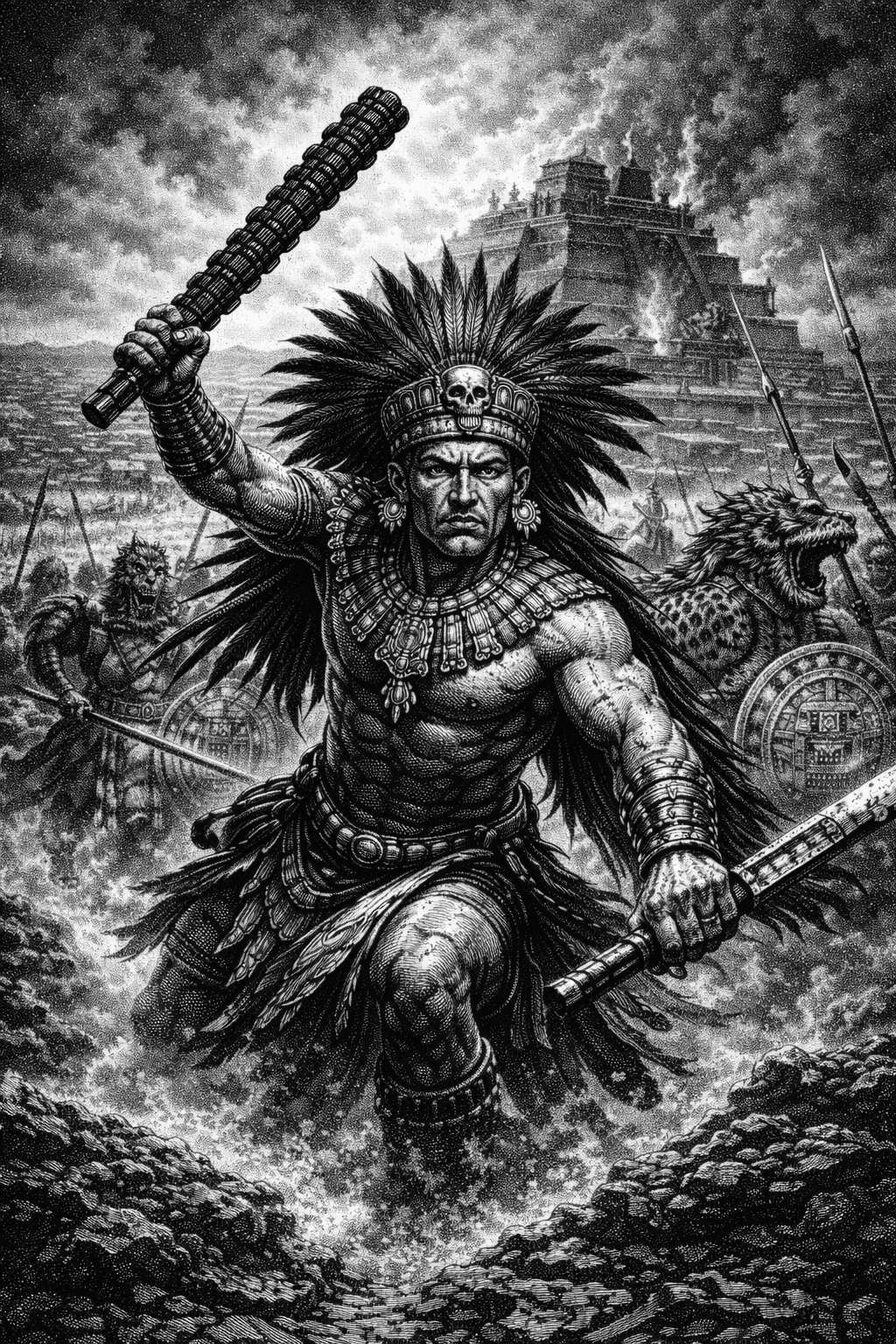
(c.1397–1487)
Imperial strategist and cihuacoatl; rewrote Mexica history, elevated Huitzilopochtli, and engineered ritual warfare to hardwire conquest into religion.
“If you want a quiet empire, build a library. If you want an eternal one, build an altar.”
(Attributed to Tlacaelel by people who definitely wanted him to sound cooler than he already was.)
Smoke rolls over the causeways like the city is exhaling rage.
Tenochtitlan is a floating fortress and tonight it’s a butcher’s raft. War-drums hammer the air. Torches skid across wet stone. Somebody screams a prayer that turns into a choking cough. Somewhere close, obsidian bites bone with that clean, casual snick that says: this is not a battle, this is a manufacturing process.
And in the middle of it all is the most dangerous kind of man.
Not the one with the jaguar helmet. Not the one with the eagle standard. Not even the one with the knife.
The dangerous one is the man standing behind the ruler, not sweating, not shouting, not swinging anything at all. He’s watching the whole thing like he’s checking inventory.
That’s Tlacaelel. The architect. The throat-clearing voice of empire. The Aztec world’s chief executive of “Have You Considered More Violence?”
The boy who wasn’t supposed to be the blade
Tlacaelel was born into the Mexica ruling family, which is like being born into a shark tank where the sharks have paperwork. He was the son of Huitzilihuitl, brother to future rulers, nephew to Itzcoatl, and the kind of noble who grows up learning two essential skills: how to smile at enemies and how to count tribute.
He was not the tlatoani, the speaker-king. He didn’t wear the crown. He didn’t sit in the cleanest seat.
He became something worse.
He became cihuacoatl, the “woman serpent,” an office that sounds mythic because it is: priestly, political, judicial, military, all braided into one job whose unofficial title is The Person Who Actually Runs This Place. Tlacaelel held it through multiple reigns, long enough to make rulers feel temporary and his policy feel like weather.
And Tlacaelel had a theory: history is a weapon. Religion is a lever. Hunger is a schedule. Fear is a budget that never runs out.
Rise: turning a city into a story that bleeds
The Mexica had been scrappy newcomers once, the people other city-states sneered at. Then came the war against the Tepanecs in the late 1420s. Tenochtitlan broke its leash, helped smash Azcapotzalco, and the world cracked open.
Out of that crack came the Triple Alliance: Tenochtitlan, Texcoco, Tlacopan. A political arrangement that begins as a partnership and ends as the kind of “partnership” where one guy holds the map and everyone else holds the bill.
You want the decisive act that made Tlacaelel immortal? Pick one. He had a whole catalog of them, like a serial entrepreneur of conquest.
But the most permanent one wasn’t a battlefield victory. It was a rebranding.
He helped recast the Mexica as a chosen people with a cosmic job description: feed the sun, keep the world running, pay in blood. He elevated Huitzilopochtli, the Mexica patron god of war and sun, into the main event. Not a god among gods. The god. The engine. The reason.
That move did something brilliant and horrifying: it turned expansion into sacred maintenance. Conquest wasn’t greed. It was plumbing. If you don’t bring hearts, the universe clogs.
And then Tlacaelel did what every regime does when it wants to look inevitable: he edited the past.
Sources credit him with burning books and recasting histories, pushing older narratives into the fire so the Mexica story could stride forward wearing stolen feathers and calling it destiny. You can argue about how literal the bonfires were, how broad the program was, how much later chroniclers inflated his role, but the result is the same: the Mexica state grew a curated memory, and Tlacaelel stood there with the red pen.
He also sharpened the social blade inside the city. Sumptuary laws: who could wear cotton, gold, certain adornments. Hierarchy written directly onto skin and cloth. The poor could still die for the empire, naturally, but they couldn’t look expensive doing it.
The flower wars: scheduled carnage with excellent branding
Then came the drought years in the mid-1400s, when the basin’s weather turned mean and the crops played dead. Famine makes people ask dangerous questions like, “Is this worth it?” Tlacaelel’s answer was basically: Yes. More so.
Tradition credits him with pushing the flower wars: formalized battles, often against enemies like Tlaxcala, designed to produce captives for sacrifice. Not always fought to annihilate, fought to harvest. Like warfare developed a second job as a supply chain.
Think of it as ritual combat with an HR department. The battlefield becomes a marketplace: bodies in, prestige out, gods appeased, empire stabilized. Everybody understands the rules. Everybody pretends this is normal. Everybody bleeds anyway.
And here’s the cynical brilliance: by making sacrifice central, Tlacaelel didn’t just terrify enemies. He bound his own elite to the machine. Warriors needed captives for status. Priests needed bodies for legitimacy. Rulers needed victories for tribute. The entire upper structure became addicted to the same ritual fuel.
He didn’t invent violence in Mesoamerica. He industrialized its meaning.
The man who refused the crown and took the knife instead
Tlacaelel is often remembered as the power behind the throne, the one who “refused” to become tlatoani. That’s a romantic story if you like your tyrants humble.
Another way to read it: he didn’t need the crown. A crown gets blamed. A crown gets toppled. A crown is a target.
Tlacaelel built something safer: a system.
Rulers came and went like ceremonial masks. Tlacaelel stayed. If you’re looking for the most Aztec version of a kingmaker, here he is: not whispering, not pleading, not flattering. Directing. Shaping. Naming reality.
And he lived a long time. Long enough to see the empire swell outward, tribute pouring in, temples rising, ceremonies scaling up into spectacles that made fear feel festive.
Downfall: no heroic death, just the quiet cruelty of survival
If you want a gory ironic death for Tlacaelel, history disappoints you.
He didn’t die screaming under enemy spears. He didn’t get sacrificed on his own altar. He didn’t slip on blood-soaked steps and get introduced to gravity.
He died old, around 1487 by many accounts, after serving as cihuacoatl across multiple reigns. Which is its own kind of irony: the man who helped make death a civic ritual got to exit the stage the way most people pray for, not the way most people earned under his policies.
His downfall wasn’t personal. It was delayed.
Because the real collapse came later, when a different kind of conqueror arrived. Steel. Smallpox. Alliances with Mexico’s enemies. A new story with a new god and a new paperwork system, and suddenly Tlacaelel’s careful myth machine met an invasion that didn’t care about its symbolism.
Empires love to believe they are eternal. Then an infection walks in and laughs.
Afterlife: saint, villain, mastermind, footnote
Posthumously, Tlacaelel becomes whatever the storyteller needs.
To some, he’s a Machiavellian genius who forged an empire with ideology and controlled violence. To others, he’s been inflated by later chroniclers into a single mastermind because it’s narratively satisfying to blame one man for a civilization’s sharp edges. Modern retellings flirt with him as the “inventor” of Aztec brutality, which is a neat simplification that ignores how many hands were already happily holding knives.
And pop culture does what it always does: it takes a complicated political operator and sands him into a character. A novel here. A film portrayal there. The man becomes a symbol, and symbols don’t have to answer follow-up questions.
But the core remains: Tlacaelel understood that an empire is a story that taxes people, and if you control the story, you can make almost anything feel like duty.
Even screaming.
Even fire.
Even a city floating on a lake, shining with temples, built on the invisible arithmetic of captive bodies.
Closing line: He didn’t conquer with a sword, he conquered with a sentence, and millions paid the punctuation in blood.
Warrior Rank #124
Sources
Diego Durán, History of the Indies of New Spain (early colonial chronicle)
Fernando Alvarado Tezozomoc, Crónica Mexicana (Nahuatl/Spanish tradition, post-Conquest)
Chimalpahin Quauhtlehuanitzin, annals and historical writings (early 17th c.)
Susan Schroeder, Tlacaelel Remembered: Mastermind of the Aztec Empire (University of Oklahoma Press)
Ross Hassig, works on Aztec warfare and imperial expansion
Miguel León-Portilla, Aztec Thought and Culture (interpretive, influential)
Anonymous palace accountant, “Heart Receipts: Q3 Sun Maintenance Expenses” (lost to a totally suspicious fire)

Alexander Nevsky was a 13th-century Russian prince famed for defeating invading forces at the Battle on the Ice in 1242. He became a national hero and later a saint, remembered as both warrior and shrewd diplomat.
Rank - 115