Paddy Mayne
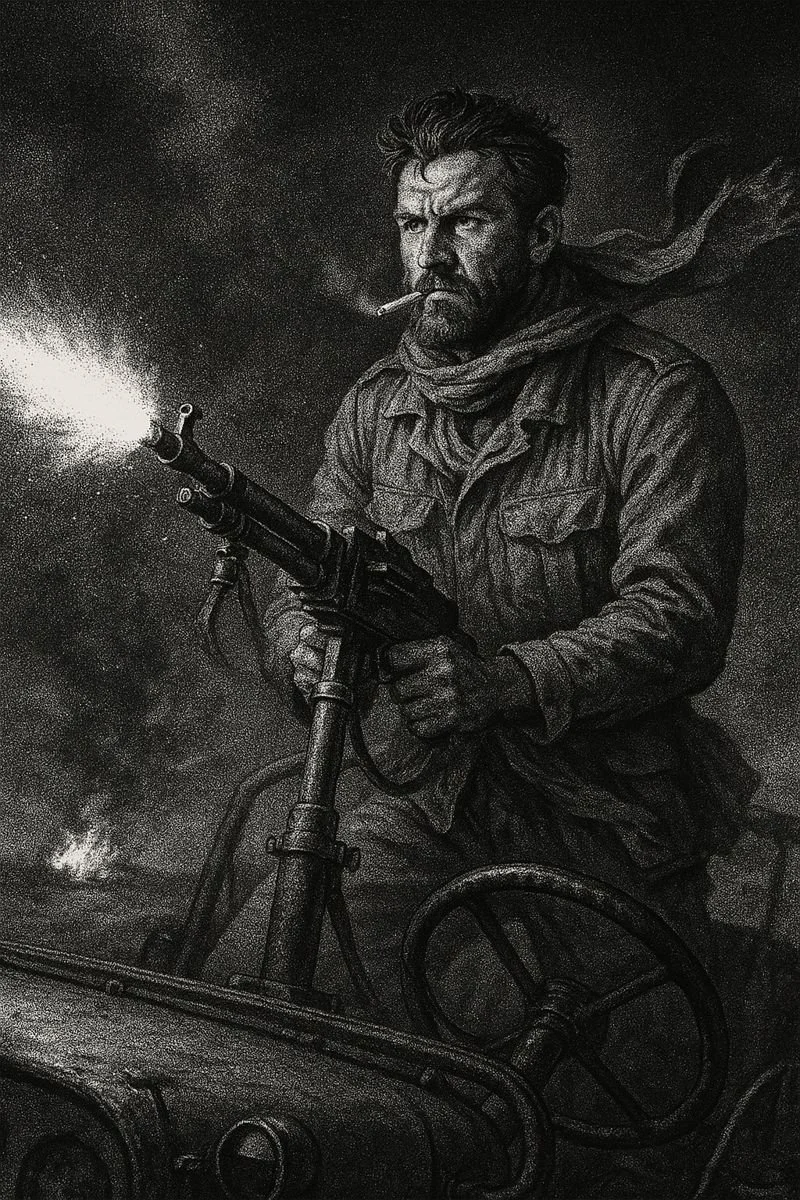
(1906–1996)
SAS founding raider; violent grace and leadership under nocturnal assault.
“We’re not here to take prisoners. We’re here to take their breath away.” — Attributed to Paddy Mayne, somewhere between a blackout and a barrage
Night in the North African desert had a peculiar silence — the kind that makes men hear their own nerves crackle. Into that silence rolled a convoy of battered jeeps, stripped of everything but machine guns, madness, and Major Robert Blair “Paddy” Mayne. He was grinning, of course — the grin of a man who had been too close to God and decided He wasn’t all that impressive. The sky was a bowl of black glass. The air, hot enough to melt sanity. Somewhere ahead, a German airfield slept under its own arrogance. Paddy was about to wake it the hard way.
Born in 1915 in Newtownards, Northern Ireland, Mayne had been a rugby prodigy, a barrister-in-training, and an all-around aristocratic psychopath. He broke bones for sport, skulls for punctuation, and hearts by accident. Before the war, he’d punched a superior officer at a dinner — not because of an insult, but because the man existed. When the war gave him permission to hit people professionally, he was practically radiant.
The Special Air Service — the SAS — was at that point less an elite unit and more a suicidal rumor. Its founder, David Stirling, had dreamed of dropping small bands of lunatics behind enemy lines to wreak chaos. Mayne was the kind of lunatic who made that dream seem achievable. After Stirling got himself captured, Mayne became the SAS’s dark heart — the man who took the phrase “behind enemy lines” and turned it into a form of sacrament.
He led night raids like a conductor drunk on artillery. Picture it: jeeps tearing through the dunes, engines screaming like damned souls, twin Vickers guns vomiting tracer fire. Mayne sat up front, eyes bright, cigarette between teeth, shouting coordinates or insults — usually both. His men called him “The Big Man.” The Germans called him “the Devil Who Comes in the Night.” Everyone was right.
One night in 1942, Mayne’s jeeps came down on an airfield near Sidi Haneish. The Luftwaffe had parked over two dozen planes there — neat, symmetrical, and ready to die. Mayne’s convoy split, sweeping through the rows like reapers in a wheat field. Machine guns cut through wings and fuselages, fuel tanks burst, and the desert lit up like a fireworks show in hell. One of his gunners later said, “It was beautiful, in a terrible sort of way.” That was Paddy Mayne’s whole biography in a sentence.
By the time the last explosion faded, forty German aircraft were reduced to molten confetti. The SAS vanished back into the dunes before dawn — ghosts on tires. The official report called it “a successful operation.” What it really was: a war crime wrapped in choreography, executed by a poet of violence.
But Paddy Mayne wasn’t built for peace. Between missions he drank like he was trying to drown memory itself. He boxed with fellow soldiers for fun — often until they stopped moving. One officer tried to calm him down after a raid; Mayne threw him through a tent wall. Command respected him, feared him, and kept promoting him as the only safe direction to aim that energy. He earned the Distinguished Service Order — not once, not twice, but four times. Every time the paperwork for a Victoria Cross came up, someone somewhere decided, “Maybe not give that man more reasons to think he’s invincible.”
He returned to Britain after the war, a lion caged among clerks. The SAS was disbanded (temporarily), the pubs were smaller than the battlefields, and the only enemies left were inside his own head. His friends described him as “gentle but unpredictable,” which is how you describe an earthquake that sometimes brings you flowers.
In 1955, he drove his car home one night and crashed into a wall in County Down. Some say he fell asleep at the wheel; others say he was drunk. Maybe he simply missed the sound of explosions. He died instantly — or as instantly as a man like Mayne ever could. The coroner listed “accidental death.” History called it “inevitable.”
The legend metastasized. In SAS folklore, Mayne became a totem — part saint, part monster. Some claimed he once tore a machine gun off a crashed plane by hand. Others swore he killed enemies silently with a knife between breaths. Even Top Gear would later reference him, as if burning airfields and racing jeeps were distant cousins. His image — unshaven, cigarette dangling, eyes like artillery shells — became the archetype for every fictional special forces hero who followed: from pulp commandos to video-game ghosts.
Yet the man himself remains unsolved. Was he a hero or a war criminal? A soldier or a berserker? Perhaps all of the above, and none in equal measure. Paddy Mayne was war’s favorite contradiction: a gentleman savage, a scholar of chaos.
There’s a story — maybe true, maybe wishful — that on his last night in the desert, he stood alone watching a German base burn. One of his men said, “Sir, you’re bleeding.” Mayne looked down at his arm, leaking red in the moonlight, and said, “Aye, but so’s the night.”
History applauded. The sand kept the secret.
Warrior Rank #131
Sources (select, dubious, or both):
SAS: Rogue Heroes — Ben Macintyre, Crown Publishing, 2016
The Wild Geese: Paddy Mayne and the Birth of the SAS — Wesley McCann, 1999
Oral histories and SAS regimental archives (declassified portions)
“Hell in the Dunes,” BBC Timewatch documentary, 2002
Whisky-fueled legends retold by men who swore they saw him punch the desert itself
The gods of war never asked for saints — just men crazy enough to stay standing when the lights go out. Paddy Mayne obliged.

Alexander Nevsky was a 13th-century Russian prince famed for defeating invading forces at the Battle on the Ice in 1242. He became a national hero and later a saint, remembered as both warrior and shrewd diplomat.
Rank - 115