Jack Churchill
(1906–1996)
Sword, bow, bagpipes—modern war briefly lost its mind.
“Any officer who goes into action without his sword is improperly dressed.”
— attributed to Jack Churchill, which is either a joke, a warning, or a diagnosis
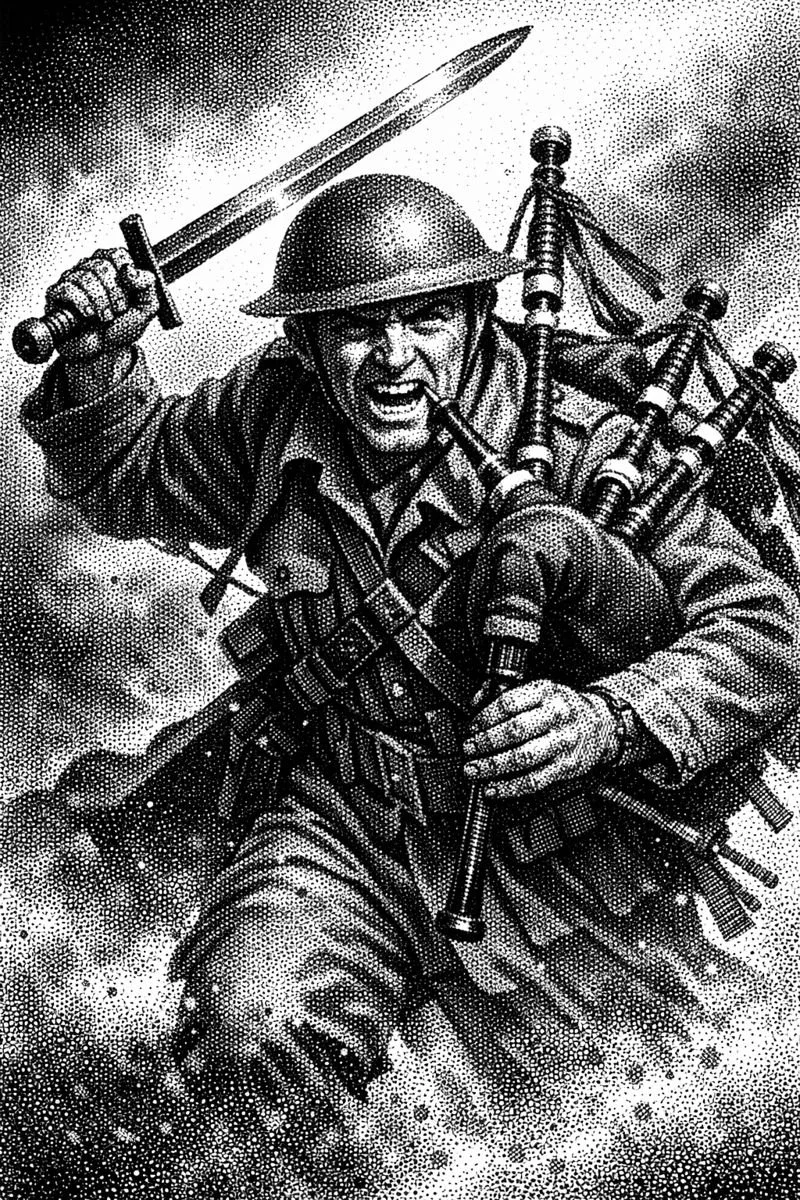
The bagpipes cut through the gunfire like a bad idea played loud. Smoke smeared the French countryside into a charcoal sketch, bullets stitching the air with the enthusiasm of men paid by do ithe hour to miss. And then there he was. Helmet. Broadsword. Longbow. Bagpipes. A walking museum exhibit charging into a modern war like history itself had snapped and was bleeding everywhere.
This was not metaphor. This was Jack Churchill in 1940, stepping onto a battlefield where everyone else had sensibly chosen rifles, mortars, and survival instincts. He chose medieval cosplay and noise. He chose to be unforgettable.
World War II had many heroes, most of them anonymous, exhausted, and dead too young. Jack Churchill refused anonymity on principle. He treated the war like an open bar at the apocalypse and ordered the weirdest thing on the menu, twice. Where other men hugged foxholes, he announced himself with music, steel, and an expression that suggested he was deeply disappointed the enemy had brought guns to a sword fight.
Before he was a problem for the Axis, Churchill was already a problem for normal life. Born in 1906 to a British colonial officer, he grew up with the kind of confidence that comes from empire, privilege, and never being told no with conviction. He trained at Sandhurst, learned the mechanics of killing politely, and promptly ignored most of them. He loved archery, loved bagpipes, loved swords, and loved attention. These are not ideal traits in a modern army. They are excellent traits in a legend.
Between wars he drifted. Actor. Model. Newspaper curiosity. He played the bagpipes on the BBC. He competed in archery tournaments. He was not drifting so much as circling, like a shark with a theatrical agent. When the Second World War arrived, Jack Churchill didn’t enlist so much as show up dressed for the wrong century and dare the paperwork to stop him.
His first combat kill was made with a longbow. Not “as legend has it.” Documented. France, 1940. One German soldier, very surprised, very dead, skewered by an arrow fired by a British officer who looked like he’d wandered in from a Renaissance fair and chosen violence. This remains the last confirmed longbow kill in modern warfare, a sentence that should not exist but does, like Churchill himself.
Then came Norway. Cold, brutal, mountainous, miserable. Churchill thrived. He led raids with his sword drawn, pipes screaming, bullets snapping. His men followed because what else do you do when your commanding officer is charging machine guns like he’s late for the Battle of Hastings. Fear works differently when the scariest thing on the field is on your side.
In Italy he went full myth. At Salerno in 1943, under fire and outnumbered, Churchill decided the enemy needed some guidance. He walked toward a German strongpoint shouting commands. In English. Loudly. Confidently. With a sword. The Germans, operating under the perfectly reasonable assumption that no sane man would do this without overwhelming force behind him, surrendered. Forty-two prisoners. One man. Zero bullets fired. Somewhere, Clausewitz quietly set himself on fire.
Churchill collected prisoners the way other men collected stamps. He was a morale weapon. He was propaganda without permission. He was proof that courage, insanity, and timing occasionally overlap in a way that breaks the universe. He also annoyed the hell out of everyone above him. Regulations do not like personality. The army tolerates eccentricity only when it comes with results, and even then it files complaints.
Eventually, reality intervened. Yugoslavia, 1944. A raid gone wrong. Surrounded. Outgunned. Churchill, out of ammunition and apparently out of options, sat down and played the bagpipes. “Will Ye No Come Back Again.” The enemy did not come back again. They knocked him unconscious with a grenade and captured him.
Captured is a strong word. Jack Churchill treated captivity like a bad hotel stay he intended to leave without paying. The Germans, recognizing the name, suspected he might be related to Winston Churchill and flew him to Berlin. When that turned out to be false, they sent him to Sachsenhausen, a place not known for whimsy.
Churchill escaped, because of course he did. Crawled under wire. Slipped into the woods. Walked over a hundred miles toward freedom like a man commuting home from work. He was recaptured, because even legends run into bad luck and bored patrols. Sent to another camp. Escaped again when the guards fled advancing Allied forces. Walked until he met American troops and asked, essentially, what took them so long.
The war ended too early for him. He was reportedly furious. He wanted to fight the Japanese. He had plans. They were bad plans. History was spared.
Peace did not suit him. It never had. He stayed in the army, found new conflicts, new excuses to be strange. In Palestine. In Australia. He surfed. He rode motorcycles. He lived like a man who’d beaten death at its own game and now refused to take it seriously. He once threw his briefcase out of a train window because the train was late and the briefcase had annoyed him. This was not metaphorical either.
Eventually even Jack Churchill had to stop. Age catches everyone. He retired. He lived quietly, if such a word can apply. He died in 1996 at 89, in bed, peacefully, the least appropriate ending imaginable. No gunfire. No pipes. No sword. Death finally got him with bureaucracy and time.
And then the myth took over. Jack Churchill became a meme before memes. Internet lists. “Craziest soldiers.” “Real-life action heroes.” He’s often flattened into a joke, a gimmick, a madman with props. That misses the point. He wasn’t insane. He was deliberate. He understood fear, understood spectacle, understood that war is as much theater as murder. He weaponized audacity. He used tradition like a club. He made the enemy hesitate just long enough to break.
He was also a product of his time. An empire man playing empire games. A privileged eccentric allowed room to be strange while others were crushed for less. His story is glorious and uncomfortable. He is fun to cheer and hard to defend. Which makes him perfect.
Jack Churchill did not win the war. He did not change its outcome. He changed its texture. He reminded everyone that history sometimes hiccups and lets a lunatic with a sword steal the scene.
And when the smoke clears, that’s what remains. Not the orders. Not the maps. Not the sensible men doing sensible things. Just the sound of bagpipes drifting through gunfire, daring the modern world to admit it’s afraid of ghosts.
Warriopr Rank #132
Sources and Further Reading
Saul David, Churchill’s Secret Warriors
Giles Milton, Churchill’s Ministry of Ungentlemanly Warfare
British Army records and wartime dispatches
Contemporary newsreels and BBC archives
Several deeply concerned German after-action reports
He died in his sleep, which feels like history apologizing for not knowing how else to end him.

Alexander Nevsky was a 13th-century Russian prince famed for defeating invading forces at the Battle on the Ice in 1242. He became a national hero and later a saint, remembered as both warrior and shrewd diplomat.
Rank - 115