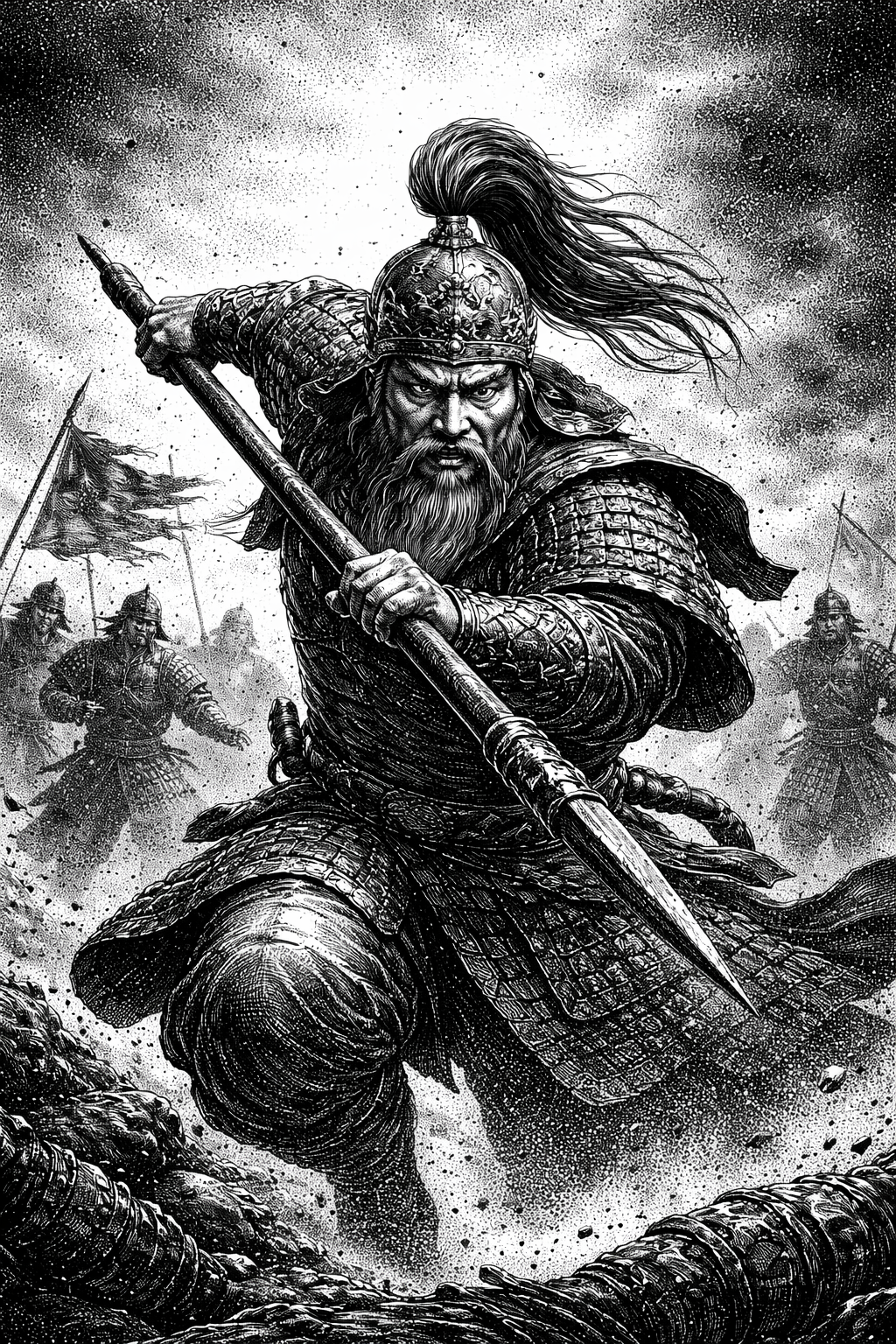
(1328–1398)
Peasant-turned-rebel who overthrew the Yuan dynasty and founded the Ming—then ruled with iron discipline and ruthless purges.
“Heaven did not choose me for my kindness.”
(attributed to Zhu Yuanzhang, and honestly, the paperwork checks out)
The monastery is burning, and Zhu Yuanzhang is not yet an emperor. He is barefoot, smoke-blackened, and recently unemployed by God.
It is the 1340s, and the Yuan dynasty is rotting from the inside. Famine gnaws at the countryside. Plague picks through villages like a meticulous tax collector. Zhu’s parents are already dead. So is his older brother. The earth has eaten his family and sent back silence. He tries Buddhism, because when the world makes no sense, incense at least smells like purpose. Then the monastery burns too. The lesson is clear: Heaven is not currently hiring monks.
So Zhu becomes what the era offers: a wandering beggar with a memory for injustice and a stomach that has never once felt full. He drifts across northern China, watching officials squeeze peasants who have nothing left to squeeze. He watches Mongol rulers preside over a realm that no longer believes in them. He learns the first law of collapsing empires: when the roof caves in, the rats become generals.
Enter the Red Turbans.
In 1352, Zhu joins the rebellion. He is not the loudest man in the tent. He is not the tallest. But he is the one who notices who eats first and who sleeps lightly. He marries into the household of his commander, Guo Zixing, because love is a luxury and alliances are oxygen. The rebel camp is a cocktail of prophecy, desperation, and ambition. Zhu drinks carefully.
The battlefield is a laboratory of Darwinian management. Those who hesitate become fertilizer. Those who boast become cautionary tales. Zhu does neither. He takes Nanjing in 1356 and makes it his base. He calls it Yingtian, “Response to Heaven,” which is either audacious branding or an act of theological vandalism. From there, he builds something more dangerous than an army: a bureaucracy.
Zhu collects scholars the way other warlords collect concubines. He studies the machinery of rule. He keeps what works from the Yuan system and sharpens it. He pays attention to grain supplies, tax rolls, troop discipline. He understands that revolutions are won with swords but sustained with paperwork.
Then comes Lake Poyang in 1363, where destiny arrives by boat.
The lake is a floating slaughterhouse. Warships packed with soldiers crash into one another under a sky thick with smoke. Fire arrows streak across the water. Chen Youliang, Zhu’s rival, commands a massive fleet and the kind of confidence that usually requires a funeral afterward. The clash lasts for weeks. Ships burn. Men drown in armor. The water forgets their names immediately.
Zhu wins.
Chen dies in the chaos, and the rebel movement tilts decisively toward Zhu. Victory at Poyang is not just tactical. It is mythic. It transforms Zhu from ambitious contender into inevitable founder. After that, other rivals fall like loose teeth. By 1368, Zhu declares the founding of the Ming dynasty. He takes the reign title Hongwu, “Vastly Martial,” which is refreshingly honest.
His armies push north. The Yuan capital falls. The Mongol court flees beyond the Great Wall, insisting this is merely a strategic relocation. The Mongol dynasty that conquered China retreats into the steppe with its dignity in tatters. A former beggar now sits on the Dragon Throne.
History applauds.
Then history checks the fine print.
Because Hongwu does not retire into benevolence. He reorganizes the state with ferocious intensity. He strengthens the agrarian base, redistributes land, reduces some taxes, rebuilds infrastructure. He wants a stable, self-sufficient empire. He also wants absolute control.
He abolishes the position of chancellor and concentrates power in his own hands. The emperor is now the state, not metaphorically but administratively. He establishes the Embroidered Uniform Guard, a secret police force with the charming job description of “notice everything and forgive nothing.” Officials who misstep vanish. Generals who grow popular grow nervous.
Then the purges begin in earnest.
Conspiracies are discovered with alarming regularity. Entire networks of officials are implicated. Executions multiply. It is estimated that tens of thousands, possibly around one hundred thousand, are killed in political purges during his reign. The founder who rose from chaos now manufactures it in controlled doses, convinced that terror is a form of preventive medicine.
And there is logic to it. Hongwu has seen what happens when elites grow complacent and provincial warlords grow bold. He will not be the Yuan. He will not be overthrown by men he once fed. Paranoia becomes policy. Suspicion becomes governance.
His eldest son and heir, Zhu Biao, dies in 1392. The loss cracks something in the emperor. The succession shifts to his grandson, a young and comparatively fragile choice in a court full of hardened princes. Hongwu purges again, eliminating powerful figures who might threaten the future ruler. He is clearing the board for a child.
It is tragic foresight.
Hongwu dies in 1398, not on a battlefield but in his palace, old enough to have outlived most of his enemies and many of his friends. He is buried at the Ming Xiaoling Mausoleum near Nanjing, beneath a hill that conceals a lifetime of suspicion and blood.
Within four years, his carefully arranged succession unravels. One of his surviving sons, the Prince of Yan, rebels against the young emperor in a civil war. The grandson disappears into legend, possibly killed in the flames of a palace coup. The son becomes the Yongle Emperor. The dynasty survives, but not in the tidy way Hongwu intended.
Myth does what myth always does.
In official narratives, Zhu Yuanzhang becomes the heroic peasant who restored native rule, a righteous founder chosen by Heaven to sweep away foreign decadence. In popular memory, he is the ultimate underdog success story: proof that hunger can sharpen into destiny. In darker retellings, he is the prototype of the paranoid autocrat, a man who trusted no one because experience had trained him not to.
All of it is true.
He was forged in famine. He mastered war. He built a dynasty that would endure for nearly three centuries. He also filled execution grounds with the bodies of men who once called him ally.
Zhu Yuanzhang is what happens when survival becomes an ideology.
He clawed his way from orphaned beggar to Son of Heaven, and in the end, he ruled as if the famine were still outside the gates, waiting patiently to finish the job.
Warrior Rank #122
Selected Sources:
Frederick W. Mote, Imperial China 900–1800
Edward L. Dreyer, Early Ming China: A Political History
John W. Dardess, Ming China 1368–1644: A Concise History of a Resilient Empire
The Ming Shilu (Veritable Records of the Ming)
One very long memory of hunger that never quite went away
He escaped starvation, conquered an empire, and spent the rest of his life making sure no one could do to him what he had just done to everyone else.

Alexander Nevsky was a 13th-century Russian prince famed for defeating invading forces at the Battle on the Ice in 1242. He became a national hero and later a saint, remembered as both warrior and shrewd diplomat.
Rank - 115