William Marshall
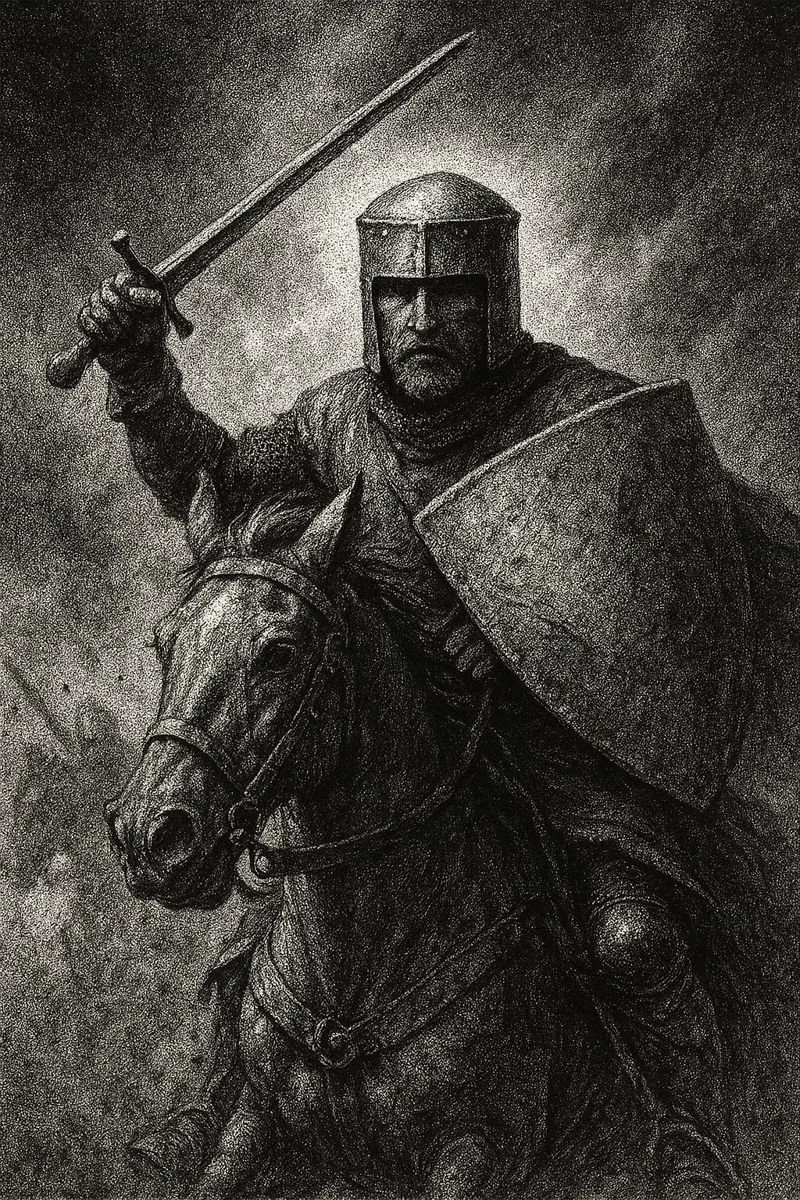
(1147 - 1219 CE)
The Greatest Knight of the High Middle Ages.
“A man who fights for honor cares not who his lord is.” — William Marshal (probably while polishing his conscience and sword)
The sun bled over the lists, gilding the dents in a hundred helmets. The air reeked of horse sweat, splintered lances, and cheap prayer. And there, at the dead center of this medieval demolition derby, sat William Marshal—calm as a man reading scripture in a thunderstorm—his visor down and his debts paid in full. The year was somewhere in the twelfth century, which meant Europe was basically a prolonged family knife fight over who got to call himself God’s favorite warlord.
Marshal, to his mild surprise, had become the last man standing. Again.
Born around 1147, William Marshal shouldn’t have survived long enough to grow stubble, let alone a legend. He was a spare son—fourth in line to nothing—and his childhood résumé included “hostage of King Stephen,” a gig that should’ve ended with his small head on a pike. When his father refused to ransom him, William’s captors prepared to hang the boy from the nearest castle wall. But little William, already fluent in audacity, laughed. The king was so amused he spared him. Even at five, Marshal understood that mockery can be armor.
The medieval world didn’t run on destiny; it ran on cunning and meat. So Marshal did what any jobless noble would: he hit people for money. He became a knight errant, jousting his way across Europe like a proto-rockstar—except instead of guitars he broke skulls, and instead of groupies he collected ransom payments. By his thirties, William Marshal was the most famous tournament fighter alive: undefeated, unrepentant, and probably reeking of both horse and sanctity.
Picture it: a wall of steel and adrenaline roaring across a field, lances exploding like wooden thunderbolts. Marshal was in his element, a human trebuchet fueled by divine arrogance. Chroniclers called him the best knight that ever lived—which is like being crowned “least hypocritical televangelist.” But in a time when valor was currency, he was Bill Gates with a broadsword.
He didn’t just win fights; he owned the damn franchise. Captured knights? He’d ransom them politely. Beat them? He’d dine with them after. Killed them? Well, c’est la guerre. Chivalry, in Marshal’s hands, wasn’t about mercy—it was brand management.
But a sword-swinging freelancer eventually needs a boss. His came in the form of Henry II, King of England—half Norman, half problem. Marshal became tutor and bodyguard to Henry’s rebellious son, the young Henry (“Henry the Young King,” because medieval England loved sequels). Young Henry was charming, useless, and allergic to responsibility—like a royal TikToker with a scepter. Marshal tried to keep him alive through the chaos of rebellion, betrayal, and plague, which in the 12th century was basically every weekday.
The legend goes that when the young Henry died of dysentery and regret in 1183, William stayed by his corpse like a loyal dog, even after everyone else had bolted. He made a pilgrimage to the Holy Land afterward, fulfilling his dead lord’s vow. He fought there too—because of course he did—but didn’t stick around for the Crusader death lottery. He came home, richer, older, and radiating that serene menace that only veterans and volcanoes have.
By then, England had swapped monarchs like bad underwear. Marshal served Henry II, then Richard the Lionheart (the original influencer king, famous mostly for dying interestingly), and finally John, who was the medieval equivalent of a toddler with a crown and no supervision. Each time, Marshal swore loyalty, and each time he actually meant it. Loyalty was his religion; politics his battlefield. He walked through royal coups like a man crossing a field of corpses—his armor was consistency, and nobody else in Christendom could afford it.
When King John—universally loathed, occasionally correct—needed someone trustworthy enough to guard his heir, he picked Marshal. Imagine that: a seventy-year-old knight, lungs full of dust and joints full of ghosts, suddenly made regent of a kingdom in civil war. The man who’d spent his life breaking skulls was now holding together a crumbling empire. And he did it.
In 1216, the French invaded England (again), hoping to turn the country into a Gallic vacation home. Marshal, old enough to qualify for sainthood or senility, rode into battle at Lincoln. Chroniclers say he charged with the vigor of a man half his age—because of course they did—but even cynics admit he won the day. The French were routed, the boy-king Henry III survived, and England remained an island of misery under English management.
When Marshal finally felt death creeping up behind him, he didn’t run. He’d faced worse. He called his sons, divided his lands, and—naturally—joined the Knights Templar on his deathbed, hedging bets with God the same way he’d done with kings. It was 1219. He was roughly seventy-two, a fossil by knightly standards. They laid him to rest in the Temple Church in London, where his effigy still lies: hands folded, sword drawn, as if he’s just waiting for another idiot to need saving.
It’s almost poetic. The man who spent his life fighting for kings, none of whom deserved him, died serving an ideal that didn’t either.
In the centuries that followed, the myth machine went berserk. William Marshal became The Perfect Knight, the human embodiment of the chivalric code—noble, loyal, brave, merciful, and probably good with dogs. Poets called him England’s greatest knight; historians called him the bridge between feudal savagery and feudal self-delusion. His life became a manual for how to survive medieval politics without losing your head or your dignity—a rare trick, like juggling swords blindfolded on horseback.
But the truth is darker and better. William Marshal wasn’t perfect. He was professional. He understood that honor wasn’t about virtue; it was about timing. He served tyrants and saints with the same steady hand because in a world made of shifting mud, he was the ground. He turned chivalry—a half-baked mix of PR, pageantry, and mild homicide—into an art form.
If every age gets the hero it deserves, the twelfth century got William Marshal: loyal without illusion, brutal without cruelty, and so good at survival he made it look holy. He was the knight who could charge into a storm of steel and somehow come out with a pay raise.
The chroniclers wrote that at the end, he confessed his sins, prayed, and smiled. Maybe he did. Maybe he just realized he’d beaten the only opponent no one ever had—time.
Either way, William Marshal died as he lived: making the Middle Ages look like a bad idea executed beautifully.
They called him the flower of chivalry—but flowers grow best in blood.
Warrior Rank # 137
Sources:
History of William Marshal (anonymous 13th-century biography, probably written by someone paid to admire him)
Thomas Asbridge, The Greatest Knight: The Remarkable Life of William Marshal (HarperCollins, 2015)
David Crouch, William Marshal: Knighthood, War and Chivalry, 1147–1219 (Longman, 1990)
G.A. Henty, The Lion of Saint Mark (for the romantic nonsense version)
Badasses: Field Notes from the Age of Iron and Inconvenient Hygiene, Vol. II (unpublished, but probably true)

Alexander Nevsky was a 13th-century Russian prince famed for defeating invading forces at the Battle on the Ice in 1242. He became a national hero and later a saint, remembered as both warrior and shrewd diplomat.
Rank - 115