Tiglath-Pileser I
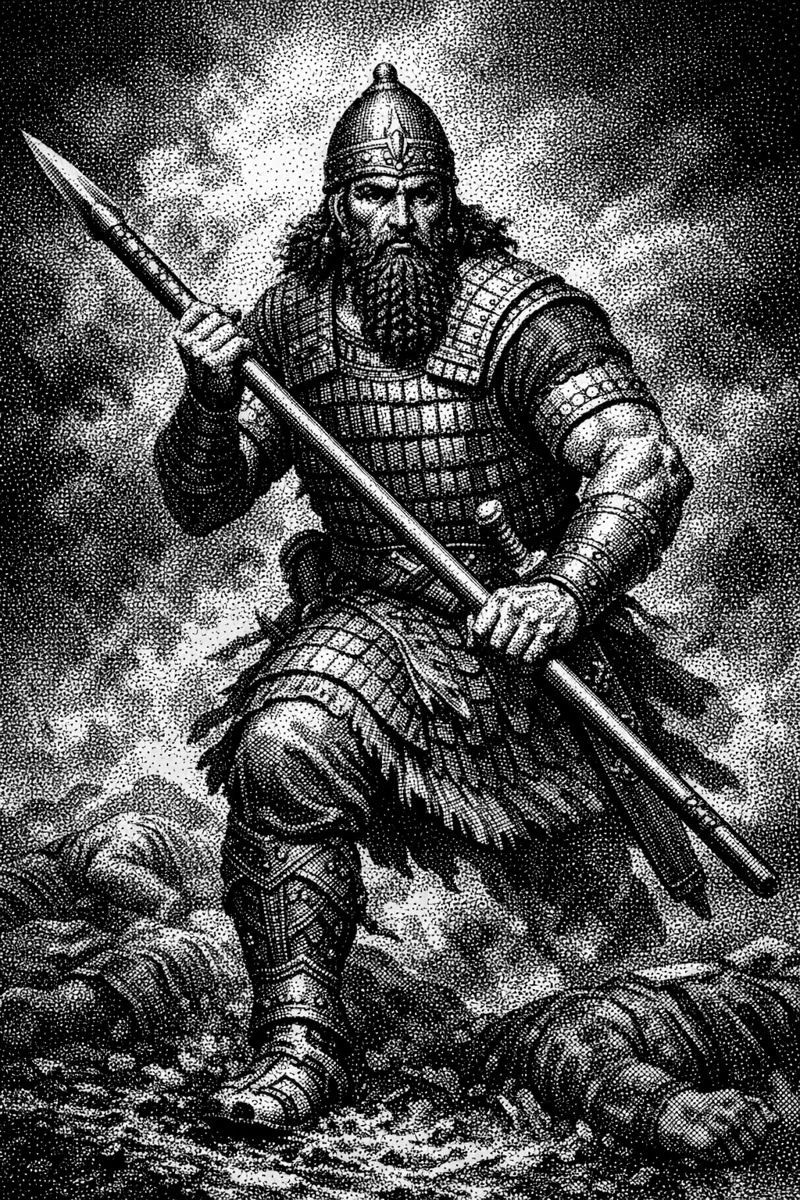
(c. 1140 -1076 BCE)
Assyria’s terror made literate.
“I crossed the Euphrates in flood, because the gods enjoy a spectacle.”
—attributed to Tiglath-Pileser I, who never met a river, mountain, or people he didn’t think should bleed for him
The shields are locked. The air smells like copper pennies and wet dogs. Somewhere a man is screaming in a language that will be dead in a century. Tiglath-Pileser I stands ankle-deep in mud and enemies, shouting orders to scribes who are already sharpening their styluses. History is happening, and he wants it written correctly. Not correctly as in true. Correctly as in terrifying.
Welcome to Assyria, circa 1110 BCE, where the king is a walking press release made of iron.
Tiglath-Pileser I did not invent brutality. He merely industrialized it and had the decency to keep notes.
He was born into the Assyrian royal line sometime around 1140 BCE, son of Ashur-resh-ishi I, a king already busy elbowing Assyria back onto the map after centuries of being the geopolitical equivalent of a forgotten side quest. Assyria was small, scrappy, and surrounded by enemies who thought of it as a speed bump. Tiglath-Pileser grew up inhaling dust, listening to veterans, and learning the two essential skills of Assyrian leadership: how to kill efficiently and how to brag about it forever.
When he took the throne around 1114 BCE, the Near East was in shambles. The Bronze Age had just face-planted. Empires collapsed. Trade routes snapped. Entire civilizations vanished like bad bets. Chaos reigned, which is to say it was an excellent time for an ambitious lunatic with an army and a god complex.
Tiglath-Pileser went to work.
His campaigns read like a drunk man’s itinerary scribbled on a tavern wall: north into Anatolia, west toward the Mediterranean, south into Babylonian territory, east into the Zagros Mountains. He fought Mushki, Nairi, Arameans, Babylonians, mountain tribes, river tribes, anyone who looked at Assyria sideways or existed too loudly. He crossed the Euphrates so many times he treated it like a suggestion rather than a boundary. Flooded? No problem. The king wades in, armor on, gods allegedly holding his hand.
This is where he differs from the usual ancient butcher. Tiglath-Pileser wanted you to know. He left inscriptions everywhere. Rock faces. Temples. Stelae. Clay tablets. If there was a surface and it wasn’t already screaming his name, it soon would be.
“I cut off their heads.”
“I piled their corpses.”
“I flayed their skins and draped them on city walls.”
This isn’t metaphor. This is the king dictating bullet points.
One campaign into the mountains describes him chasing enemies into terrain so hostile it reads like a personal insult from geology. Snow, cliffs, forests, narrow passes where men die anonymously. Tiglath-Pileser follows anyway, because nothing says legitimacy like killing people where no one thinks killing is practical. He boasts of hunting wild bulls and lions during these marches, because in Assyria kings didn’t just conquer humans. They conquered nature for leisure.
And then there’s the Mediterranean.
At some point in his western campaigns, Tiglath-Pileser reached the Great Sea. For Mesopotamian kings, this was a sacred flex. He performed rituals, offered sacrifices, and symbolically washed his weapons in saltwater. It’s the ancient equivalent of dipping your boots in the ocean and declaring victory over geography itself. Assyria had arrived. Please applaud or be impaled.
The decisive act that made him immortal wasn’t a single battle but a doctrine. Terror as policy. Violence as branding. He didn’t just defeat enemies; he curated their suffering. Deportations. Public executions. Mutilations performed with the enthusiasm of a man who knows future kings are watching. The goal wasn’t annihilation. It was memory. Survive, limp home, and tell everyone what happened.
In that sense, Tiglath-Pileser I was less a general than a performance artist working exclusively in blood.
And it worked. For a while.
Assyria expanded. Tribute flowed. The king styled himself “King of the Four Quarters,” which is ancient for “World Champion.” He rebuilt temples, especially for Ashur, the national god who conveniently endorsed every massacre. He hunted lions, recorded eclipses, cataloged foreign lands. He was brutal, yes, but also administrative, meticulous, and weirdly intellectual. A spreadsheet tyrant with a sword.
But history has a sense of humor sharper than any blade.
Late in his reign, the wheels started wobbling. Climate shifts. Drought. Famine. Aramean tribes surged across Mesopotamia like ants at a picnic, harassing trade routes and settlements. The same terror tactics Tiglath-Pileser perfected lost their edge against mobile, decentralized enemies who didn’t have cities to sack or walls to skin.
The great conqueror spent his final years fighting fires instead of lighting them. Assyria contracted. Borders shrank. The inscriptions get quieter. Less boasting. More maintenance. Even a man who once treated rivers as dares eventually runs out of momentum.
He died around 1076 BCE. No dramatic last stand recorded. No poetic battlefield death. Just a king who outlived his moment and left his successors a mess wrapped in glory. His empire fractured not long after, collapsing into another dark age where Assyria would again wait, sharpening knives in the shadows.
And yet.
Centuries later, Assyrian kings resurrected him like a patron saint of cruelty. His inscriptions were copied. His style imitated. His violence became curriculum. Tiglath-Pileser I wasn’t remembered as a man. He was remembered as a manual.
Modern historians read him with equal parts fascination and nausea. He is evidence that propaganda works, that brutality scales, and that writing things down makes them eternal whether or not they deserve it. Pop culture barely knows his name, but every “shock and awe” campaign owes him a quiet nod. He proved that fear travels faster than armies and lasts longer than borders.
Tiglath-Pileser I wanted to be remembered forever.
He got his wish, just not the way he imagined.
Warrior Rank #149
Sources and Further Reading
Royal Inscriptions of Tiglath-Pileser I, translated by A. Kirk Grayson
Mario Liverani, Assyria: The Imperial Mission
Trevor Bryce, The Routledge Handbook of the Peoples and Places of Ancient Western Asia
Assyrian palace scribes, who definitely weren’t exaggerating at all
The Euphrates River, which remembers everything and forgives nothing
He carved his name into the world so deeply that even time had to bleed a little to forget him.

Alexander Nevsky was a 13th-century Russian prince famed for defeating invading forces at the Battle on the Ice in 1242. He became a national hero and later a saint, remembered as both warrior and shrewd diplomat.
Rank - 115