Mahmud of Ghazni
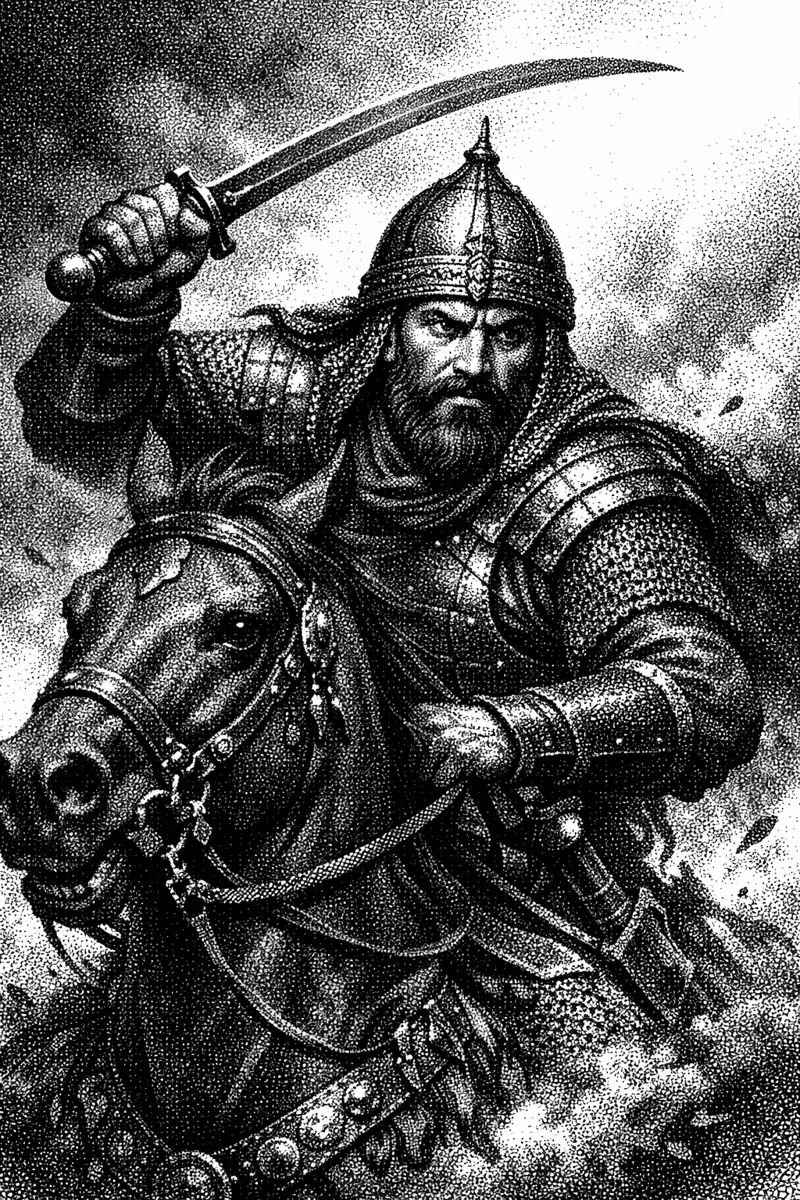
(c. 971 - 1030 CE)
Turkic conqueror and first ruler to widely adopt the title “Sultan”
“I came for faith,” he said, standing ankle-deep in temple blood, “and found a treasury.”
— attributed to Mahmud of Ghazni, probably apocryphal, definitely accurate in spirit
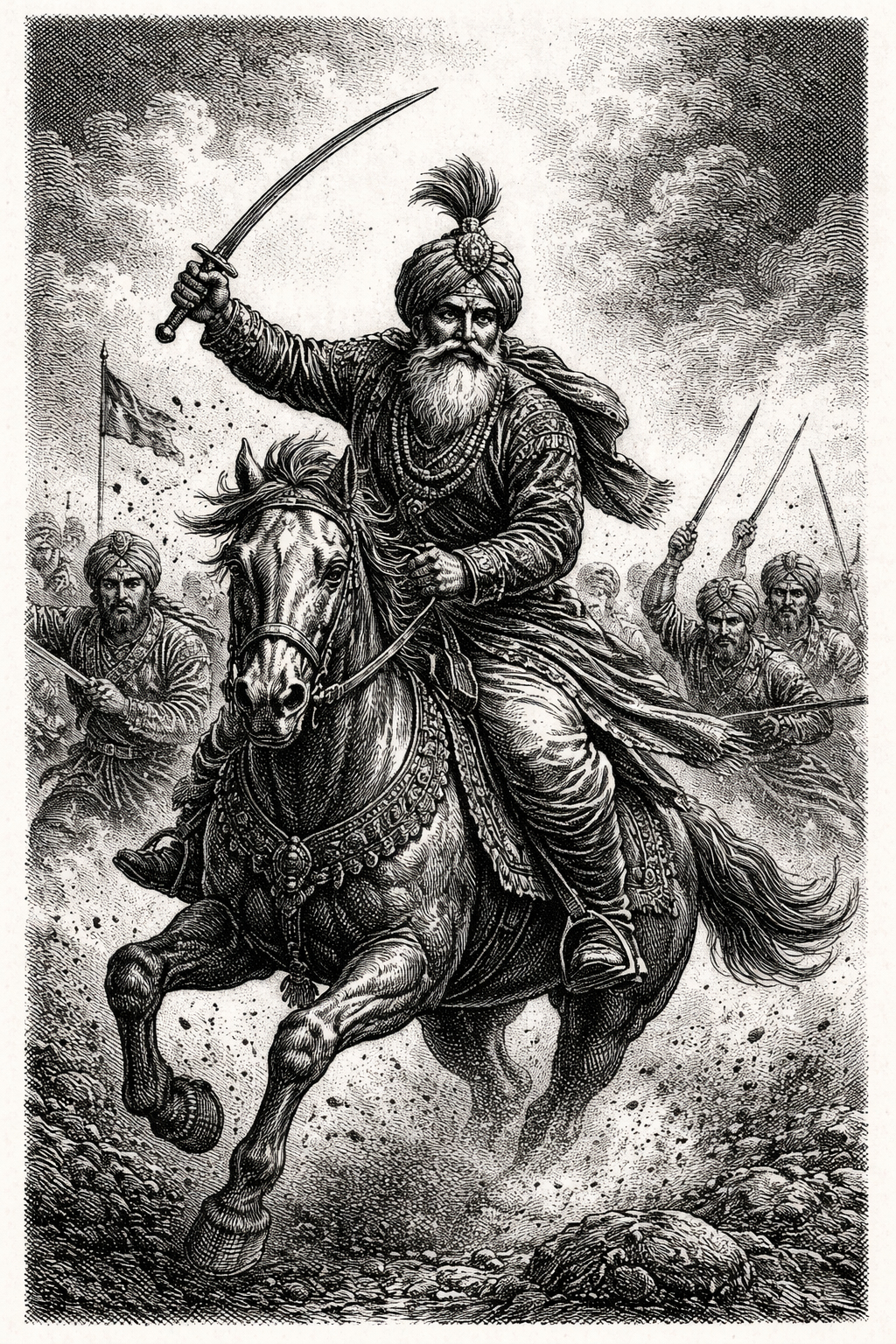
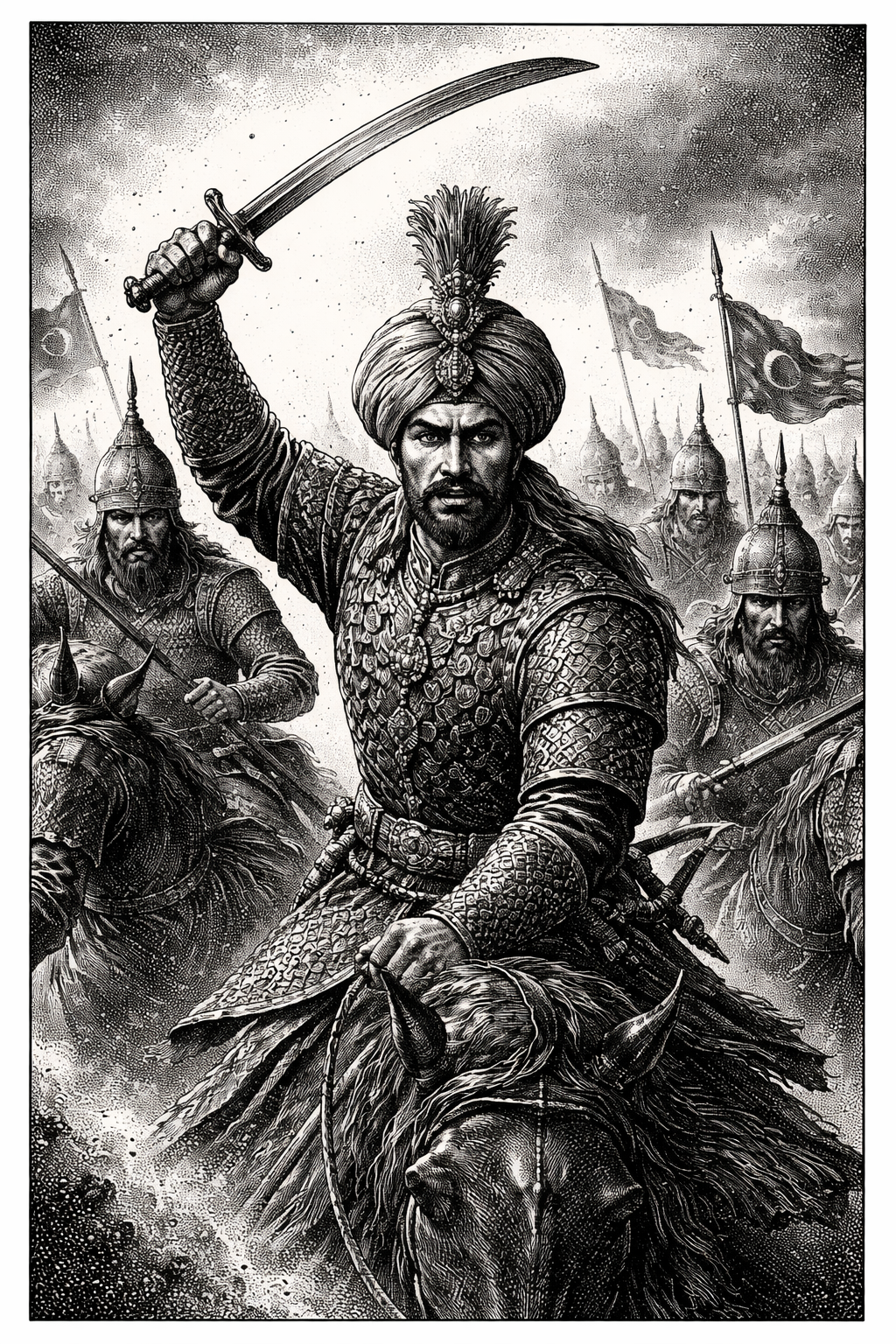
Smoke first. Always smoke. Smoke clawing at the blue Gujarati sky, incense strangled by fire, idols screaming as they shattered on the stone. It’s 1025 and the gates of Somnath are coming down under iron and profanity. Mahmud of Ghazni rides in with his beard stiff from salt air and prayer, armor ringing like a cash register. The defenders fight because they must. The attackers kill because they’re paid to. Somewhere a god loses his head. Somewhere else, a treasurer finds his voice.
This is how Mahmud prefers it: noise, confusion, the sort of holiness that can be melted down and weighed.
Mahmud ibn Sebuktigin, born around 971, didn’t inherit an empire. He inherited a military payroll problem and a taste for expansion. His father Sebuktigin was a former slave soldier who clawed his way into rulership in Ghazni, a mountain town in what’s now Afghanistan. Slavery, in this context, was a ladder. Mahmud climbed it with spurs on. He learned early that the world belonged to men who moved first and hit hardest. He also learned that the eastern plains were fat, divided, and rich enough to solve any number of problems.
Mahmud took the throne in 998 after a family squabble that ended the way these things usually do: with a brother quietly removed from the inheritance equation. Then he crowned himself Sultan, the first to really use the title like it mattered, which it did. Caliphs gave blessings. Mahmud did the accounting. He was a Sunni orthodox ruler with impeccable paperwork and an appetite for conquest that made the map whimper.
Seventeen times, give or take a massacre, Mahmud invaded the Indian subcontinent. Seventeen times he came down out of the mountains like winter itself, freezing resistance, cracking cities, and hauling wealth back north in such obscene quantities that Ghazni turned into a jewel box with minarets. Gold, silver, slaves, war elephants dragged home in chains like exotic regrets. Every campaign had a religious justification and a balance sheet. Jihad paid well. So did terror.
He didn’t conquer India in the sense that later empires would. He raided it. He hit Punjab, Multan, Mathura, Kannauj. He smashed armies that still thought elephants could solve cavalry problems. He understood mobility. He understood logistics. He understood that fear spreads faster than supply lines. His soldiers rode light, fast, and cruel, the medieval equivalent of a smash-and-grab crew with state backing.
Mahmud was not subtle about it. Temples were targets because they were treasuries with theology. Break the idol, break the resistance, melt the gold. The chroniclers tell us he smashed idols to prove monotheism’s superiority. The ledgers tell us he smashed idols because they were made of money. Both can be true. Faith and finance have always shared a bed and stolen each other’s wallets.
Somnath was the climax, the crescendo where rumor becomes legend. A coastal temple famous enough to dare him. Pilgrims, priests, and a god who had outlived a few previous sackings. Mahmud marched across deserts that tried to kill him with thirst, bribed guides who tried to lose him, and arrived anyway, because that’s what happens when willpower is funded. The defenders fought. The walls fell. The idol shattered. The loot was immense. So was the messaging. Mahmud didn’t just take the wealth. He took a piece of the idol back to Ghazni and set it underfoot, so worshippers would tread on a defeated god on their way to prayer. Subtlety, again, was not his thing.
Back home, Ghazni bloomed. Libraries, mosques, palaces. Poets sang. Scholars argued. Al-Biruni measured the earth and described India with a curiosity that his patron’s sword had not encouraged. Mahmud liked culture the way a bonfire likes books: selectively, and from a position of heat. He was generous to scholars and ruthless to rivals. He wanted immortality and he wanted it spelled correctly.
His army was a machine built on Turkic cavalry, Persian administration, and Indian wealth. It ran on loyalty bought with silver and fear. It also ran on Mahmud’s health, which began to fail as the years piled up. Empires don’t notice their own arthritis until the joints stop moving.
The end wasn’t cinematic. It was domestic. Mahmud died in 1030, in Ghazni, sick and probably bitter, surrounded by the very wealth he’d ripped from other people’s gods. The chroniclers say he lay staring at his treasures, finally understanding their weight. This is likely another moral flourish, but it’s a good one. He left behind a son, Mas‘ud, and an empire that would soon learn how expensive cavalry pensions become when the loot dries up. Within decades, the Seljuks would roll in and teach Ghazni the same lesson Mahmud had taught everyone else: power is a loan with compound interest.
Then came the stories. In Persian chronicles, Mahmud is the sword of Islam, the breaker of idols, the patron of genius. In Indian memory, he is the nightmare on horseback, the template for a thousand later fears, a villain whose name became shorthand for desecration. In pop culture, he oscillates between holy warrior and cartoon barbarian, depending on who’s holding the pen and what century they’re afraid of.
The truth is uglier and more interesting. Mahmud was not uniquely cruel for his age. He was uniquely efficient. He did not invent religious violence or economic plunder. He just perfected the synergy. He understood that myth is a weapon and memory is a battlefield. He won both while alive and lost neither in death.
Stand in the ruins of Somnath or the dust of Ghazni and you can still hear it: hooves, prayers, coins clinking like teeth. Mahmud of Ghazni didn’t conquer a subcontinent. He taught it to remember him, and that lesson has never been fully unlearned.
Warrior Rank # 147
Sources and Suspects
• Al-Utbi, Tarikh-i Yamini (primary, enthusiastic, and very selective)
• Al-Biruni, Kitab al-Hind (primary, brilliant, accidentally damning)
• Romila Thapar, Somanatha: The Many Voices of a History
• C.E. Bosworth, The Ghaznavids
• One very tired temple accountant who swore it was all insured
Mahmud died rich, feared, and praised, which is history’s way of telling you the bill was never meant for him.

Alexander Nevsky was a 13th-century Russian prince famed for defeating invading forces at the Battle on the Ice in 1242. He became a national hero and later a saint, remembered as both warrior and shrewd diplomat.
Rank - 115