Yusuf ibn Tashfin
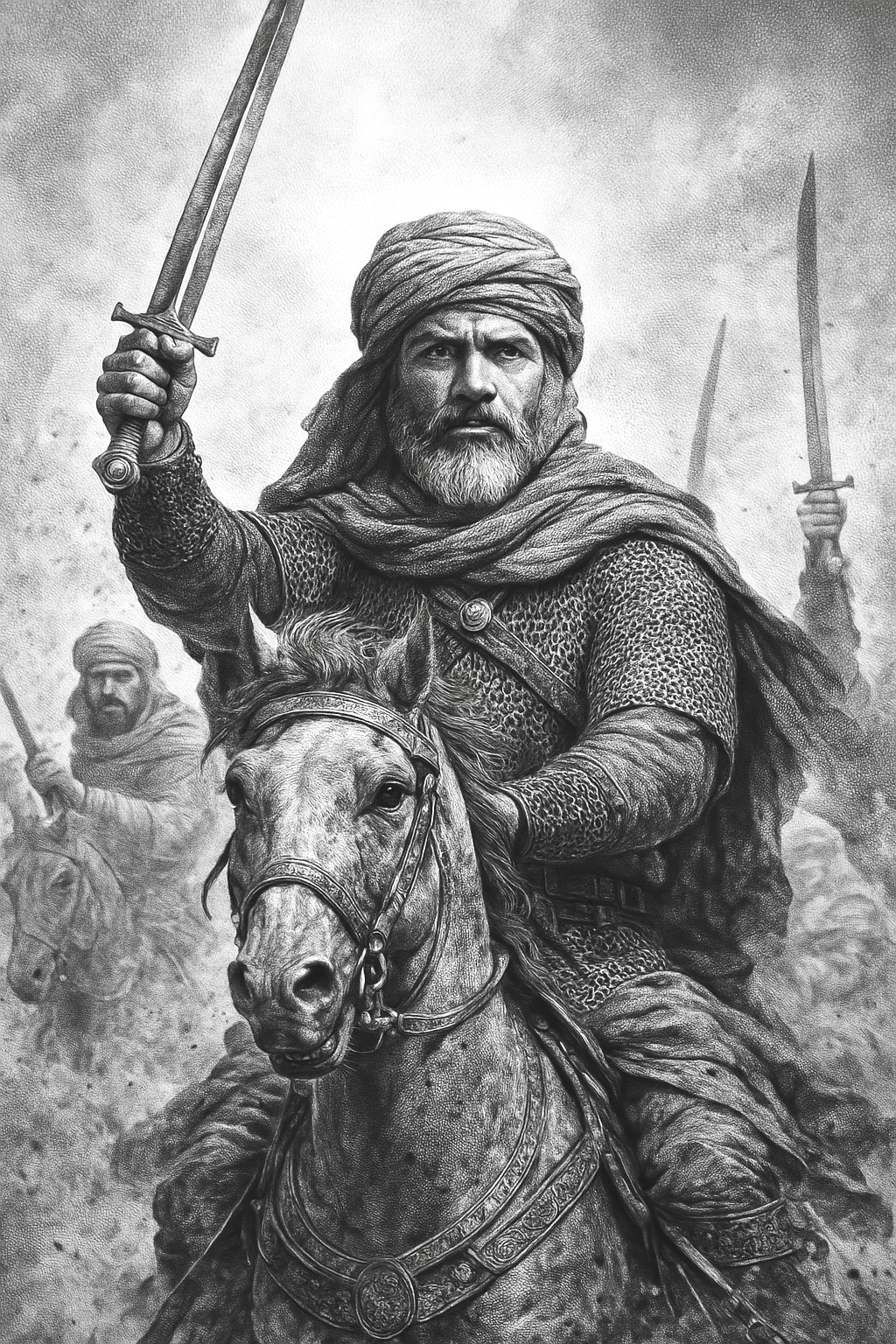
(c. 1009 - 1106 CE)
The Sandstorm Who Learned to Wear a Crown
“The earth is wide, but God leaves just enough room for a man to be dangerous.”
—attributed to a Sanhaja elder during Yūsuf’s rise, source uncertain.
Smoke rolled across the field like a tired djinn dragging its chains, clinging to the cracked Andalusian soil where men had spent the morning dying loudly and the afternoon pretending they still had a chance. Horses stamped nervously at the stink of opened bodies. Helmets shone like dented moons. Someone’s prayer mat fluttered in the dirt, half-soaked, as if faith itself had tried to escape and slipped.
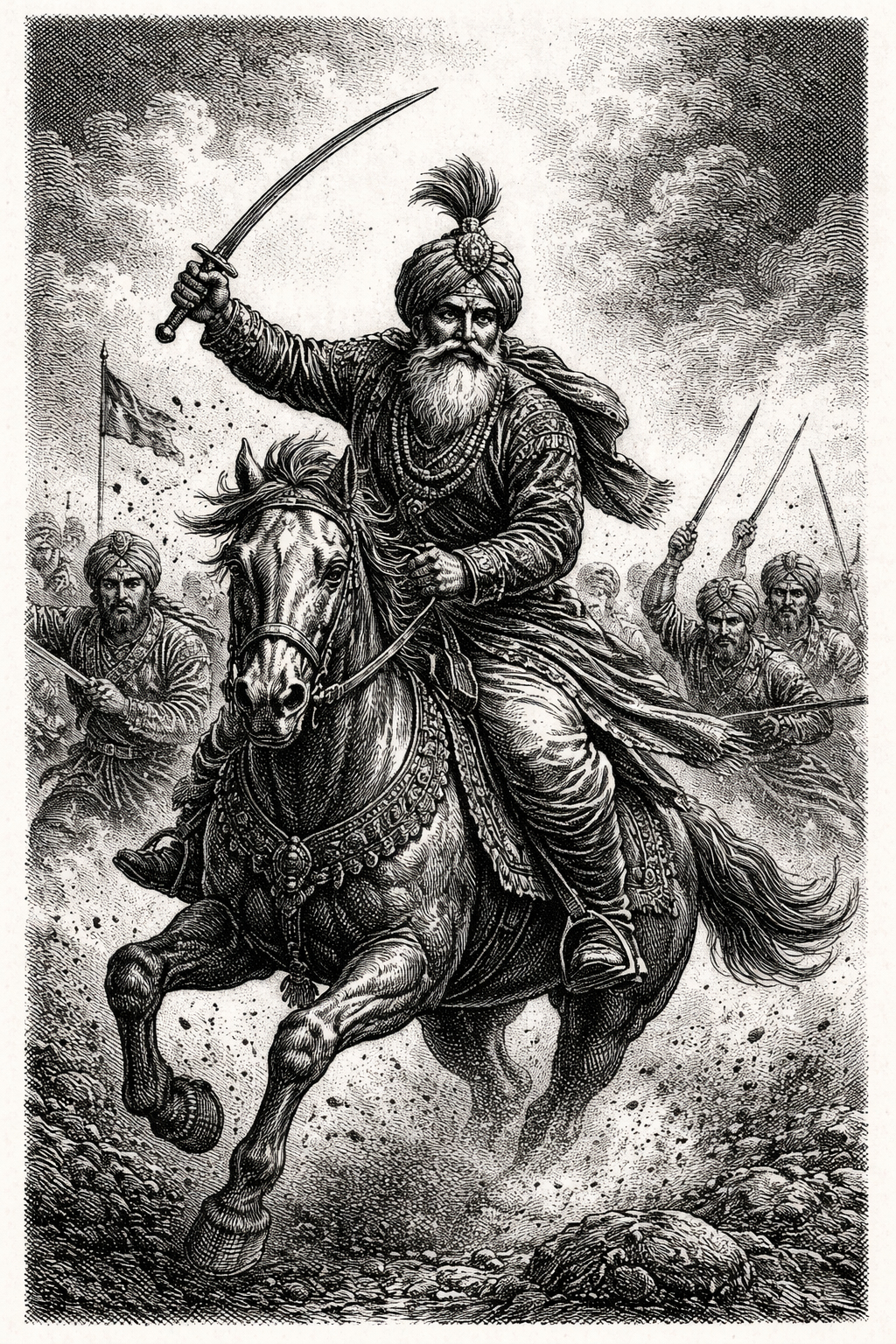
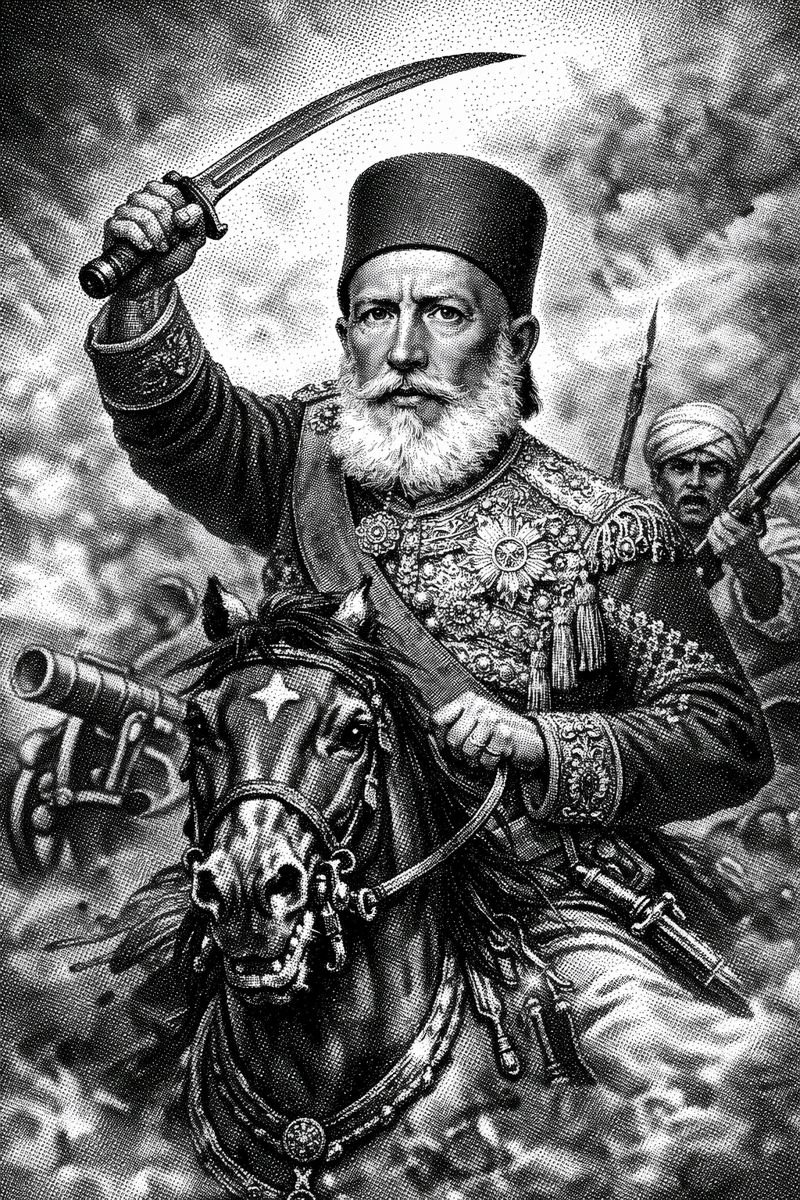
And through that unkind haze came the desert cavalry—lean figures in hide and mail, turbans wound tight, eyes darkened by kohl and war. They moved silently at first, then with the rising thunder of inevitability, the way a drought becomes a sandstorm and a sandstorm becomes history. At their center rode a man who looked like he’d been carved out of the Sahara itself: Yūsuf ibn Tāshfīn, the quiet blade behind the Almoravid avalanche.
No theatrics. No war cry. Just an austere, weather-beaten face and a certainty that the line of Castilian shields ahead would break like a clay jug under camel hooves. The Christian knights had been drinking confidence all month; Yūsuf had drunk the desert for fifty years, and the desert never lied.
A rider next to him sucked air between his teeth—the kind of breath a man takes when the world is balancing on a hinge. Yūsuf didn’t turn. He didn’t need to. The hinge was already snapping.
When the charge hit the Castilian flank, it wasn’t heroic, or noble, or chivalrous. It was the kind of violence that erased adjectives. Men disappeared beneath the crush. Lances splintered into ribcages. The sound was meat and metal rearranging itself into tragedy. Somewhere in the chaos, the banner of León sagged like a tired saint, and the dust swallowed it whole.
Before sundown, the great Alfonso VI—king, crusader, and professional thorn—was fleeing with a shredded army, muttering prayers through cracked lips. The Taifa princes who’d begged for Yūsuf’s help against the Christians would later regret ever sending the invitation. But in that moment, as the dying groaned like a broken cathedral choir, Alfonso’s nightmare had a name, and it was written in desert script: Yūsuf ibn Tāshfīn, Commander of the Faithful by necessity long before he claimed the title officially.
There was no triumph in his face. No bloodlust. Just a grim knowledge that victory was the easy part.
What came after would require patience, iron, and a willingness to bulldoze an entire peninsula of vanity.
A Profile in Sand and Iron (Origins Without Ornament)
Yūsuf was born among the Lamtuna Sanhaja—Berber desert people with the survival instincts of a cactus and the diplomatic charm of a sand snake. The Sahara trained him early: silence, endurance, the discipline of heat that roasted hesitation out of the bones. Nothing in the dunes was wasted. Not motion. Not words. Certainly not opportunities.
The Almoravid movement had already begun under the charismatic Ibn Yāsīn, who tried to mold the fractious Berbers into a disciplined Islamic revival. The early Almoravids were hard—ascetic, militant, allergic to luxury. Yūsuf absorbed the ethos like a man learning to breathe again after too much city air. He wasn’t flashy. He wasn’t theatrical. He wasn’t one for speeches. He simply did what deserts do: expand relentlessly.
His early campaigns in Morocco were not the glorious epics later chroniclers would pretend. They were hard logistics, grueling marches, and the occasional village that discovered too late that resisting the Almoravid tax collectors was bad for life expectancy. Yūsuf emerged as the rare type of commander who could take chaos, break its teeth, and make it march in formation.
Contemporaries noted his austerity. He slept on straw when he could have slept on silk. He preferred plain clothes. He ate what the men ate. This wasn’t some PR stunt. It was habit. It was identity. It was the deep, bone-deep humility of a man who understood that in a desert, every luxury carries the price tag of death.
Psychological X-Ray (A Quiet Man with Cataclysmic Edges)
Yūsuf is often portrayed as a calm, pious warrior-king. True enough. But beneath that calm was the flint that struck sparks: a relentless practicality bordering on ruthlessness. He didn’t kill for pleasure, but he certainly killed for order. He didn’t seek glory, but he recognized that sometimes glory had to be trampled before it grew into rebellion.
He hated excess, mistrusted opulence, and viewed the Taifa kings of al-Andalus as soft, perfumed liabilities. To him, their courts were not centers of culture—they were crime scenes waiting for their bodies.
His restraint was not gentleness. It was discipline, a coiled spring behind a polite face.
The Road to Sagrajas (A Defining Moment, No Flourish Required)
By 1086, al-Andalus was bleeding out. Alfonso VI had taken Toledo, and the Taifa kings panicked, as aristocrats are prone to do when reality interrupts poetry. So they invited the Almoravids. They expected reinforcements.
What they got was a political earthquake.
The Battle of Sagrajas (Zallaqa) remains one of the most decisive engagements of the age. Attested accounts follow a grim pattern: the Almoravids absorbed the Christian charge, fixed the enemy in place, then unleashed their desert cavalry in a flank attack that collapsed the Castilian formation like a kicked anthill. The slaughter was thorough. The Christian army disintegrated. Alfonso survived by the width of a ghost’s whisper.
That moment—when Yūsuf’s calm broke the might of León—cemented his legend. It was not the flash of a hero. It was the precision of a surgeon removing a tumor.
After the victory, he returned to Morocco. But the Taifa kings kept bickering, raising taxes, betraying each other, and generally acting like children playing with knives. Yūsuf asked the jurists of al-Andalus whether removing them was permissible. They replied that yes, it was not only permissible—it was necessary.
Yūsuf took their kingdoms.
Not with glee. With efficiency.
By 1090, he began annexing the Taifas, replacing poetry-soaked princelings with Almoravid governors and a tax code that actually worked. It was a hostile takeover of an entire civilization—without the corporate jargon, with significantly more cavalry.
Holding a Fractured World Together (The Forensic Years)
Yūsuf’s empire stretched from the Senegal River to Zaragoza—a vast, multicultural sprawl of languages, loyalties, and theological disagreements sharp enough to cut throats. Managing it required a rare competence: he had to be a warlord, a bureaucrat, a judge, a diplomat, and occasionally a human thunderbolt.
He kept the Christian kingdoms at bay, stabilized al-Andalus, improved fortifications, standardized administration, and maintained Almoravid religious rigor.
And yet even the best iron eventually cracks.
As Yūsuf aged, the thin seams of his empire began to quiver. Andalusian elites resented Almoravid austerity. Berber tribes simmered with their own rivalries. New religious movements—the Almohads most notably—began brewing in the Atlas like storms waiting for sunset.
But none of that touched him directly during his lifetime. He was too respected, too feared, too consistent. He ruled into his nineties—a longevity historians still blink at, considering the occupational hazards of medieval empire management.
The Quiet Exit (A Death Without Orchestration)
Yūsuf ibn Tāshfīn died around 1106, in his late nineties, after overseeing an empire that had no right to exist and no equal on either shore of the Mediterranean. His death was natural—quiet, almost anticlimactic. No heroic final charge. No betrayer’s blade. No collapsing palace. Just a long life ending in the way the desert ends a day: silently.
His successors were not him. Within decades, the empire crumbled under pressures he had held at bay with little more than willpower and structured discipline.
But his legend? That endured.
Posthumous Reputation (Myth, Memory, and Creative Amnesia)
Later chroniclers, especially in the Maghreb, elevated him as the model of righteous kingship—a pious warrior who saved al-Andalus from Christian domination. Some myths painted him as a saintly figure; others as a merciless hammer of God. Both exaggerations. His historical reality was sharper, stranger, and more human: a desert ascetic who built an empire because everyone else was too soft or too stupid to do it.
European writers, centuries later, cast him as a grim antagonist—an exotic threat at the edge of Christendom. Modern historians generally paint him as one of the most competent rulers of the medieval Islamic West. The man himself remains hard to touch, like a polished stone heated by the sun: simple on the surface, blistering underneath.
His real legacy was the proof that a quiet man can change the map more effectively than a noisy one.
The desert teaches that.
He never forgot it.
warrior Rank #162
Sources (Serious & Sardonic Mix)
Amira K. Bennison, The Almoravid and Almohad Empires
Allen J. Fromherz, The Almoravids: West Islamic Empire, 1040–1269
Évariste Lévi-Provençal, Histoire de l’Espagne Musulmane
Khalid Yahya Blankinship, The End of the Jihad State
“The Chronicles of the Taifa Courts” (attested but frequently embellished)
Camels, Sand, and Unpaid Taxes: A Practical Field Guide to Early Almoravid Governance (probably fictional, definitely helpful)

Alexander Nevsky was a 13th-century Russian prince famed for defeating invading forces at the Battle on the Ice in 1242. He became a national hero and later a saint, remembered as both warrior and shrewd diplomat.
Rank - 115