Askia Muhmmad I
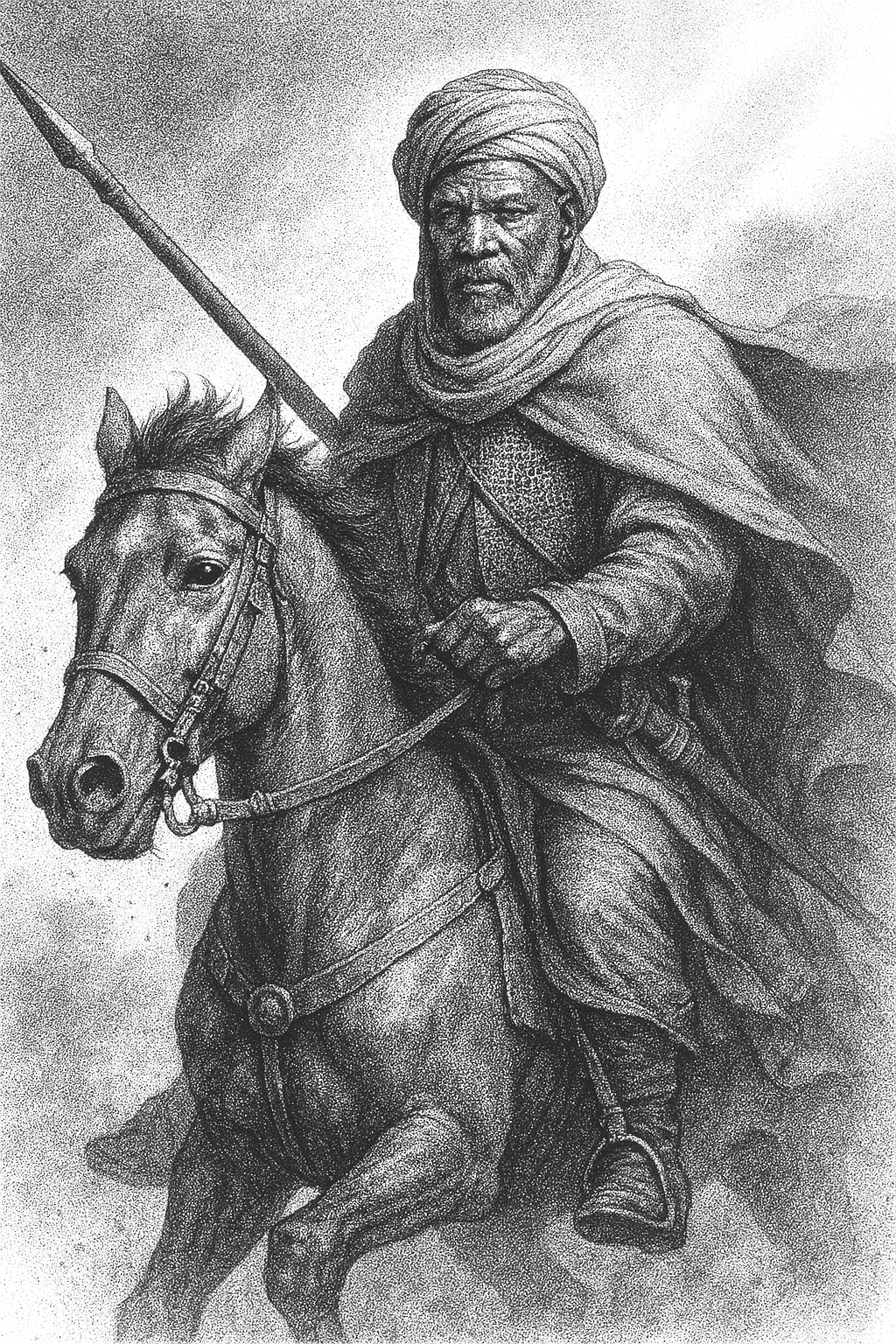
(c 1443-1538 CE)
Emperor of Songhai, Hammer of the Sahel, the Soldier-Scholar Who Rebuilt an Empire While Bleeding It into Order
The river remembers everything. It remembers the weight of bodies pushed into it, the screams swallowed by reed beds, the iron taste of civil war, and the day a one-eyed general rode out of the dust to seize destiny by the throat. The Niger’s brown current carried coronations and massacres with the same lazy swirl, indifferent as it lapped Timbuktu’s docks. That morning in the mid-1490s — the exact year folds in on itself depending on the chronicler — the riverbank smelled of wet clay, spent powder, and fear. Soldiers whispered the name that would soon be carved into the Sahel like a scar: Askia Muhammad, the man who toppled a dynasty without pretending he was gentle.
Nothing about his rise was clean. The empire he walked into was already fracturing under Sunni Ali’s heirs: rival factions, half-loyal generals, clerics with knives under their robes, provinces looking for excuses to bail. And in the middle of this violence, Muhammad Ture — not yet Askia — moved like a man who believed history owed him a refund. He’d served as a commander under Sunni Ali, surviving the man’s paranoia and brutality with the calm of someone who could bide his time. But when Sunni Ali drowned (attested; though the “drowned by sorcery” claim belongs in the absurdities drawer), the succession fell to Ali’s son, Sunni Baru. Baru had the name. Muhammad had the army’s grudging respect and the clerics’ irritation with the Sunni line’s hostility toward Islamic scholars. That was enough tinder.
The first clash wasn’t a grand battle so much as a surgical strike wearing the skin of a civil war. Muhammad drove hard toward Gao, fought Baru’s forces near Anfao in 1493, and shattered the line that was supposed to keep him out. Chroniclers claim he invoked divine approval. Men on the ground likely heard something more familiar: a commander who promised order after years of instability, backed by cavalry who’d rather gamble with him than die for Baru. The sound of Baru’s retreating horsemen, hooves slapping the dust, was the unofficial start of the Askia era.
His coronation came with all the subtlety of a hammer. “Askia” itself was already a political body-slam: a title layered with legitimacy, soaked in both Songhai tradition and Islamic authority. Under the new emperor’s shadow, bureaucrats straightened their backs, merchants recalculated their loyalties, and soldiers who had hesitated learned to hide it fast. The unspoken rule in the Sahel still held: survival belonged to the man with the calmest voice and the sharpest blade.
And Askia Muhammad spoke quietly.
He killed loudly.
The origins that fed him were neither humble farmstead myth nor courtly legend; he was from the Soninke people, a relative outsider rising through a Songhai structure that pretended to value lineage until a talented man proved lineage was optional. What mattered was discipline. And Askia had the rigid, spine-straight dedication of a man who expected to live to ninety — and did, though exile soured the victory.
He rebuilt Songhai with the precision of a commander counting the beats in a cavalry charge. Taxation restructured. Provincial governors appointed or replaced with surgical ruthlessness. Bureaucracy tightened until even the clerks were afraid to misplace a document. His pilgrimage to Mecca in 1496–1497 served both as religious duty and diplomatic flex: he paraded wealth so staggering that some Arab writers later embroidered it into near-myth. (Attested: he spent lavishly; Disputed/embellished: the exact scale of gifts and entourage numbers.) The pilgrimage certified his authority among Islamic states and scholars, granting him the ideological firepower to reshape Songhai from a regional empire into a continental engine.
But the warrior never dissolved into the ruler. Askia Muhammad fought like the Sahel burned under him. He expanded Songhai outward in all directions — Hausaland to the east, Mossi to the south, Tuareg strongholds to the north. His cavalry, lean and fast, operated like knives thrown from horseback. His infantry, often a mix of levies and professional corps, followed with brutal efficiency. And always behind them: the emperor with one working eye, scanning for weak points like a man reading a map over an open grave.
His campaigns weren’t romantic epics; they were calibrated displays of force. Against the Mossi states, he pushed deep, smashing through resistance with a mix of maneuver warfare and psychological pressure — loot redistribution, hostage-taking, forced allegiance. Against Tuareg confederations, he struck hard at control of trade routes, understanding that the desert was less a battlefield and more a ledger. Whoever owned the caravan roads owned the future.
What defined him wasn’t a single battle, but the pattern: he made Songhai the largest empire West Africa had ever seen, stretching from the Atlantic almost to Lake Chad. Under him, Gao hummed as an imperial nerve center, Timbuktu’s scholars finally got a ruler who respected their ink, and trade caravans fattened with gold, salt, slaves, and learning.
But the river that remembers also whispers warnings.
Askia Muhammad was brilliant, but brilliance calcifies. He aged into paranoia and absolutism. Modern historians debate whether the decline in his later years was caused by illness, blindness (attested in later life), factional rivals, or simply the entropy of a massive empire that required constant martial pressure to stay cohesive. Whatever the cause, by the late 1520s, the emperor who had risen through civil war found himself cornered by another: a palace coup, led by his own son, Askia Musa.
It is an old rule of emperors: raise enough sons and one eventually comes for the throne with your blood still warm on his hands.
Askia Muhammad was deposed in 1528. Too respected to kill outright, too dangerous to leave in reach of power, he was exiled to an island in the Niger. There, amid reeds and waterbirds, the man who once commanded an empire the size of Western Europe waited out the slow unwinding of time. Musa reigned briefly; others followed. The dynasty survived, the empire did not. Morocco’s invasion under Judar Pasha in 1591 cracked Songhai open like a skull.
Askia Muhammad outlived several successors, which is its own dark joke: the warrior who built an empire could not save it, but he could survive longer than the men who replaced him. He died around 1538, an old man whose remaining eye had watched his work begin to rot.
His legacy is contradictory because it is vast. He is remembered as a reformer who professionalized governance; a devout Muslim who embedded Islamic law deeply into West African political culture; a conqueror who expanded borders through iron and fire; a patron of learning whose reign saw flourishing manuscripts in Timbuktu; and a man whose family line eventually tore itself apart before Morocco finished the job.
Myth rarely bothers with nuance. Later oral traditions dress him as a righteous unifier; some chronicles cast him as the scholar-king Songhai always deserved. None lie outright, but all simplify a man who thrived in a world where religion, warfare, and statecraft walked the same road and often trampled one another.
To understand Askia Muhammad is to accept the friction: he was a builder who needed destruction to clear the ground; a ruler who needed war to maintain peace; a pious man who understood fear better than scripture; a commander who saw governance as another battlefield.
His great monument, the Tomb of Askia, still stands in Gao — a pyramidal mud-brick spike jutting from the Sahel sky. It is a metaphor so obvious it risks cliché: an emperor who carved his name into the earth with such force that even centuries of sandstorms haven’t erased it. The structure is not beautiful. It is stark, angular, massive — the architectural equivalent of a cavalry charge.
History gives some men marble. Askia Muhammad gets sun-baked mud that refuses to die.
And maybe that is fitting. Empires crumble. Chronicles exaggerate. Sand swallows roads. But the river remembers. It always remembers.
Warrior Rank #164
Sources
John O. Hunwick, Timbuktu and the Songhay Empire: Al-Sa'dī's Ta'rīkh al-Sūdān and Other Contemporary Chronicles.
Nehemia Levtzion & J.F.P. Hopkins (eds.), Corpus of Early Arabic Sources for West African History.
Basil Davidson, West Africa Before the Colonial Era.
Lamin Sanneh, The Jakhanke Muslim Clerics: A Religious and Historical Study of Islam in Senegambia.
“Askia Muhammad’s Secret Manual of Empire-Building,” (obviously fictitious, kept in a termite-proof chest somewhere on the banks of the Niger).

Alexander Nevsky was a 13th-century Russian prince famed for defeating invading forces at the Battle on the Ice in 1242. He became a national hero and later a saint, remembered as both warrior and shrewd diplomat.
Rank - 115