Bayinnaung
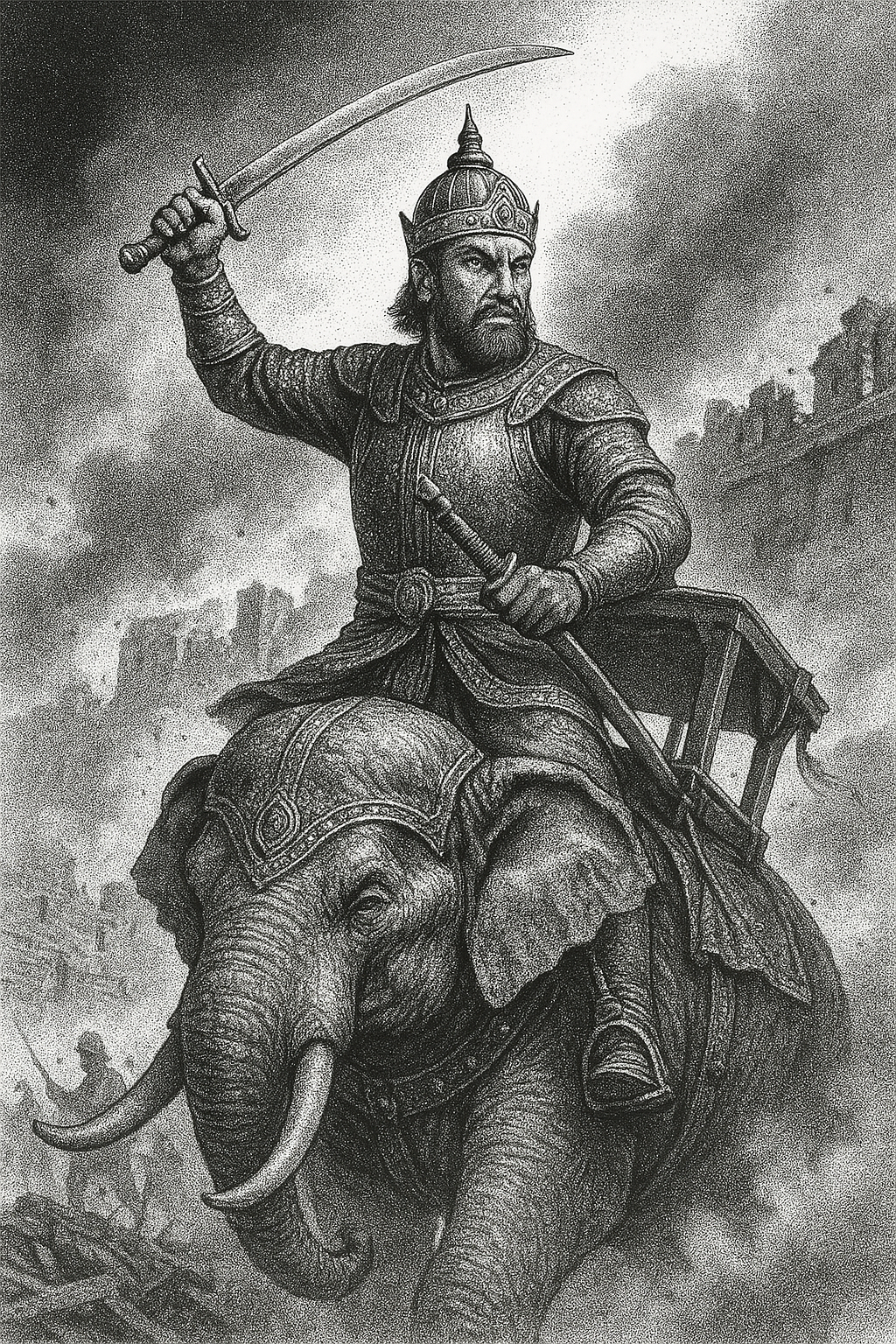
(1516–1581 CE)
THE LION WHO ATE HALF A CONTINENT AND DIED OF PAPERWORK
“History is a house made of bones. I simply rearranged the furniture.”
attributed to Bayinnaung, probably by someone missing a limb
Smoke leans over the scorched teak palisade outside Martaban like a lazy god deciding whether to smite the place again for fun. The air tastes of burnt resin and overcooked ambition. Bayinnaung, Lion of the East, stands amid the shrieking and the thud of collapsing towers, wearing the relaxed expression of a man contemplating lunch rather than orchestrating one of the most savage takeovers in sixteenth-century Southeast Asia. Men are dying, elephants are screaming, and the world is turning red at the edges, and Bayinnaung looks serenely bored. This is, for him, just another Tuesday.
A commander yelps something about enemy reinforcements. Bayinnaung waves it off with the casual grace of a man shooing a particularly needy mosquito. He has already calculated the angles: the breaches, the morale, the inevitable panic-swirl that grabs an army and squeezes it into running or dying. And he knows which option his enemies will pick. Once the Lion has your scent, you run until the jungle itself gets tired of you.
But to appreciate how the Lion learned to roar, you have to wander backward through the blood-slick timeline. Born in 1516 in the Kingdom of Toungoo, Bayinnaung started life as Ye Htut, a lad with very little and an appetite for everything. His early talent was loyalty, which in royal contexts is either a superpower or a countdown clock. Fortunately for him, his cousin Tabinshwehti recognized the former. They became inseparable war-pals, carving up rivals with such cheerful energy that the chronicles start sounding like travel brochures for people who enjoy plunder as a hobby.
Bayinnaung rose because he was a logistical marvel in an age before spreadsheets and caffeine pills. He could move armies like a river moves silt: everywhere, all at once, with the faint implication of eventual drowning. He backed Tabinshwehti’s unification plans, helping to munch through Lower Burma piece by stubborn piece. And when assassins bumped Tabinshwehti off in 1550 (royal job hazard), Bayinnaung didn’t mourn so much as he recalculated the throne’s vacancy like a man checking if someone left cake unattended on a table.
He took over. Obviously.
Cue the forging of the greatest empire Southeast Asia would see until Europeans arrived with their jaunty hats and weaponized smallpox.
Now we return to Martaban, where the battle is entering its rude climax. The city had been holding out behind walls thicker than a palace accountant’s excuses. Its defenders bristled with Portuguese mercenaries, artillery, and a sincere wish to not be conquered. Bayinnaung responded with an artillery barrage so relentless the chronicles soften their phrasing, which is historian code for “we feel weird writing how bad this actually was.”
Elephants, armored and disagreeably sober, thunder up the breaches. Soldiers clamber behind, stepping on rubble, corpses, and any hopes Martaban might have entertained about having a future. Bayinnaung is directing the tempo with gestures that look almost priestly. He believes in conquest the way others believe in morning prayers: it orders the universe, and without it nothing makes sense.
When Martaban finally breaks, the surrender is less surrender and more an exhausted exhale that happens to be fatal. Bayinnaung strolls through the ruins, accepting obeisance from survivors too shocked to process that they still have faces. His terms are vicious. His mercy, real but sparse, depends entirely on whether he thinks you’d make a decent subject or a problematic ghost.
His empire expands in a series of campaigns so swift that rival kings suspect witchcraft or at least indecorous mathematics. He conquers Ayutthaya in 1569, collecting vassals the way a drunk noble collects regrettable tattoos. He installs governors with the efficiency of reorganizing pantry shelves. For about a decade, he builds a realm stretching from Lan Na to Manipur to the edges of Laos. The maps grow so wide they look like someone sneezed ambition across them.
Of course, empires are like bonfires: gorgeous, enormous, and powered by the certainty that something is being consumed. Bayinnaung’s something was manpower. His campaigns drained populations, and the subject kingdoms simmered with the kind of resentment that only truly flourishes when you’re forced to build pyramids of rice for people who keep renovating their capital every few years.
By the 1570s he’s working himself to death. Literally. Years of nonstop campaigning fray even the toughest leaders like old elephant harnesses. In 1581, while preparing yet another campaign, Bayinnaung’s body politely quits. Just stops. The Lion collapses not on a battlefield, not at the peak of a charging war-elephant, but during what amounts to administrative preparation. It’s the sort of mundane exit that makes chroniclers furious, because after pages of carnage, they have to write “the conqueror then died of exhaustion, probably.” Not glamorous.
His vast empire, balanced on fear, tribute, and the gravitational pull of his personality, begins to shred within months. Vassals revolt. Borders crumble faster than a tourist’s stomach after drinking local water. His son Nanda tries to keep the place glued together but ends up presiding more over a dramatic unraveling than a reign.
Then comes the mythmaking. Later Burmese chronicles inflate Bayinnaung into a warrior-king of cosmic intent. Thai sources paint him as the storm that swallowed kingdoms whole. For the Laotians, he’s the neighbor who overstayed his welcome with thirty thousand armed guests. Europeans describe him with breathless awe, insisting he must have been “the Alexander of the East,” which is historians’ way of saying “we don’t know how to describe non-Europeans without comparing them to Europeans.”
Pop culture, when it bothers with him, turns him into a composite boss character: half god, half warlord, all plot device. His elephants grow fangs in retellings. His armies march in perfect unison like well-disciplined ghosts. His real genius, the ability to manage logistics, diplomacy, fear, and architecture while still finding time for warfare, shrinks into background noise behind the more marketable pyrotechnics.
But in the burnt-out core of the chronicles, Bayinnaung is what he always was: a man who saw the chessboard of Southeast Asia and thought it would look better if he replaced half the pieces with ones he carved himself.
His empire died quickly, but his legend didn’t. It lingers like smoke: drifting, acrid, impossible to ignore.
Some men build kingdoms; Bayinnaung built a warning label.
Warrior Rank #158
Sources
Harvey, G. E., History of Burma.
Lieberman, Victor, Strange Parallels: Southeast Asia in Global Context.
Charney, Michael, A History of Modern Burma.
The Royal Chronicles of Toungoo, translated selections (real, though variable).
de Brito, Filipe, Honestly, I Didn’t Think the Elephants Would Be Armored (questionable).
Captain Willem van Hooft, Notes from a Man Who Regretted Visiting Martaban (extremely questionable).

Alexander Nevsky was a 13th-century Russian prince famed for defeating invading forces at the Battle on the Ice in 1242. He became a national hero and later a saint, remembered as both warrior and shrewd diplomat.
Rank - 115