Carl Gustaf Emil Mannerheim
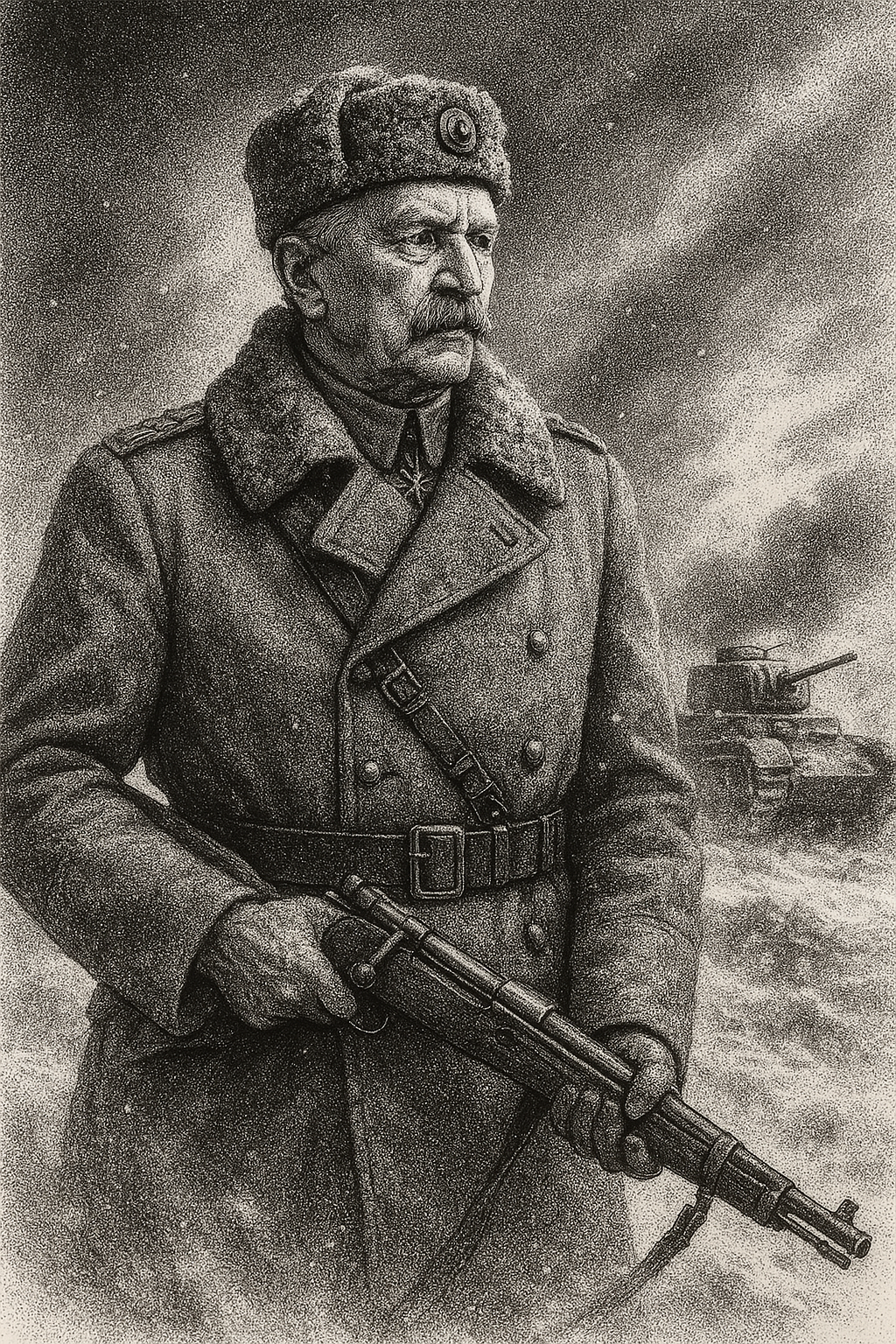
(1867-1951)
Finnish marshal who led the nation through the Winter War.
“In Finland, we don’t surrender. We just run out of ammunition and freeze to death standing up.” — attributed to a soldier under Mannerheim, Winter 1940
The world was ending in white.
Not the holy, peaceful kind of white—the snow-blind, bone-splitting, gunmetal white that eats men alive. Soviet tanks, black crosses of fire on their turrets, ground through the Karelian Isthmus while Finland—tiny, under-armed, frostbitten Finland—stood behind its last line of defense: a wall of snow, willpower, and one six-foot aristocrat with the posture of a cavalry statue and the eyes of a man who’d seen too many empires fall.
Carl Gustaf Emil Mannerheim was sixty-something, silver-haired, half-Russian, half-myth already, and utterly out of fucks to give. He was the kind of man who’d drink cognac for breakfast and then lead a counteroffensive before lunch, because someone had to make the paperwork of war look dignified.
In the winter of 1939–40, the Red Army came for Finland with half a million men, more tanks than the Finns had bullets, and Stalin’s personal assurance that it would all be over in two weeks. Two weeks later, the Soviets had advanced maybe a few kilometers—and left a landscape littered with frozen corpses and shattered illusions. Somewhere in the blizzard, Mannerheim, the old fox, watched it all unfold from behind the Mannerheim Line that bore his name, sipping black coffee and chain-smoking like a condemned aristocrat waiting for his empire to resurrect itself.
The Tsar’s Servant
Before he became the sainted marshal of Finland, Mannerheim had been a loyal officer of the Russian Empire—a decorated cavalryman, fluent in seven languages, and utterly allergic to small talk. He’d ridden across Central Asia on reconnaissance for Tsar Nicholas II, wearing silk underwear under his uniform because civilization had to start somewhere.
He survived revolutions, duels, court politics, and the entire First World War by doing what Finns do best: pretending not to care until everyone else dies of exhaustion. When Russia finally imploded in 1917, Mannerheim packed up his medals, lit a cigar, and walked home to a newly independent Finland. He found a country divided—Red Guards versus White Guards, Bolsheviks versus everyone who liked furniture—and decided to fix it the only way he knew how: by fighting a civil war.
He led the White Army with aristocratic precision and merciless efficiency. The Reds called him the “butcher baron.” His own men called him “the Marshal.” By the time the snow melted, Finland was his.
He never smiled about it. Victory was just survival with paperwork.
The Gentleman in the Blizzard
Fast forward twenty years: Europe’s catching fire again, and Stalin wants a slice of Finland. Hitler’s still pretending to be reasonable, and the League of Nations is practicing its favorite art form—strongly worded disappointment.
The Soviets invade on November 30, 1939. The Winter War begins.
The Finnish army, outnumbered four to one and outgunned ten to one, greets the Red Army like an unwanted dinner guest. Mannerheim, seventy-two and still built like a sabre, commands from his headquarters in Mikkeli, wrapped in blankets, reading casualty reports like a priest reading sins.
What followed was one of the coldest, strangest, and most beautiful wars ever fought. Finnish ski troops—ghosts in white parkas—cut Soviet columns apart in the forests. They moved like whispers and killed like mathematics. They ambushed tank crews with Molotov cocktails (a Finnish invention, offered as “a drink to go with your tanks”).
When Stalin’s officers tried to retreat, the NKVD shot them. When Mannerheim’s officers tried to retreat, he raised an eyebrow, and that was enough.
Every inch of the Mannerheim Line was paid for in frostbite and shrapnel. Every victory was temporary. But for three months, this small, starving republic humiliated the biggest army in the world.
The Soviets finally broke through in March 1940, after losing a quarter million men. Finland sued for peace—kept its sovereignty, lost some land, and gained a legend.
Mannerheim became the embodiment of something almost extinct in Europe: dignity under annihilation.
Between Hitler and Hell
Then came 1941. Operation Barbarossa.
Mannerheim didn’t like Nazis. He also didn’t like Soviets. He liked Finland—and expensive cigars. So when Hitler sent him birthday greetings (on his seventy-fifth, no less), Mannerheim didn’t throw a party. He recorded the Führer’s visit secretly—the only surviving audio of Hitler speaking conversationally. You can hear it: Hitler droning on about tanks while Mannerheim, ever polite, gives him the vocal equivalent of a raised eyebrow.
Finland fought alongside Germany that year—not as an ally, officially, but as a “co-belligerent,” because legalese makes war sound civilized. The goal was to get back the land lost in 1940, not to conquer Russia. Still, the moral math got ugly fast.
By 1944, the tide had turned. The Soviets came back, meaner, bigger, and slightly less incompetent. Mannerheim, now 77, took over as president. He negotiated a peace with Stalin that kept Finland independent—barely—and then turned on the Germans, driving them out of Lapland with the same stoic precision.
It was the ultimate balancing act: a dance between two devils, led by a man who didn’t even like music.
The Last Cigar
Mannerheim retired in 1946, his country scarred but free. He moved to Switzerland—because Finland had run out of cigars worth his time—and started writing his memoirs.
He died in 1951 at seventy-three, not on the battlefield but in a hospital bed, which was almost indecent for a man who’d lived through four wars, three regimes, and one of history’s worst climates.
At his funeral, Helsinki froze solid. The flags hung stiff, and soldiers wept behind sunglasses. The man who’d out-cavalried Cossacks, out-frozen Stalin, and out-negotiated Hitler went into the ground like an iceberg: slowly, with gravity.
The Myth of the Marshal
In Finland, they don’t just remember Mannerheim—they preserve him. His statue towers over Helsinki like an equestrian ghost, watching his city stay awkwardly neutral in every war since.
To the Russians, he’s still a reactionary relic. To the Finns, he’s a symbol of impossible poise: the nobleman who fought for a democracy, the general who valued survival over ideology, the aristocrat who made stubbornness into a national strategy.
Mannerheim didn’t win. Not exactly. But he didn’t lose either—and in Finland, that’s better than victory.
He taught his people how to endure. How to outlast. How to turn freezing to death into a political statement.
And if the world ever ends again, somewhere in that blizzard you’ll probably see him: tall, calm, lighting a cigarette, asking which empire plans to die next.
He never surrendered; he just waited for history to get tired first.
Warrior Rank #155
Sources (questionable and otherwise):
Mannerheim: Marshal of Finland, by J.E.O. Screen (Cambridge University Press, 1970)
The Winter War: Russia’s Invasion of Finland 1939–40, by William R. Trotter
Finnish Defence Forces Archives, Mikkeli (those that didn’t freeze)
The ghost of a Soviet tank, still apologizing somewhere near Suomussalmi
The sound of a match striking, just before the next snowstorm

Alexander Nevsky was a 13th-century Russian prince famed for defeating invading forces at the Battle on the Ice in 1242. He became a national hero and later a saint, remembered as both warrior and shrewd diplomat.
Rank - 115